

SWOT analysis: Do you know your business’s strengths and weaknesses?
What is the ultimate goal for a strategic plan? You want to come out of it knowing your company’s strengths and weaknesses, and understanding the opportunities and threats facing your business.
A SWOT analysis does just that. It not only gives you a global view of your business, but also points out where you are strong, or not so strong, and can help you explore the opportunities and threats existing in your market.
Having this type of targeted report makes your strategic planning that much more robust.
This is not an intellectual exercise. A SWOT analysis is the foundation of your strategic planning.
Michelle Feder
Lead Consultant, BDC Advisory Services
What does SWOT stand for?
SWOT is an acronym for strengths, weaknesses, opportunities and threats.
SWOT analysis is sometimes called internal-external analysis. That’s because strengths and weaknesses are internal to your organization, while opportunities and threats are external factors.
What is a SWOT analysis?
SWOT analysis is a framework for identifying and analyzing your organization’s strengths and weaknesses, as well as the opportunities and threats you are facing.
“The strengths and weaknesses should not be seen as simple attributes of your company, but more specifically as something that stacks up against your competitors or that affects your clients’ experiences,” explains Michelle Feder, Lead consultant, BDC Advisory Services.
As for opportunities and threats, these can be changes in your market or the wider world.
Why conduct a SWOT analysis?
Feder, who has been advising businesses with BDC for a decade and lectures on business practices at McGill University, says you need to capitalize on your strengths while preventing your weaknesses from becoming a liability.
Working on your organization’s weaknesses can only get you so far. Feder suggests instead to keep building on your strengths. While it is important to neutralize your weaknesses so that they don’t undermine your success, your strengths, she says, will give you a competitive edge.
Put more effort into leveraging your strengths as they will be the key to your outperformance.
Michelle Feder
Lead Consultant, BDC Advisory Services
What are the four parts of a SWOT analysis?
Strengths
Strengths are what your company does particularly well, or the resources and assets it owns that distinguish it from your competitors. You need to know your company’s strengths; they’re what make it thrive.
Examples of strengths:
- solid financing
- a positive reputation
- valuable intellectual property
- an innovative mindset
- low production costs
- product variety
- a healthy company culture
- a strong online presence and following
Weaknesses
Weaknesses are internal attributes and resources that your company lacks. You need to know your weaknesses because they make your business vulnerable. To identify the underlying cause of your company’s weaknesses (or its strengths), Michelle Feder suggests using root cause analysis, a structured way to identify underlying reasons for a business issue and a key tool of operational efficiency and lean thinking.
Examples of weaknesses:
- high levels of debt
- low customer satisfaction
- long delivery times
- outdated equipment and/or machinery
- gaps in expertise
- poor employee engagement and retention
- products slow to get to market
- rigid structures and a lack of agility
Opportunities
Opportunities are a set of external circumstances that, with the right decisions, can grow your company or put you in a favourable strategic position.
Examples of opportunities—and some possibilities for your business:
- new trade agreement—export possibilities
- new environmental, social and corporate governance (ESG) reporting requirements—can showcase your track record
- buy-local trend—favours your locally made products
- work-from-home trend—can promote your communication app
- expanding industry
- new government support programs
Threats
Threats are external forces that constitute a risk to your business. Your company should be on the outlook for external obstacles; it will have to overcome them if it is to flourish.
To analyze the threats (and opportunities) facing your business, Feder suggests one of the tools be a PESTEL analysis, which takes in the political, economic, sociological, technological, legal and environmental factors that influence an organization.
PESTEL analysis focuses on the external environment of an organization. More widely, it can be applied to strategic planning, but it can also be used in the context of smaller projects. For instance, an entrepreneur may use a PESTEL analysis when launching a new product line.
Examples of threats:
- new trade agreement or increased tariffs—which can bring increased competition or shut you out of a market
- new ESG reporting requirements—with possible heavier paperwork
- supply-chain problems
- shortage of recruits
- aging customer base
- changing product standards
An example of a SWOT analysis
Company: ABC Pharmaceuticals
SWOT table
|
Strength |
Strong R&D capabilities, stemming from an enviable company culture. High employee satisfaction helps attract and retain formulation scientists. |
|
Weakness |
Inefficient and expensive manufacturing processes. Could result in quality issues. |
| Threat |
New ESG reporting standards, means more complex reporting on the manufacturing of pharmaceuticals. |
|
Opportunity
|
New supply chains are developing in Asia. Could mean opportunity for outsourcing manufacturing at a low cost. |
In this example, ABC Pharmaceuticals is strong in developing pharmaceuticals but weak at manufacturing them. Moreover, new reporting standards will make manufacturing more complex, while opportunities in the supply chains are opening up avenues for low-cost manufacturing. Given that its source of competitive advantage is its R&D capability, it may be better off outsourcing its manufacturing.
“ABC Pharmaceuticals’ competitive advantage is its ability to develop new formulations, and this is what it should focus on, while its competitor may be in the opposite situation and should probably focus on manufacturing,” says Feder.
When to conduct a SWOT analysis?
A SWOT analysis should be performed on a regular basis.
You can perform a comprehensive analysis, using extensive data and looking at key industry players, every three to five years, according to Feder. You can then spend a few hours doing a review of its initial assessment every year or every other year.
“Has anything changed in a fundamental way in the company or in the business environment?” asks Feder. Of course, the frequency of reviews and in-depth analyses will vary depending on the stability of your company and industry. “Hydro-Québec may not need to do a SWOT analysis more often than every five years,” says Feder. “On the other hand, TikTok will undoubtedly need to do it more often.”
Beyond those systematic analyses, a company can and should conduct a SWOT analysis on a smaller scale whenever it changes direction, and whenever it is facing a challenge on a more tactical level. A SWOT analysis can be very useful, for instance, if a specific business unit is underperforming or if the company wants to gain a deeper understanding of its product mix.
How often should you perform a SWOT analysis?
- In-depth analysis every 3-5 years
- Review every 1-2 years
- Small-scale analysis whenever smaller-scale problems come up, or at the department or team level
How to perform a SWOT analysis
A SWOT analysis is usually conducted in a workshop session, with leaders from every department present. Key employees and managers also typically take part in the sessions.
“You need to have a deliberate conversation about the four components of the SWOT analysis. You try to identify your strengths and weaknesses, and identify the opportunities and threats facing your company,” explains Feder
It’s important for everyone involved in the process, when possible, to gather and present relevant data that points to company strengths, weaknesses, opportunities and threats.
A generative AI tool like ChatGPT or CoPilot can be valuable for supplementing your research, as long as you don’t enter any proprietary information. Any output the tool generates would need to be validated by an expert.
The following information should be gathered before completing a SWOT analysis.
External factors:
- What are the market trends in your industry?
- What is your market share?
- Who are your main competitors?
- How can you stand out in the market?
- How do clients perceive you?
- What pitfalls and dangers await you?
Internal factors:
- Sales and marketing performance
- Financial performance and trends
- Efficiency of your systems and processes
- Key internal personnel, competencies and governance structure
- Your company’s culture and strategy
- You mission, vision and values
Consider getting an outside expert
You might want to involve a neutral third party in your SWOT analysis.
“Leaders will sometimes sit and discuss together, and say ‘We’re strong at this and this and this,’ and before your know it, they have come up with a lengthy list of strengths while the weakness list remains pretty thin,” says Feder, who adds that a neutral third party will take a more clinical look at these issues.
She says that business owners are often surprised to learn that their strengths don’t necessarily lie where they thought, but also, that they have weaknesses they did not suspect they had.
Ask your clients, ask your business partners, ask your friends, ask your suppliers: what are our strengths and weaknesses?
Michelle Feder
Lead Consultant, BDC Advisory Services
“It doesn’t need to be a long, complicated report involving the hiring of a new employee,” reassures Feder. “You can do a four-hour meeting and summarize your conclusions in a few pages, or maybe even on a white board. What’s important is for everyone to keep this framework in mind.”
SWOT – Questions to consider
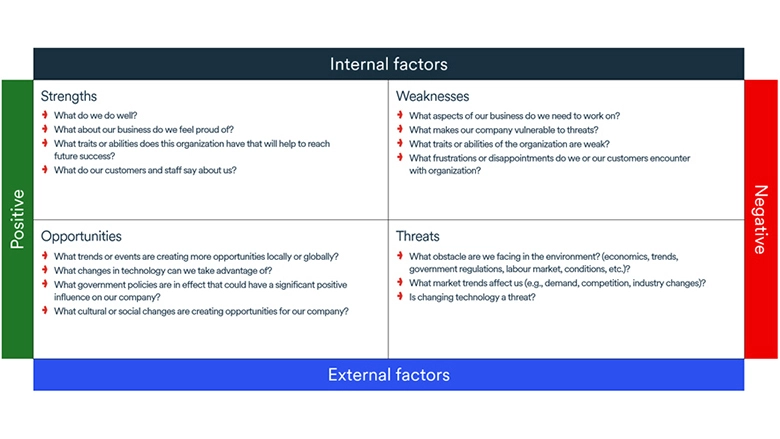
Free SWOT analysis template
Download our free PPT SWOT analysis template. The document also includes an example of a SWOT analysis.
Why a SWOT analysis is important
Performing a SWOT analysis on your company is important for two reasons:
1. A SWOT analysis helps build common understanding
Performing a SWOT analysis is important because it helps build a common understanding of the company among the leadership team.
“This is an immediate benefit of doing a SWOT analysis,” says Feder. “Your leaders will be more aligned because they will be looking at the company through the same lens. Otherwise, it’s difficult to agree on actions and strategies, since we may not see the business the same way.”
2. A SWOT analysis is the bedrock of your strategic plan
The analysis, and the alignment resulting from it, are really the first stage of a wider strategic study. The real purpose of a SWOT analysis is to develop a competitive advantage through the creation of a solid strategic plan.
More specifically, your plan should include concrete steps to harness your company’s strengths and target the opportunities identified in your analysis, says Feder.
“You have no choice. If you want to grow and move from being a seat-of-the-pants organization to a deliberate, professionally managed business, you will need to do more reflective planning. A SWOT analysis is the right tool for that; it lets you build a robust and relevant action plan.”
What is a SWOT analysis used for?
- Drawing up a clear and realistic path
- Helping you to better serve clients
- Achieving your objectives
- Preparing effective strategies
- Improving your performance
- Helping you find growth levers
A SWOT analysis helps you analyze your external environment and prepare for opportunities (e.g., changing demographics, announcement of a new residential development in the area, new trade agreement) and threats (e.g., new technologies, a dip in the currency, loss of a major employer in the community, new trade agreement) that will affect your business in coming years.
You can then work with your team to develop an appropriate response by answering the questions in the table below:
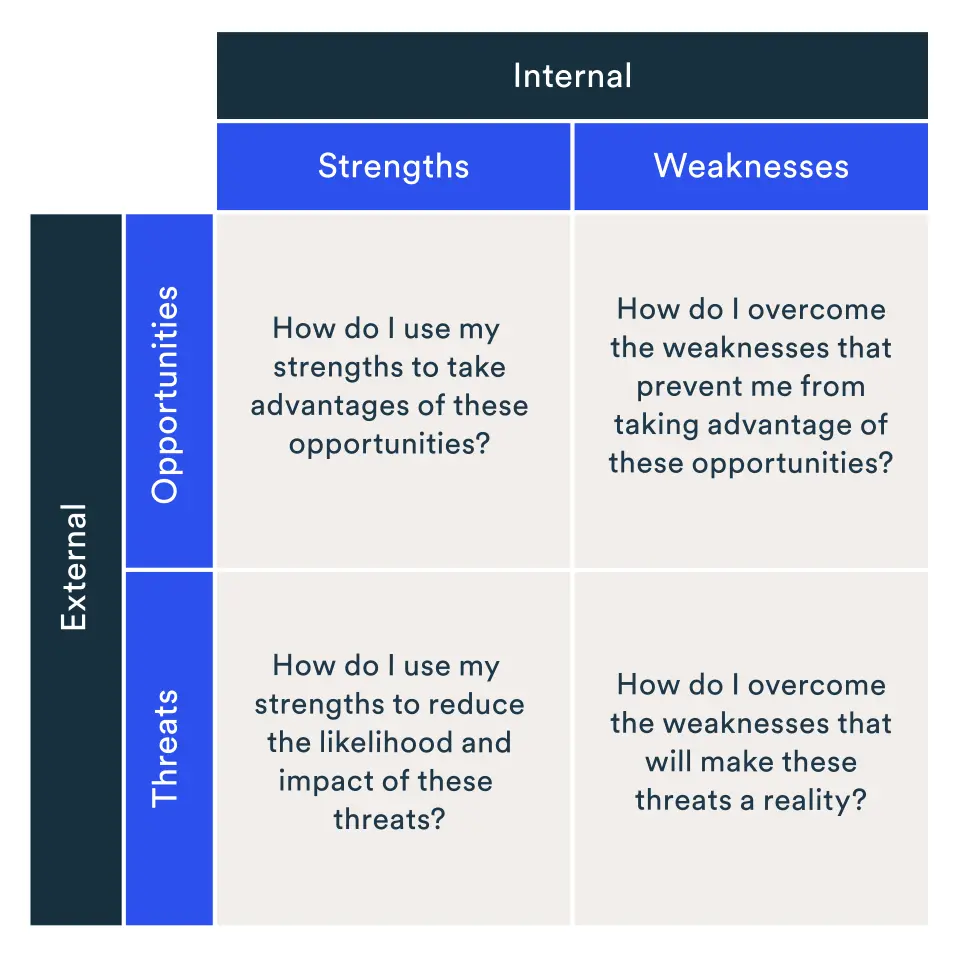
How do I use a SWOT analysis in my strategic plan?
Don’t make the mistake of preparing a SWOT analysis and then ignoring it. Your plan should include concrete steps to harness your company’s strengths in order to target the opportunities identified in your analysis.
The actions identified as priorities should be incorporated into an action plan that sets a deadline and identifies a person responsible for carrying them out.
How does SWOT differ from a PESTEL analysis?
A SWOT analyzes your company’s internal strengths and weaknesses alongside external opportunities and threats, giving a snapshot of its strategic position.
PESTEL, by contrast, looks only at the external macro-environment—political, economic, social, technological, environmental, and legal factors—that may impact your organization.
In short, SWOT is inward-and-outward, while PESTEL is outward-focused.
Next step
For more tools on developing your business growth strategy, download BDC’s free strategic planning toolkit.