

Don’t risk your acquisition. Why you absolutely need an integration manager.
Buying another company is a smart strategy that can fast-track your business growth. But to reap all the benefits, you must look past the excitement surrounding the negotiations and prepare for the transition phase.
In a 2023 survey, BDC directors with experience in acquisition deals identified good integration planning as one of three key factors (along with a strong management team and support from professional experts) that increase the chances of meeting or exceeding the business objectives of the transaction.
And yet, many entrepreneurs delay this step, which can create uncertainty among employees, clients and suppliers about what the newly announced combination means for them, says Devesh Dwivedi, Lead Consultant, BDC Advisory Services.
“Yes, you are busy, but all this integration planning has to be done before the transaction,” he warns. “Otherwise, what are you going to do on day one?”
That’s why you need an integration champion.
The integration manager doesn’t have to come from top management. It can be someone who understands the business, who has been there for a long time. Someone everybody knows and respects.
Devesh Dwivedi
Lead Consultant, BDC Advisory Services
What is an integration manager?
They are the person, typically hailing from the acquiring side, responsible for developing and implementing an integration strategy for the crucial first 100 days of the newly formed company. While their involvement depends on the size of the project, it is good practice to dedicate about half of their time to it, according to Dwivedi.
Integration managers usually lead a small team called the integration management office, which oversees the daily process of joining the two companies. Integration managers help connect the big-picture plans from top bosses and board members (in smaller firms, this can be just the CEO and a couple of senior leaders) with the people who execute the work, like sales, IT and other departments. The integration manager ensures leadership goals are implemented in daily operations.
“Integration champions don’t do everything on their own. They’re project managing, collating, collaborating, communicating with others,” Dwivedi says.
Integration governance
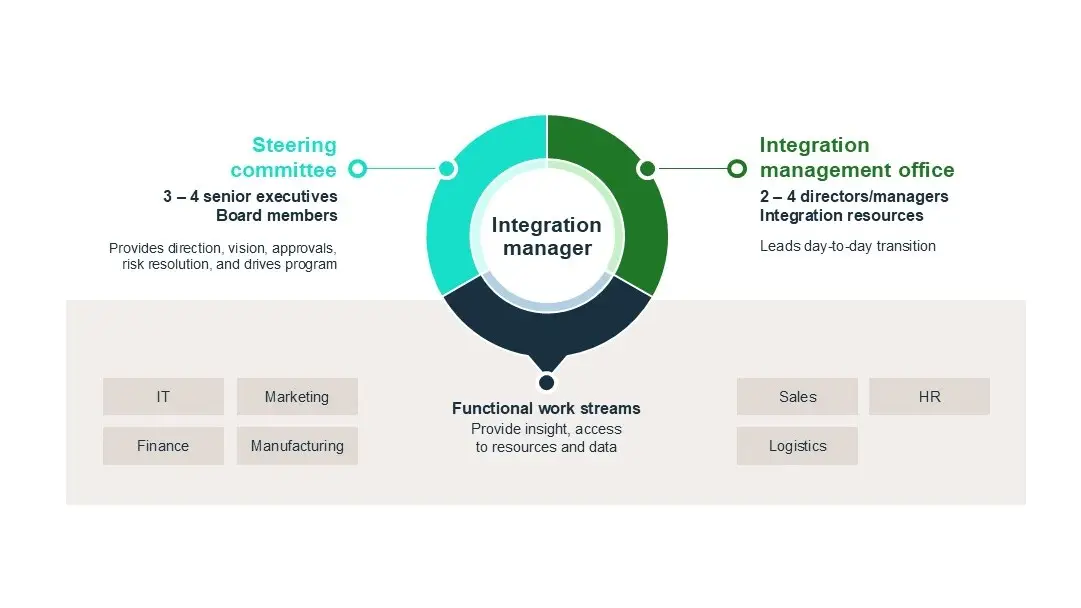
How does the integration manager support the process?
The integration manager’s role starts with the development of an integration strategy, a plan that defines how the newly formed company will look and operate once the transaction closes. Often referred to as a target operating model (TOM), it addresses hundreds of questions, such as:
- Are we going to merge the brands, leave them both as is, retire one or create a new one for the merged company?
- How will we integrate our technology? Which technologies need to be replaced or migrated?
- How do we harmonize compensation and benefits across teams?
Just as important is the execution timeline, which should reflect the urgency of each target. Changing signs on a building can wait a few weeks, but employees from the acquired company should switch email addresses within days. Communicating clearly with every group concerned, from employees to vendors, should be a priority from the moment the acquisition is announced.
The integration manager then needs to make sure the strategy trickles down to the operational level, with each department having a specific integration plan.
Once the structures are in place, the integration manager must:
- Conduct regular integration team meetings.
- Track and record progress.
- Make sure things are moving along.
- Watch out for disgruntled employees.
- Find ways to retain talent.
If the process is at risk, the integration manager must act fast. For instance, they should escalate issues that require senior leaders’ decisions or help teams find the resources they need to stay on track with integration milestones.
Their role becomes even more strategic when the two companies are in different locations, Dwivedi adds.
“You don’t want a situation where the left hand doesn’t know what the right hand is doing. You need a conduit between the two who’s working on both sides, and you want as much physical presence as possible.”
What qualities make someone an effective integration manager?
The following traits and skills are especially valuable:
- strategic thinking
- conflict resolution
- communication
- team leadership
- empathy
- project management
- self-confidence
- result orientation
The ideal candidate for the job usually already works for the buying company, where they have built up both knowledge and influence. While it could be the CEO or the CFO, titles are not what matters most.
“The integration manager doesn’t have to come from top management. It can be someone who understands the business, who has been there for a long time. Someone everybody knows and respects,” Dwivedi says.
This corporate knowledge can shape critical decisions in the first weeks following an acquisition. In one transaction Dwivedi worked on, the integration manager realized that the seller’s processes were stronger than the buyer’s. As a result, the buyer chose to adopt the seller’s systems and policies.
While demanding, this mission is a stepping stone for someone eager to grow within the executive team. If this acquisition is the first of many, the integration manager could be a candidate to head your future corporate development office.
When should the integration manager be brought in?
As soon as you’re serious about the deal, such as after sending a letter of intent, you should decide who will lead the integration and who will support them in the integration management office.
If the two companies have had a good working relationship in the past, they can share information and connect their teams early, making it easier to pick key players for the transition team. When a deal is highly sensitive and discussions are limited to top leadership, the integration team may need to be finalized later, once the acquired company is brought into the integration planning.
As the transition starts, there are several ways you can measure the success of an integration manager. Here are some areas to look at:
- Were the expected financial and operational benefits met?
- Did you lose many employees?
- Was the timeline respected?
“Most of the integration should be completed within the first 100 days,” Dwivedi explains. “If it takes any longer, the process could drag on indefinitely. Prolonged integration can also create cultural issues, as employees may struggle to feel like they’re part of a single, unified company.”
If you see the integration manager falling behind, you may need to step in and support them. There are proactive steps you can take to help them succeed, beginning as early as your initial consideration of the acquisition. For example:
- Ensure they understand the rationale behind the acquisition.
- Give them metrics to measure against by identifying cost or revenue synergies and quantifying the expected financial impact.
- Assess the risks associated with the deal to help them address hurdles early on.
Ultimately, you want the integration manager equipped to hit the ground running. They ensure that the people, systems, and daily operations of both companies align quickly, protecting customers, employees, and the value of the deal from day one.
Next step
To help you ensure the long-term success of your merger or acquisition, download BDC’s Post-merger integration checklist.