

Monthly Economic Letter
Keep abreast of key economic indicators.
Read moreThe economy in 2026: Make or break time for Canada?
It's been a tough year for the Canadian economy. Entrepreneurs, consumers and governments have all been shaken by uncertainty caused by trade tensions.
Can we hope for better in 2026? Yes and no. The outlook remains clouded as we continue to face trade disputes and other external and internal issues. But while the year ahead will be challenging, a recession doesn’t look to be in the cards.
Key determinants of the 2026 outlook:
• International tensions
• Limited domestic demand
1. Uncertainty and geopolitics will shape the coming year
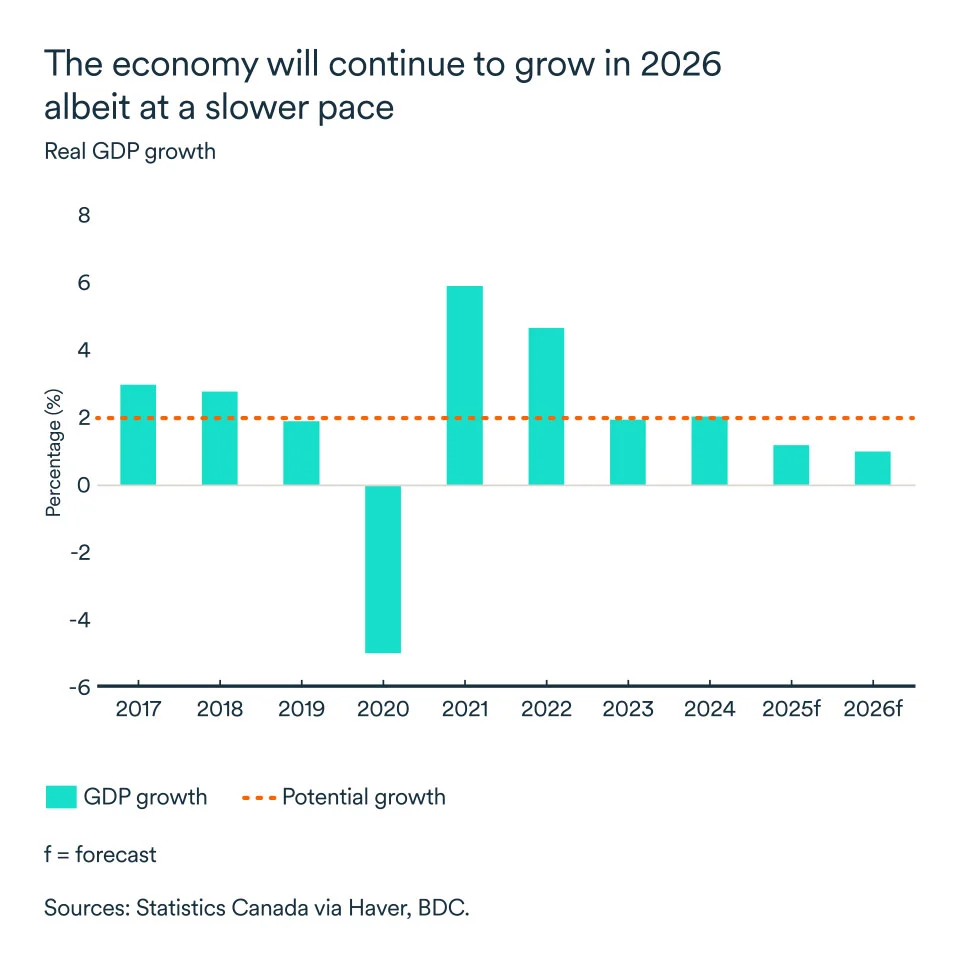
The Canadian economy should continue to grow in 2026 but at a slower pace than in 2025. Economic growth is slowing around the world, including in the Eurozone, China and the United States. As an open economy and a major producer of natural resources, Canada won’t avoid the effects of the expected international slowdown in the coming year.
What's next for tariffs?
The Canadian economy is under strain from uncertainty caused by trade tension with the U.S. and China, Canada’s most important trading partners.
Canada’s relationship with these two giants is in flux, and this will continue to hamper our export growth in the coming year.
Canada could face more tariffs. For example, U.S. duties on upholstered wood furniture are set to increase next year from 25% to 30% and those on kitchen cabinets and vanity units to 50%.
On the other hand, there’s the possibility of a comprehensive trade agreement between Canada, the U.S. and Mexico because the CUSMA (Canada-United States-Mexico Agreement) is up for renewal in 2026.
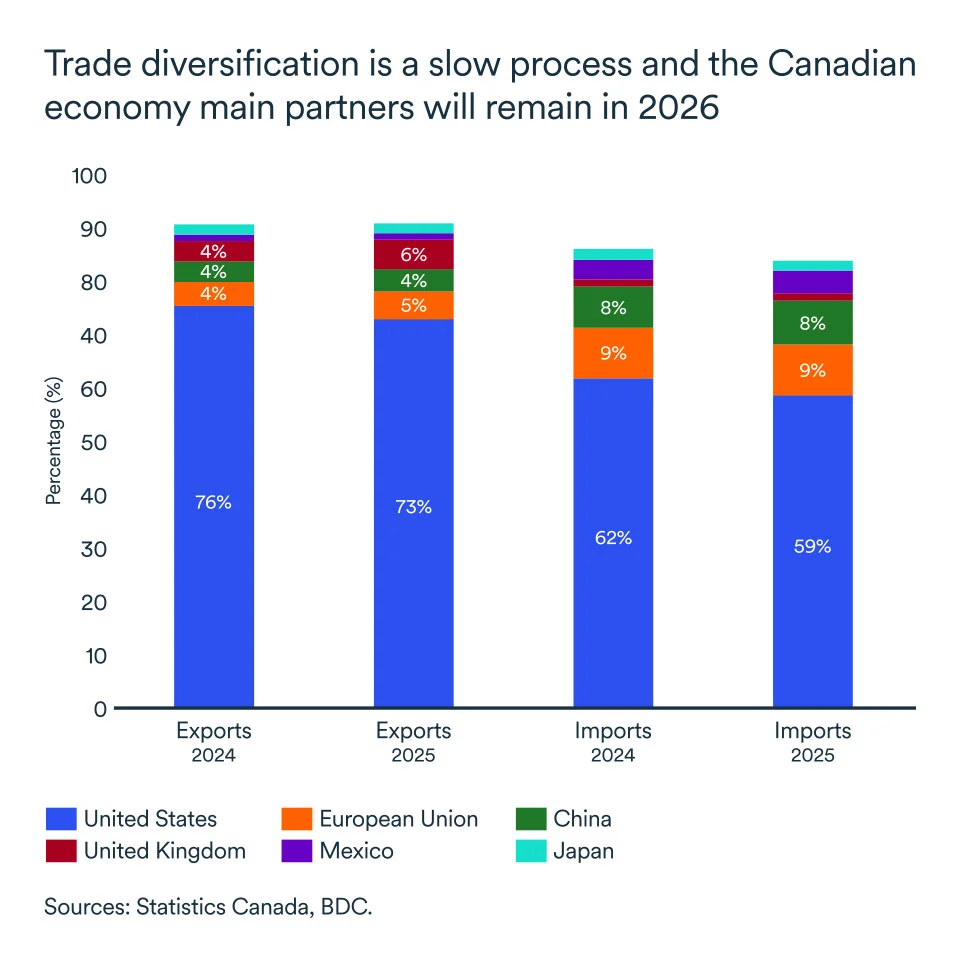
Canada adapts to new trade environment, but uncertainty remains
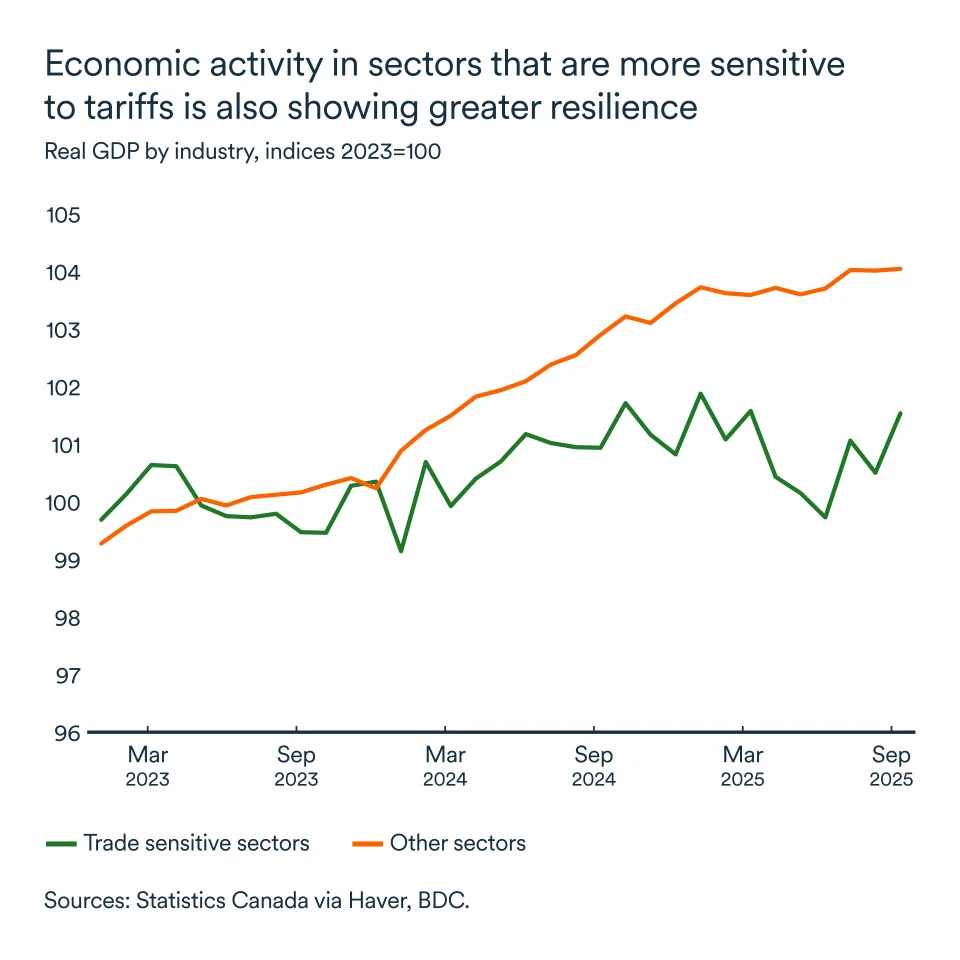
The sectors most affected by trade tensions showed signs of adjustment at the end of 2025, and other parts of the economy remained stable. A surprising 26,200 jobs were created in export-dependent sectors over the year, while the rest of the economy generated 192,000 more. Sectors that are more sensitive to international trade experienced sluggish growth (0.2%), while the others chugged along at a steady pace (1.5%).
In 2026, we expect the Canadian economy to remain resilient, producing modest growth overall.
Real GDP growth, projected to be 1.2% for 2025, will slow to 1% in 2026, according to our estimates. That’s a result that would indicate the country isn’t using its full capital and labour capacity.
This outlook is based on the current geopolitical context and could be revised upward in the event of a significant easing of trade barriers. By contrast, it could be adjusted downward if new tariffs are imposed.
2. The pillars of growth in 2026 will come from within the country
Canadian household spending plays a key role in economic growth. Year in, year out, household consumption accounts for about 60% of GDP. Household demand for goods and services are doubly important during a global slowdown because it has a strong influence on domestic business investment.
We expect consumer spending to remain a stabilizing force for the Canadian economy in 2026. Supported by a relatively strong job market and inflation that remains within the Bank of Canada's target range (close to 2%), domestic demand will continue to cushion the effects of the global slowdown.
Consumption will be constrained
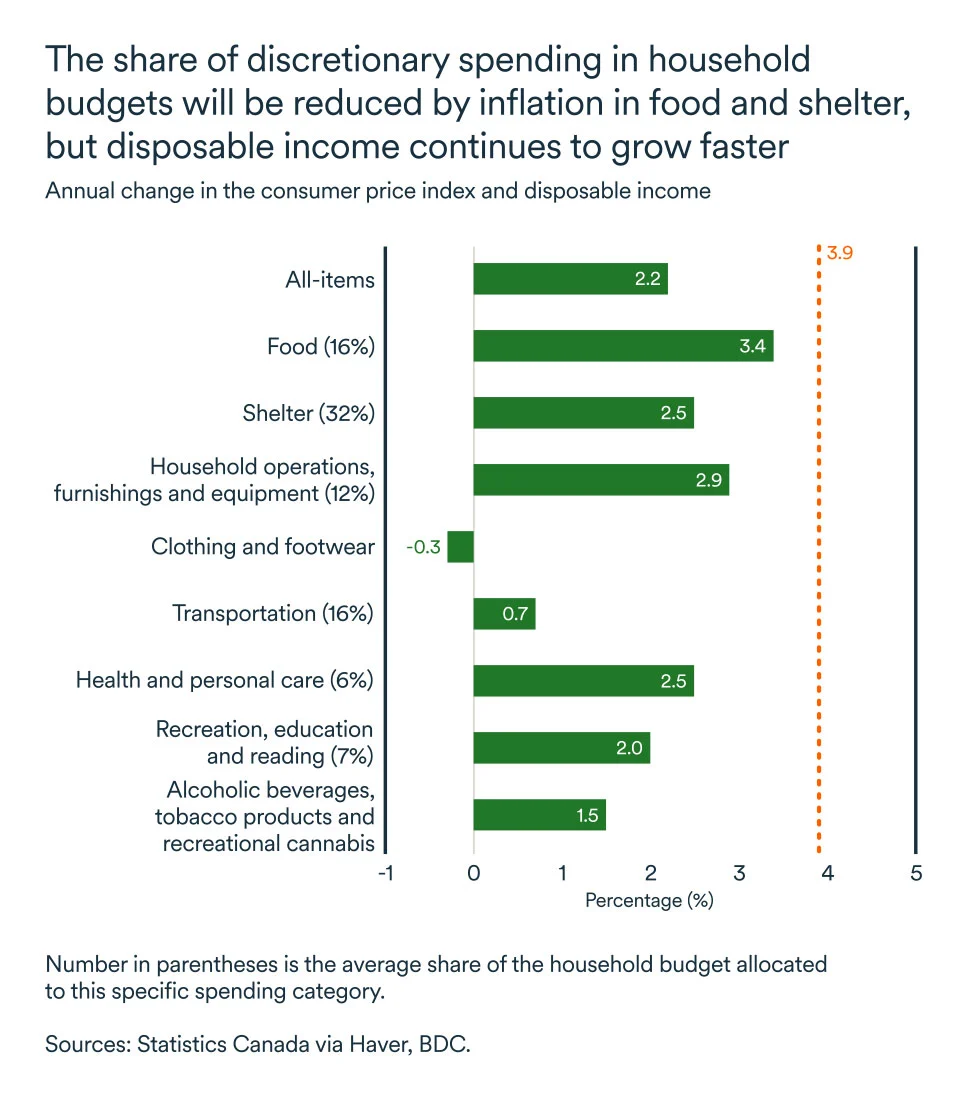
However, high debt levels and prices continue to weigh on consumers. These factors, along with weak population growth and poor consumer confidence, will limit the contribution that domestic demand makes to growth.
Consumer spending will focus more on essential goods and services, while discretionary purchases and real estate investments will remain under pressure.
Fortunately, the Bank of Canada’s key interest rate of 2.25% is currently at the bottom of the neutral rate range—that is, at a level that encourages neither excessive debt nor savings accumulation. This should promote a balance between consumption and investment.
The bank began its easing cycle (rate cuts) in June 2024, and made four additional cuts in 2025, for a cumulative reduction of 100 basis points over the past 12 months. While the bank is expected to hold the rate steady in the near term, it takes between 18 and 24 months for the full effect of previous cuts to be felt in the economy.
Sectors that are more sensitive to interest rate changes have suffered from high uncertainty and household pessimism. The residential housing market, for example, experienced weak growth in 2025, which is likely to continue in 2026. A cautious mood among households will limit the potential for a strong recovery.
The sales outlook for businesses in 2026 is positive but modest. This is dampening Canadian business investment and prompting SMEs to focus on targeted investments aimed at improving operational efficiency, rather than growth.
Once consumer confidence improves, consumption should rebound because disposable income continues to grow. Companies that will benefit most from the recovery will be those with the ability to respond quickly and cost-effectively, i.e., the most efficient ones. (Assess whether you’re one of them).

An evolving economic picture for businesses
Fortunately, Canada entered 2025 on a solid footing, with low unemployment, inflation under control, interest rates trending downward and strong population growth. These factors largely explain the economy's resilience despite record levels of uncertainty.
However, as the year unfolded, the foundation began to show cracks. 2026 will start of shaky ground. Here’s what we expect for 2026’s numbers:
• Real GDP: 1.0%
• Unemployment rate: 6.8%
• Exchange rate: 74 US cents
• Inflation: 2%
• Key interest rate: 2.25%
SMEs are caught between a rock and a hard place: they must absorb the rising costs of certain inputs while remaining competitive on price.
Looking ahead, we expect oil prices to remain low in 2026, fluctuating between US$55 and US$63 per barrel, far below the levels of previous years, due to persistent oversupply and moderate demand.
Despite lower oil prices, the economies of oil-producing provinces will continue to outperform other parts of the country. At the same time, energy-consuming businesses and households will benefit from lower energy costs.
Meanwhile, the outlook for the Canadian dollar shows little sign of significant strengthening versus the U.S. dollar. The loonie could appreciate slightly at the beginning of the year when the interest rate differential between the U.S. and Canada is expected to narrow.
Despite a more flexible labour market, wage growth isn’t slowing significantly due to structural and demographic changes in the country. Wage increases are therefore expected to remain moderate but above inflation, averaging 3%, reflecting strong competition to attract and retain talent.
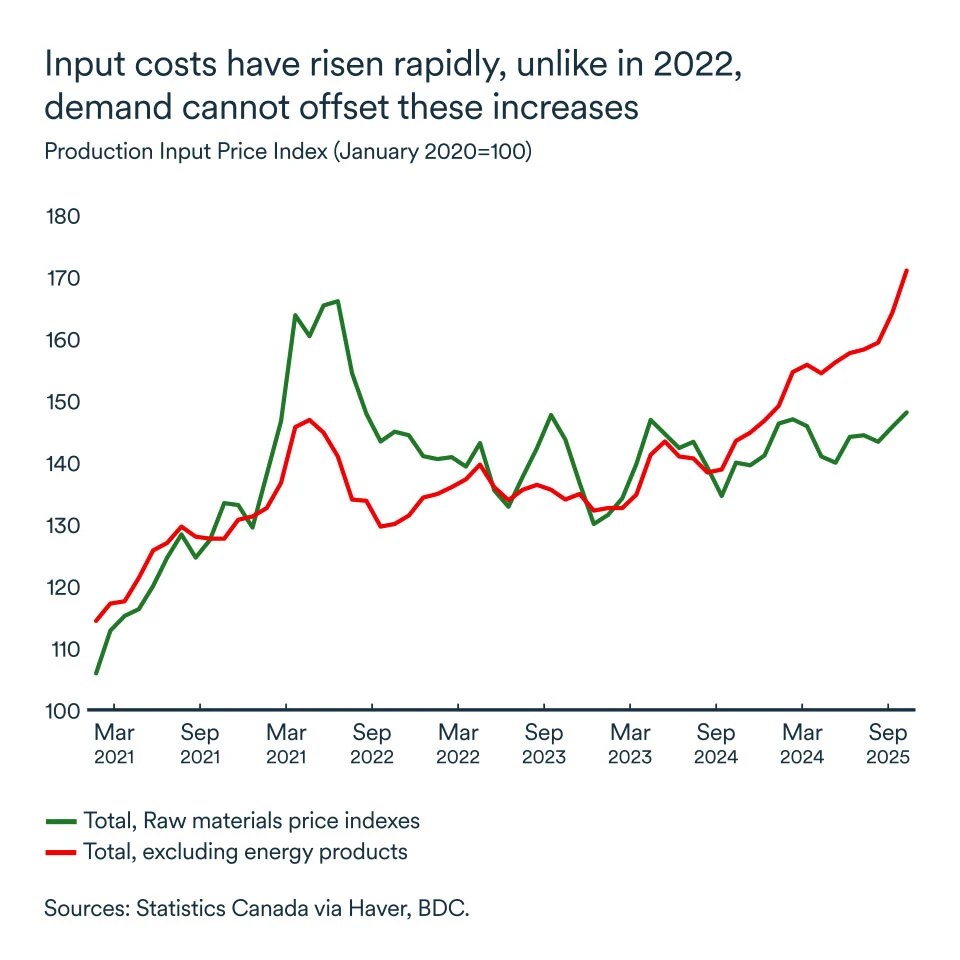
SMEs: Tight management and forward-looking investments will be key
The economic outlook for 2026 suggests that good profit margin management will remain essential to the financial health of Canadian businesses.
As the cost of doing business continues to rise and companies face more cost-conscious consumers, focusing on productivity is also a must. Investing in technology, automation, and process modernization through artificial intelligence will not only offset cost pressures but will also improves operational efficiency.
In a volatile environment, organizations that invest to improve productivity will position themselves to seize opportunities when demand picks up again, turning uncertainty into a strategic advantage.
In short...
Uncertainty is not going away. Tariffs continue to hurt the Canadian economy, but a recession should still be avoided this year, thanks to domestic spending. Canadian businesses must continue to invest in innovation and productivity to adjust to the new economic reality and the trends that will shape our future.
The Canadian economy returns to growth
Canada's economic growth rebounded at an annualized rate of 2.4% in the third quarter, a solid recovery from the negative growth of 1.8% recorded in the second quarter. For the first nine months of the year, GDP grew by 1.2% compared to the same period in 2024. Statistics Canada's preliminary estimates for October indicate a slowdown in the pace of growth.
Tariffs and lower inventories remain key factors
The third quarter was stronger than expected, but the details of how the growth was achieved point to challenges for the economy. Household consumption took a turn for the worse in the quarter, cutting 0.2 points from growth. Businesses have been putting the brakes on investment since the beginning of 2025, and the slowdown continued in the third quarter. Fortunately, a gradual recovery in residential investment helped offset the lacklustre business performance.
Businesses began to sell off accumulated inventories, which hurts GDP figures but is a good sign for the economy. Inventories grew rapidly when businesses brought forward their purchases due to tariff uncertainty in the first half of the year. With demand slowing, businesses are now focusing on better inventory management.
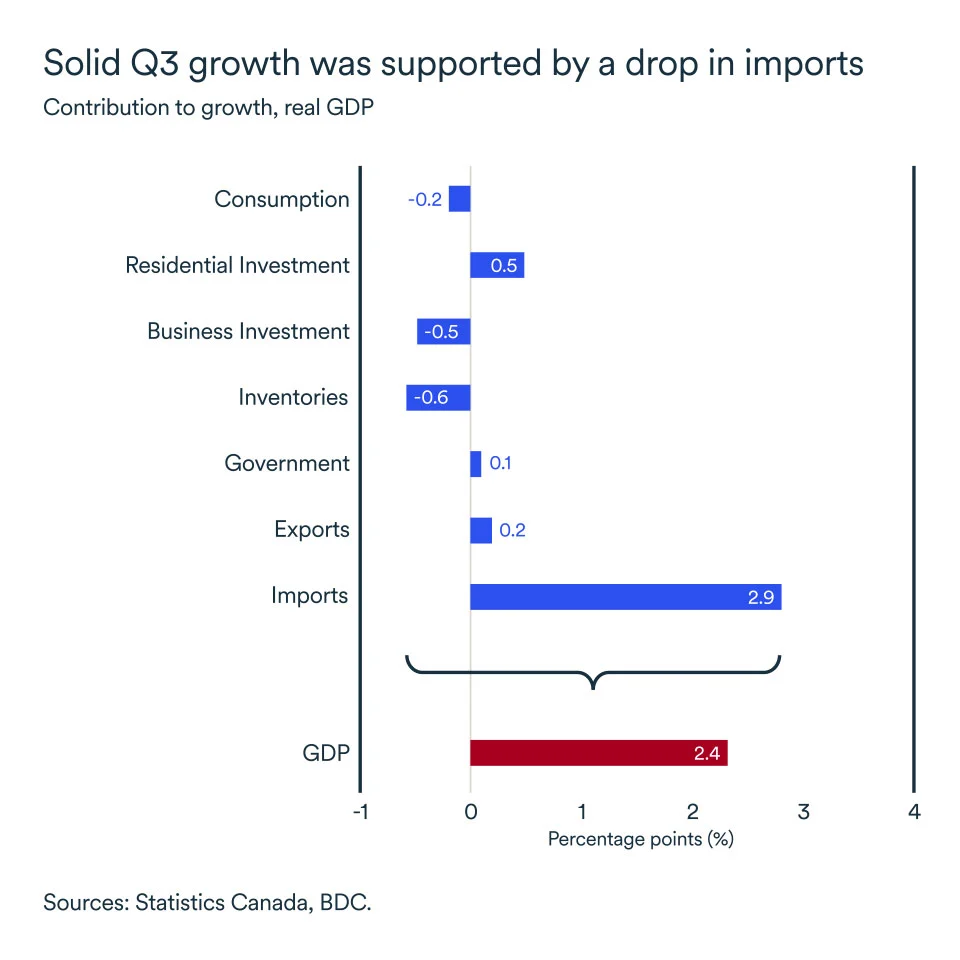
In addition, businesses (and households) have reduced spending outside the country. Imports declined so significantly that it accounted for most of the growth in Q3. The decline in imports alone contributed to a 2.9-point increase in real GDP growth compared to Q2.
Meanwhile, there were new signs of stabilization in sectors heavily exposed to foreign trade, but also signs of a slowdown in domestic demand.
For example, Canadian exports increased compared to Q2, even though many tariffs have increased and new ones have been imposed by the U.S. and China.
For the first nine months of 2025, economic activity in the more export-sensitive sectors stagnated, recording real GDP growth of 0.3% compared to the same period in 2024. The slowdown in growth still appears to be limited, however, as other sectors grew at a rate of 1.8%.
Weak consumer demand persists
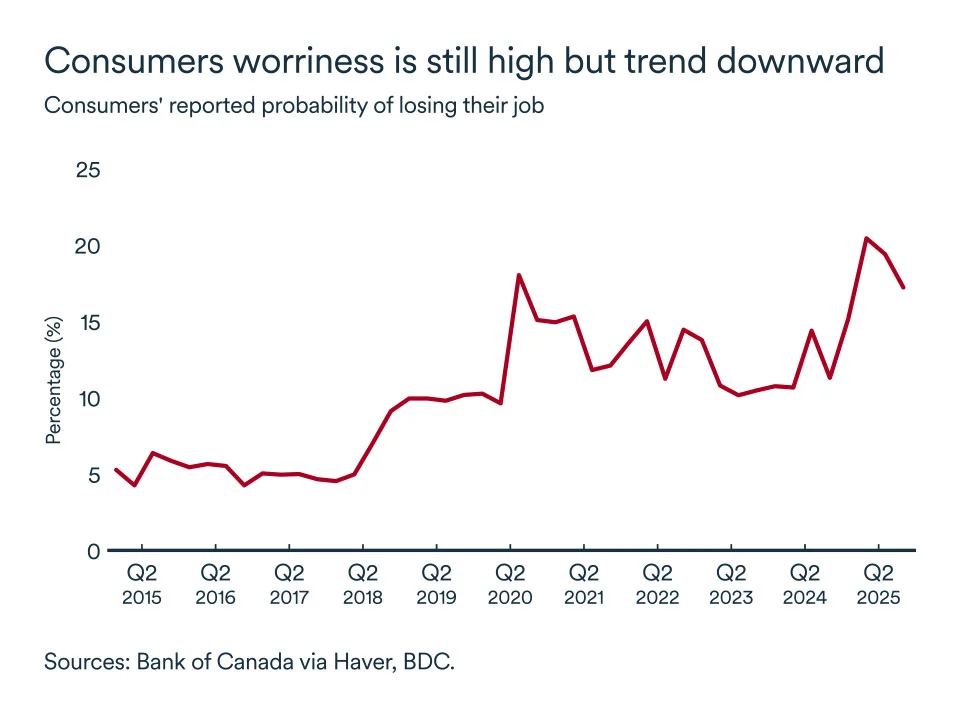
Consumer spending is being held back by weak population growth and a lack of confidence in the outlook for the economy. Some measures of consumer confidence showed a slight increase in November, but they remain below 2024 levels. Close to one in five workers still fears losing their jobs, according to the Bank of Canada. This level is similar to that in the second quarter of 2020, when the pandemic forced a widespread economic shutdown.
When job prospects seem uncertain or individuals anticipate possible adjustments to their working conditions, the natural tendency is to become cautious and increase savings.
Since 2024, households have been socking money away. This accumulation—occurring even as interest rates have fallen—suggests that individuals are indeed building up rainy day savings in response to this period of uncertainty.
The labour market remains relatively strong
Despite some recent positive signs, factors such as rising costs and uncertainty continue to weigh on consumer sentiment. However, employment is relatively strong in the country.
The November labour force report showed more gains in total employment, with 53,600 new jobs added, bringing the total for 2025 to nearly 220,000 through November. The unemployment rate fell significantly between October and November to 6.5%. Nearly one in five people who were unemployed in October found a job in November.
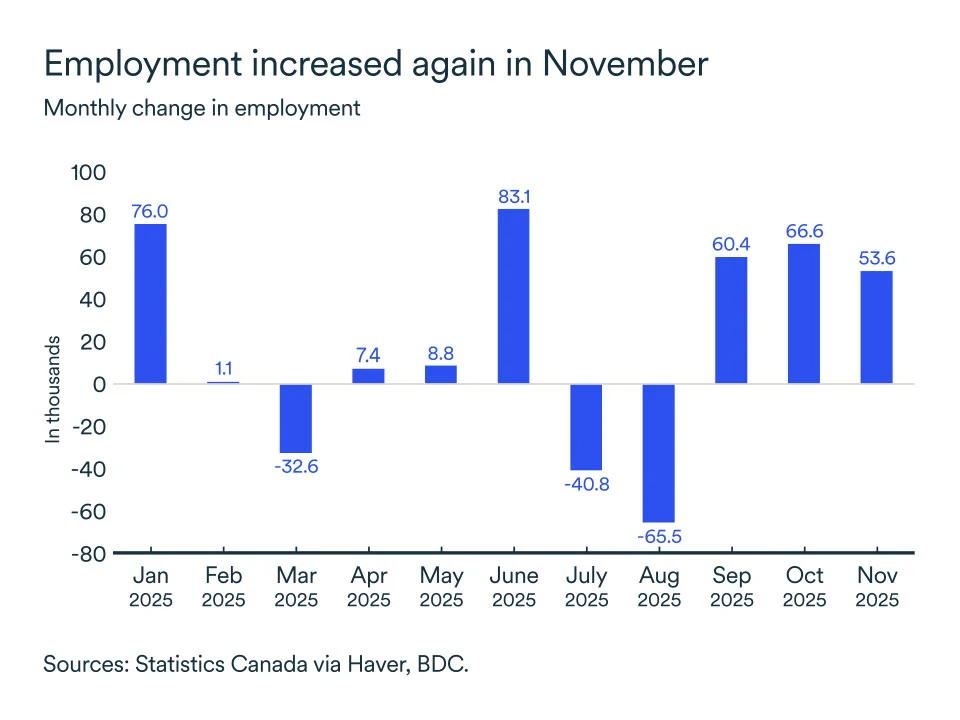
In September, the number of job vacancies in Canada increased by 25,000, marking the first monthly increase since January 2024. Statistics Canada estimates that there are still nearly half a million job vacancies in the country.
The impact on your business
- The labour market is improving, but cautious households and rising savings are limiting consumption, which could affect your sales. Lower demand adds to cost management challenges for businesses whose margins may be squeezed. So, focus on efficiency gains rather than volume.
- However, declining imports may create an opportunity for Canadian businesses to meet domestic demand. Whether you deal with other businesses or directly with consumers, the current economic environment tends to favour the domestic economy.
- Despite a slight recovery in exports, growth remains weak in trade-sensitive industries as significant tariffs persist. Companies must continue to adjust their plans in the face of volatile growth and fierce competition in international markets.
A resilient 2025, gives way to fragmented provincial outlooks in 2026
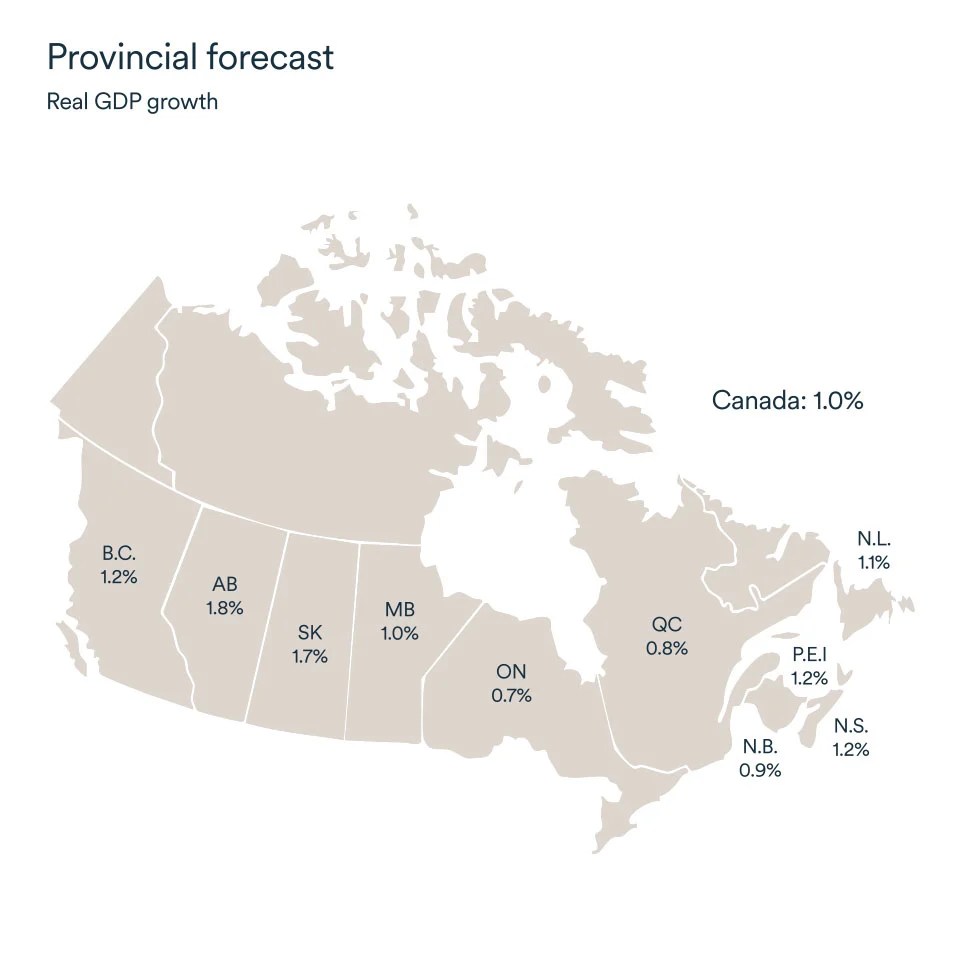
Canada’s provinces are expected to experience uneven economic growth in 2026, due to unresolved trade disputes and other regional challenges.
Ontario and Quebec were the provinces most impacted by trade tensions in 2025, and they are set to experience another year of low growth as they endure the same challenges in 2026.
Higher U.S. tariffs on lumber and copper that took effect in October have added more pressure on Manitoba and British Columbia, leading us to believe that 2026 will be lacklustre for those provinces.
By contrast, Alberta should lead the provincial pack with relatively strong growth, while Saskatchewan is also expected fare well, despite tariffs on canola and potash.
We expect the Atlantic provinces to perform better than the national average in 2026, lifted by strong public spending and major projects in Nova Scotia and P.E.I.
British Columbia — Another year of resilience
Tariffs had a mild impact on B.C.’s trade in 2025 with exports remaining flat despite sectors like metals and lumber experiencing declines. Manufacturing activity grew slightly by 0.8%, but the labour market remained weak. Unemployment crept up, reaching 6.4%, close to a peak of 6.6% reached in mid-2021.
Despite slower economic conditions, B.C.’s households spent more in 2025 than the year before, and home sales slowly started to recover. Consumers should be able to continue spending in 2026 albeit at a slower rate due to persistent uncertainty on tariffs and lower population growth.
Consumers will benefit from lower interest rates, but we expect them to remain cautious amid the uncertainty. Unless there’s a big breakthrough in trade talks that would boost confidence, we expect only a slow improvement in home sales next year.
On the bright side, big projects are lined up for B.C. Phase 2 of the Kitimat expansion project and the Red Chris Mine expansion should provide support for the economy. GDP growth is expected to be around 1.2% in 2026.
Alberta — Leading the pack in 2026
Alberta’s economy is under pressure from falling export earnings, largely due to weaker oil prices. However, even though oil prices have decreased considerably in 2025, the province has pumped more barrels than ever and has been able to diversify its shipments to reach China. The strong momentum we’ve seen in 2025 is expected to continue in 2026, lending support to the whole economy.
While manufacturing sales dropped by 1.4%, the province added 76,200 jobs since the start of 2025, and retail sales grew by a strong 5.0%. Solid fundamentals will allow Alberta’s households to continue to spend in 2026, but stronger confidence in the economic outlook will be needed to boost the real estate market.
Home sales struggled to recover in 2025 in what was once the hottest market in Canada. We expect housing activity to return to balance in 2026, increasing at a more sustainable pace.
Residential investment reached record levels in 2025, reflecting robust construction activity. The trend could continue into 2026 as the province still attracts more immigrants than the rest of Canada, thanks to its relative affordability.
Public spending and steady oil production will remain the key drivers of economic growth in the coming year. Alberta is expected to outperform all provinces with GDP growth increasing by 1.8% in 2026.
Saskatchewan — Under pressure but still strong
Saskatchewan faced significant challenges from Chinese tariffs and lower energy prices. Exports were down 5%, dragged down mostly by energy prices, but also Chinese trade restrictions on canola and potash. The same trade headwinds are expected in 2026.
Another area of weakness will be the public sector. It contributed greatly to employment in 2025, supporting consumer spending. However, with projected restraint in government spending next year, we’re not forecasting a positive contribution to employment. Still, healthy labour market conditions will be supportive of consumer spending.
Mining will also contribute to economic growth, especially potash and uranium. We see exports in these categories to keep rising due to strong global demand and higher prices. Major projects like the Jansen potash development and the inclusion of the McIlvenna Bay Foran Copper Mine in federal fast-tracking initiatives are expected to further support the economy. GDP growth is forecast to increase by 1.7% in 2026.
Manitoba — Tariffs drag down economic growth
Exports have fallen by 6% since the start of the year. Most of the drag was felt in sales of industrial machinery and equipment and metals, but lower energy prices also hurt export earnings. Total manufacturing sales fell by a modest 0.3%.
Demand is not expected to pick up significantly in 2026, especially given the new tariffs on copper and subdued investment intentions.
But there were some positive signs at the end of 2025. The province added 9,500 jobs, and consumers increased their retail spending by 5.3%. Going into 2026, relatively solid job market fundamentals should give Manitobans room to spend more.
Public spending, including fiscal relief measures and a $4.1-billion infrastructure plan, will lend support to the economy. We see modest economic growth of 1.0% for 2026, reflecting the persistent impact of tariffs.
Ontario — Avoiding recession despite the headwinds
Tariffs hurt Ontario’s growth considerably in 2025. Autos and parts exports decreased by 3.7% since the start of the year, putting pressure on auto-intensive areas like Windsor and Guelph. The job market struggled for most of the year before showing some signs of recovery in late summer.
Faced with a turbulent economy, Ontarians moved to rebuild their savings. Disposable income continued to increase, allowing households to build up their savings. While they increased their retail spending in 2025, they remained cautious with big ticket items. The residential market lost steam quickly this year, notably in the Greater Toronto Area. The GTA condo market struggled the most in 2025 with lower sales and prices falling as much as 6.4% year-over-year n Q3 2025. Overall, home sales remained below trend and builders postponed plans. 10,000 jobs were lost in the construction sector since the start of the year.
Solid household finances should support continued spending in 2026, but without a trade deal, we don’t expect a swift recovery for the housing market. Rather, we foresee a slow improvement in home sales over time.
Remarkably, the province appears to have avoided a recession in 2025. The coming year looks to be similarly weak with unresolved trade disputes and CUSMA trade pact under review. As the province continues to adapt to the new trade environment, we expect the labour market to stabilize and resilient consumers to spend more.
Public spending through targeted fiscal measures will help industries and regions that have been heavily impacted by tariffs. We expect another year of weak growth at 0.7% in 2026, just enough to keep the province out of recession once again.
Quebec — Holding its ground through the turbulence
U.S. tariffs hit some of Quebec’s most important manufacturing sectors. The steepest declines in exports were in steel, aluminum and lumber products.
However, when it comes to aluminum, Quebec still held a competitive advantage especially with limited capacity on the U.S. side. Overall, trade with the U.S. looks to be stabilizing and should continue to do so in 2026.
The rest of the economy held its ground, adding 13,800 jobs, which supported consumer confidence in the province. Quebecers in fact, increased their spending, retail sales were up 4.1% and home sales have steadily increased since March.
We believe the job market will remain solid in 2026. Despite continued economic uncertainty, consumer spending should remain solid, thanks to significant accumulated savings and lower household debt than in other provinces.
We also see decent housing activity in 2026, with a continued recovery on the horizon. The only caveat is that the province’s population growth is decelerating, keeping a lid on consumption.
Large-scale projects, including the Port of Montreal expansion and Hydro-Quebec’s initiatives, should bolster growth. GDP growth is expected to slightly increase to 0.8% in 2026
New Brunswick — Low growth in 2026
New Brunswick’s economy slowed in 2025 as uncertainty and tariffs hurt trade and consumer confidence. Exports fell by 6% and manufacturing also declined. For 2026, we expect trade with the U.S. to stabilize at a lower level. Since the province also relies on interprovincial demand, the weaker outlook for Ontario and Quebec will put additional pressure on trade in 2026.
Households remained cautious with their spending throughout the year. Without a clear improvement in trade disputes, consumers are expected to remain cautious well into 2026.
Public spending is expected to give a boost. A $1.26-billion public investment plan will help sustain economic activity. GDP growth is projected to come in at 0.9% for 2026.
Nova Scotia — Modest improvement in 2026
Nova Scotia’s economy eased in 2025, dragged down mostly by its services sector. Despite significant tariffs on seafood exports to China, the province was able to increase trade with other countries such as Japan and Mexico. The manufacturing sector remained resilient led by strong computer and electronics production.
Easing in the job market slowed consumer spending in the first half of 2025, but signs of improvement emerged in the fall. Home sales followed the same trend, but recovery was much faster. As the labour market stabilizes further, we see more upside for consumer spending and the housing market in 2026.
Nova Scotia’s economy will be helped in coming years by federal investments in major defence and energy projects. A $3.5-billion capital plan by the Nova Scotia government will also support already strong construction activity. We see growth improving to 1.2% in 2026.
Prince Edward Island — Momentum to fade, but growth shall remain
The province’s exports were up 12%, driven by strong U.S. demand that offset declines in sales to China. Manufacturing surged by 10%, and tourism remained robust.
U.S. demand is expected to remain strong in 2026, and the province will continue to attract tourists from the U.S. and Canada. This will support the economy next year, but slower population growth will have a cooling effect.
A $1.3-billion investment plan and aerospace sector developments are key contributors to the positive outlook. We see P.E.I.’s economy faring better than the Canadian average with GDP expected to increase by 1.2% for 2026.
Newfoundland & Labrador — Growth to ease
Newfoundland and Labrador’s economy benefitted from the reopening of the Terra Nova platform, which contributed to the year’s strong oil production. Exports increased thanks to lower tariffs on energy and diversified markets. Around 50% of exports go to the U.S. and 40% to Europe.
Despite lower oil prices, increased output should compensate in the coming months. On the other hand, metals prices, including for iron ore and nickel, could see further declines in 2026, adding downward pressure on the economy.
While there are no major projects in the pipeline, a new energy deal with Quebec for Gull Island will potentially create thousands of jobs and sustain long-term economic growth.
In 2026, slowing population growth, lower energy and metal prices will lead to an easing of growth compared to 2025. GDP is expected to reach 1.1%.