


Quadshift had the deals—but needed a partner with funds

Quadshift had a problem most companies would envy: lots of great potential deals, but not enough capital to close them.
The Toronto-based software company was quickly growing as an acquirer of B2B software businesses. Quadshift specializes software that serves a specific industry. It operates in five areas: environmental software, pharmacy software, agriculture and food, chemical compliance, and communications.
It all started in 2017 when CEO John Paterson and three other investors acquired an automotive database marketing company. “We then bought two more businesses, looked at ourselves and said, ‘These companies look good together. Maybe we can scale this out,’” he says.
And scale they did, focusing on acquisitions in essential sectors relatively unaffected by business cycles. “We bought some good companies and showed that we were good at operating them,” Paterson says.
By 2025, Quadshift had bought 12 companies. More acquisitions were available, but Paterson and his partners didn’t have the funds to carry them out.
“We had deals lined up,” Paterson says. “We just didn’t have the capital to move on them.”
“We needed a partner to bet on us”
Quadshift also needed help to get to the next stage in its growth plan—ramping up synergies and taking advantage of artificial intelligence (AI).
The company approached BDC Capital’s Growth Equity Partners division for additional capital. “To continue scaling, we needed a partner to bet on us,” Paterson says. “We needed external capital to get to the next level because we were moving at a pace that required a party to come in—but we weren’t yet at the scale that would have justified a larger private equity shop to provide a growth equity cheque.”
BDC Capital was impressed by Quadshift’s track record of buying and operating strong businesses that owned industry-specific software. The team that provides minority investments for rapidly growing mid-sized Canadian companies provided Quadshift with growth equity to help it pursue its ambitious growth strategy.
Revenue tripled after BDC investment
The company put the funds to work right away. It expanded from 12 to 17 businesses in a little over a year. Revenue tripled, while profits grew even more quickly.
Quadshift was able to implement sought-after synergies and AI plans. Instead of operating as a loose collection of companies, Quadshift organized them into groups of businesses by theme or customer.
Cost and revenue synergies
The reorganization allowed cost synergies to be realized within each group. Expenses could be reduced to increase profitability and deliver services more cheaply. Quadshift also increased revenues by promoting cross sales among the businesses.
For example, in its environmental software group, one of the holdings helps municipalities educate residents to properly dispose of recycling. Another company detects contamination in recycling bins and uses this to inform households to improve practices.
“Our groups of holdings are all coherent in that way. We can package the software together. You’re adding more value to your customers, and they end up spending more with you.”
To achieve additional synergies and improve performance even more, Quadshift developed shared services for all of its holdings in finance, sales and marketing.
“A lot of smaller businesses don’t have fully flushed-out professional functions,” Paterson says. “That level of talent doesn’t exist at that size of company. To get it, you need some scale. We can offer this in our shared services.”
Quadshift gives its acquisitions a brand lift, revamps and manages their website, and offers financial reporting, including budgets and forecasts.
AI investment was transformative
In March 2025, Quadshift acquired IdeaPoint, a pharmacy-industry software company with top AI talent. These experts were tapped to help develop an AI strategy for Quadshift. They organized weekly sessions for key software developers in the subsidiaries to discuss how to use AI. In each of the holdings, champions were appointed to accelerate AI adoption.
Even non-developers got involved—thanks to powerful new AI models and apps that allow anyone to write complex software.
“Everybody’s work is changing. We can build our own solutions. Every person at Quadshift is either a builder or is using tools to make their work more effective,” Paterson says.
“AI isn’t a project at Quadshift—it’s is an operating system that we’ve rolled out organization-wide.”
At the weekly AI meetings, employees excitedly show each other new ways they’re using the technology. “It’s just a knowledge-sharing explosion that creates best practices and raises the standards for everybody,” Paterson says.
Not only are we buying companies that make sense to be put together, we’re layering on AI to make them the most effective companies at serving their customers. We’re racing ahead.
John Paterson
CEO, Quadshift

Employees collaborate to write apps
As an example, the company’s AI and finance teams collaborated to create an app to automate the reconciliation of acquired companies’ financial reporting. The company also wrote its own project management software and productivity tracking tools.
AI has helped reduce costs, boost efficiency and improve product offerings. “AI isn’t just something we’re experimenting with. It’s how we operate,” Paterson says.
“We’re pushing this as hard as we can because it’s so beneficial. Not only are we buying companies that make sense to be put together, we’re layering on AI to make them the most effective companies at serving their customers. We’re racing ahead.”
Follow-on BDC investment
In February 2026, BDC Growth Equity Partners made a follow-on investment in Quadshift to further accelerate the company’s growth. Paterson believes the funds will allow his company to achieve revenue growth of 100% to 150% in 12 to 18 months.
“Now we’ve got more dry powder and our cash flows are good, and with the debt capacity we still have, we’ve got a lot of runway,” Paterson says.
“We needed somebody to make a bet on us, and BDC did. Now you can look at what we’ve done and say it makes so much sense—the performance is fantastic. But when BDC came in, that wasn’t the story. It wasn’t fully flushed out yet.
“It was a really critical step for the company at the time. We’re super grateful because it got us to where we are now. It was the right partner at the right time.”
AI in action
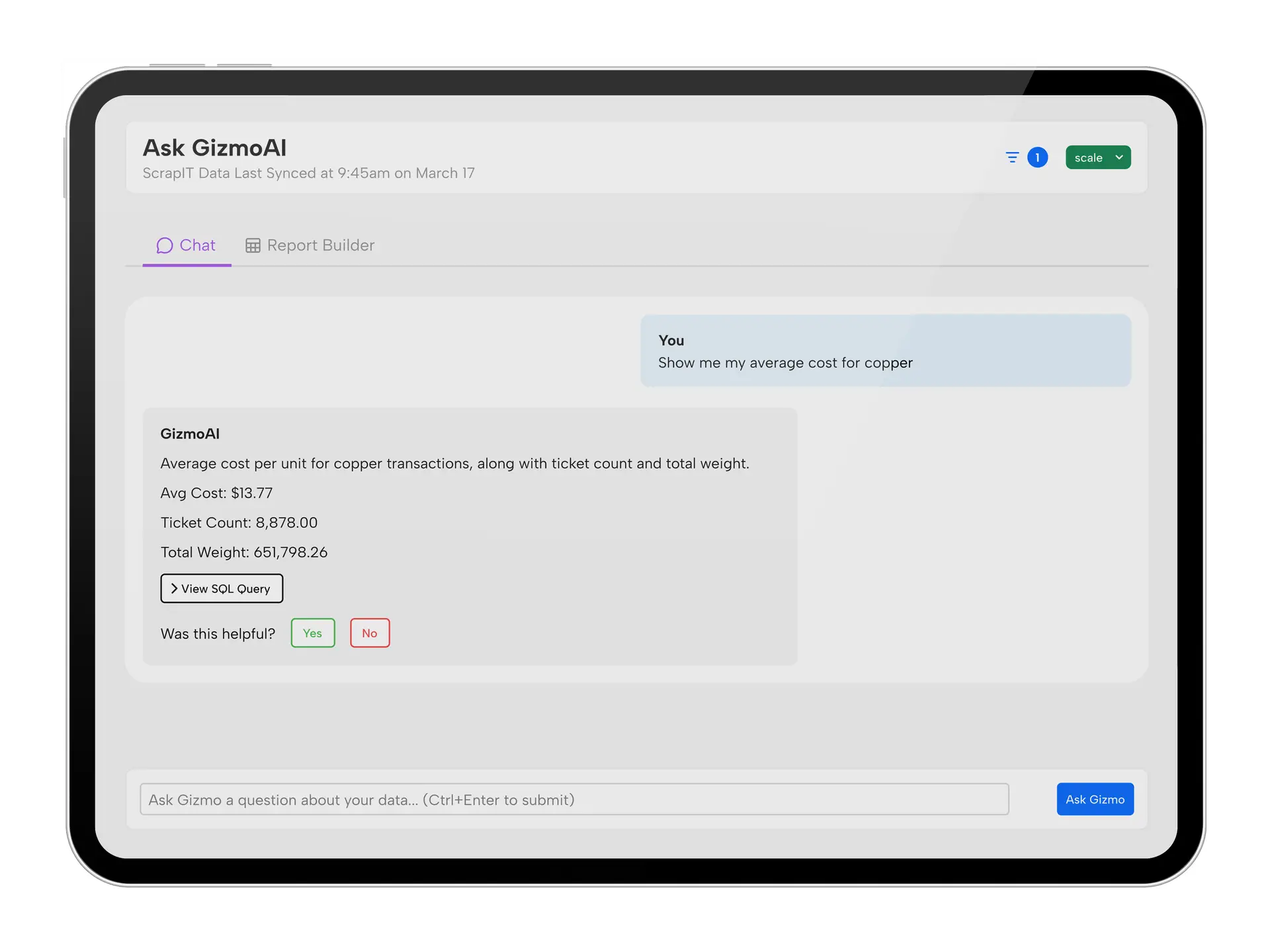
The image above is an example of a chat box for one of Quadshift’s environmental companies, ScrapIT Truck Scale. Operators can ask plain-language questions about their data, such as "show me my average cost for copper." They will get back the answer along with the underlying query so they can audit it. It replaces what would normally be a custom report request or a manual dig through a business intelligence tool.
Quadshift also develops custom-trained models built for specific tasks that a foundation model can't do well. This is rarer and more expensive, but for the right problem it's the only approach that works.
For example, one of Quadshift’s portfolio companies, Prairie Robotics, put smart cameras on garbage and recycling trucks. As those trucks go through their routes, a computer vision model identifies what's in every cart. That model was trained from the ground up on a huge library of labeled images, and it keeps getting better through a continuous feedback loop.
Want to go further with technology?
Adopt AI, digital tools or smart equipment and get preferential-rate consulting and financing. Learn more.