

Monthly Economic Letter
Keep abreast of key economic indicators.
Read moreIs Canada entering a new interest-rate hiking cycle?
For the first time since July 2023, the Bank of Canada has raised its policy rate, increasing it by 25 basis points to 2.50% on October 28. For Canadian businesses, the decision immediately raises a bigger question: is this a one-off adjustment, or the beginning of a new hiking cycle?
A hike based on where inflation is going
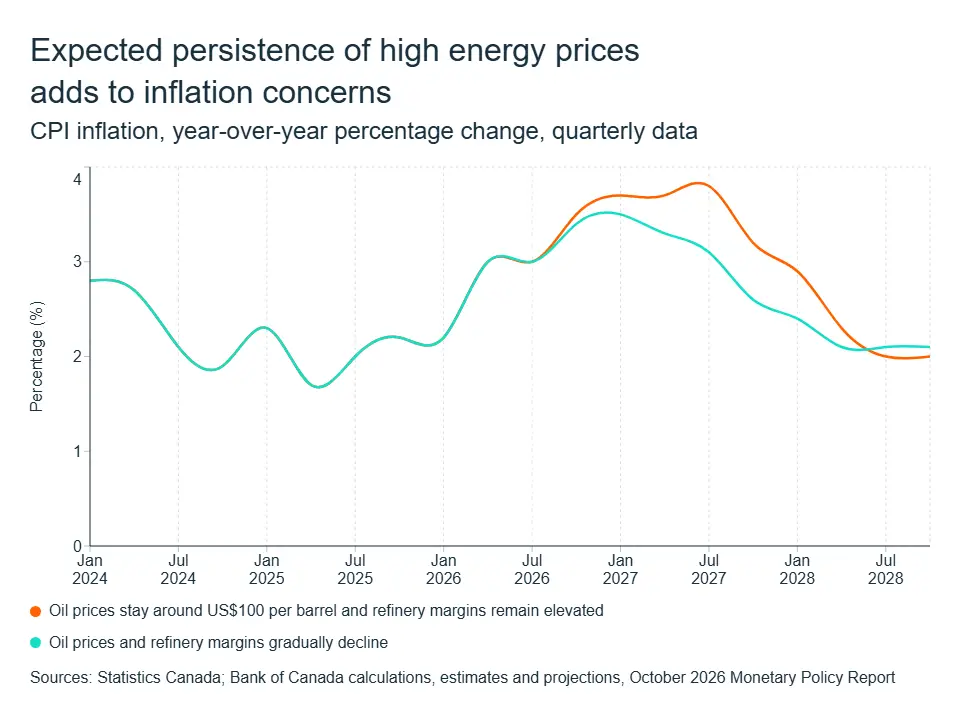
Inflation is already elevated, but the October decision is mainly about what the Bank expects to happen next. Higher oil prices and refinery margins have kept headline inflation around 3% since April. The Bank expects inflation to rise to about 3.5% by the end of 2026, remain above 3% through much of 2027 and return to around the 2% target only by mid-2028.
Until recently, the increase in inflation was concentrated mainly in gasoline. Core inflation remained close to 2%, suggesting that the economy was not experiencing a broad surge in domestic price pressure. That distinction allowed the Bank to leave the policy rate at the lower end of neutral and look through part of the energy shock.
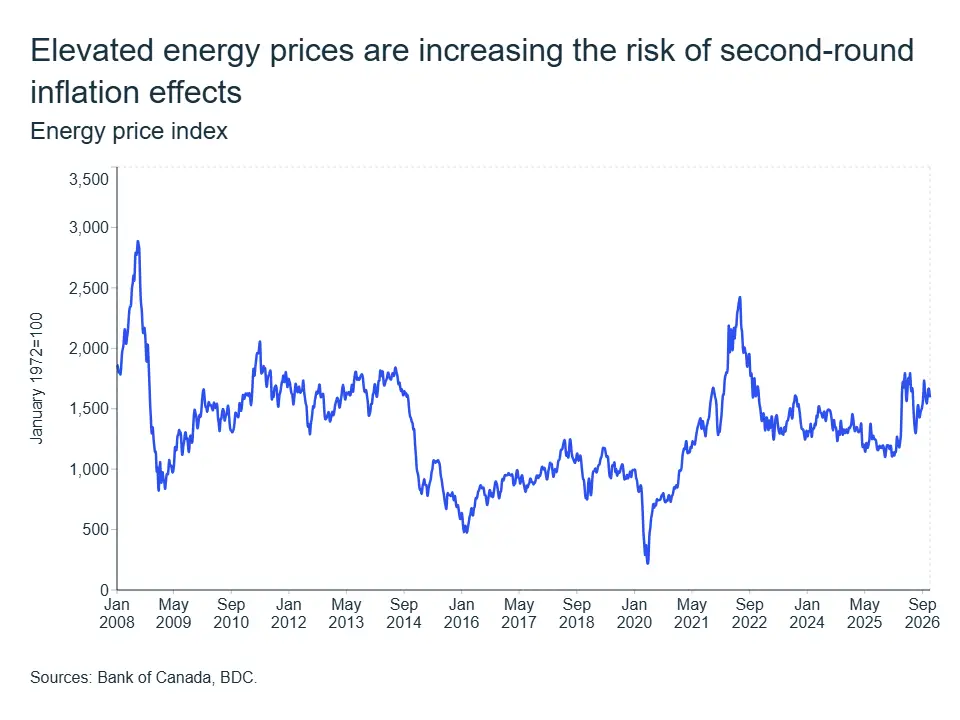
What has changed is the expected transmission of energy costs. Higher gasoline and diesel prices affect inflation first through what households pay at the pump. The second stage occurs more gradually: transportation, production and distribution costs rise, and businesses pass a larger share of those increases into the prices of goods and services. The Bank’s new outlook assumes that this pass-through will become more visible in consumer prices over the coming months as the transfer typically arise after seven to eight months pass the initial shock.
In other words, the Bank is not responding only to today’s inflation reading. It is trying to reduce the risk that external energy shock becomes generalized inflation even though inflation excluding gasoline sat at 2.2% in September.
Neutral rates give the Bank room to move
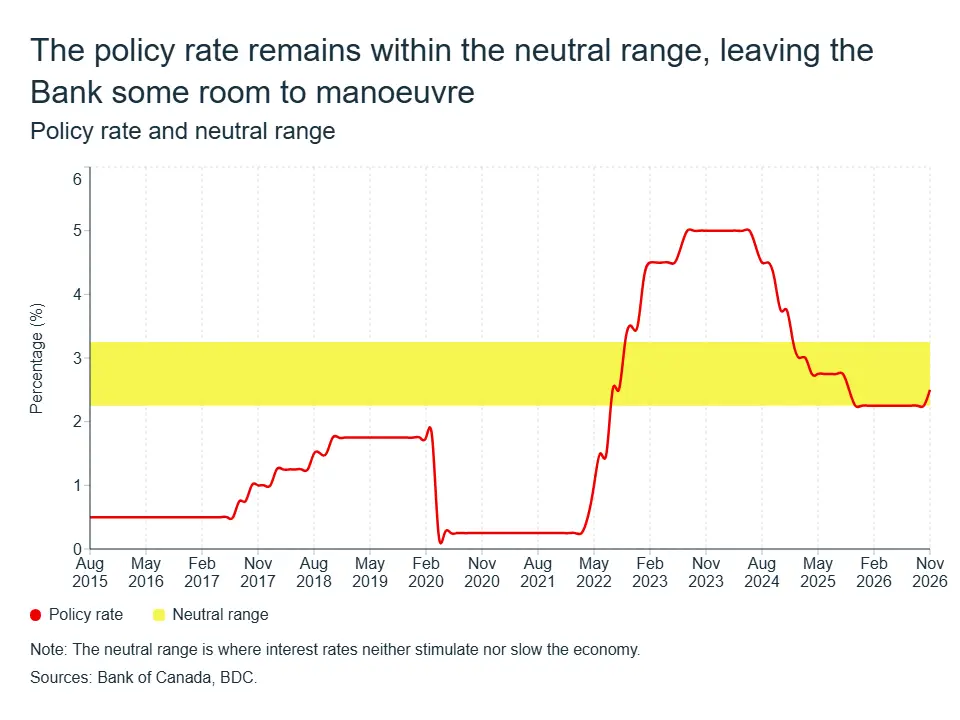
The level of interest rates matters for understanding what may come next. At 2.50%, the policy rate is only 25 basis points above the bottom of the Bank’s 2.25% to 3.25% neutral range. The move therefore removes a small degree of accommodation rather than imposing a strongly restrictive stance.
This gives the Bank room to “play around” within the neutral range as it weighs two competing risks. If it does too little and energy costs spill broadly into prices, inflation could remain above target for longer. If it does too much, higher borrowing costs could deepen the weakness still visible in employment, housing and trade-exposed sectors.
The Bank also has more room to act because the economy performed better than it expected through the middle of the year. Real GDP grew at an annualized rate of 3.3% in the second quarter, and the Bank estimates growth of about 2% in the third while data published since are pointing toward 1.3%. This is not an overheating economy, but it is resilient enough, in the view of the Bank, to place greater weight on inflation risk.
Does one hike make a cycle?
Not yet. The October increase marks a change in direction, but the length of the cycle remains uncertain. A sustained hiking cycle would require evidence that energy and import-cost pressures are spreading, that businesses are passing those costs more fully, or that economic activity is absorbing excess capacity faster than anticipated.
The reverse is also true. If oil prices and refinery margins retreat, and core inflation remains close to target, the Bank will have less reason to continue tightening. Additional tariffs could also weaken demand and make additional hikes more costly. Energy prices and Canada–U.S. trade relations are therefore the two most important variables for the rate outlook. Both have greater chances to improve following the U.S. Midterms results.
For now, the most reasonable interpretation is that October was an insurance hike with the door left open to more. The policy rate is low enough, relative to the neutral range, for the Bank to raise it again if its inflation forecast is confirmed. But the economy is soft enough that the Bank will need convincing evidence before moving far into restrictive territory.
Borrowing costs may stay higher even if the cycle is short
Entrepreneurs should also remember that the policy rate is only one part of financing costs. Short-term and variable borrowing rates respond relatively directly to the Bank of Canada. Fixed rates are influenced more heavily by government bond yields, bank funding costs, credit conditions and risk premiums.
That distinction is significant for indebted businesses because it explains why borrowing costs did not decline as quickly as the policy rate during the easing phase. It will matter again during any hiking phase: a small increase in the policy rate could be reinforced by higher bond yields or partly offset if markets conclude that inflation will eventually return to target.
What it means for entrepreneurs
- Plan around stable-to-higher rates, not renewed cuts. The direction of monetary policy has changed.
- Stress-test both financing costs and operating margins. The central risk is that fuel, freight and imported-input costs spread into a wider range of business expenses.
- Review pricing more frequently. Businesses should distinguish temporary energy surcharges from persistent cost increases and identify which costs can be absorbed, offset through productivity or passed on to customers.
- Keep investment decisions selective rather than freezing them. Projects that reduce energy use, transportation costs or labour intensity may become more valuable in a higher-cost environment.
- Compare variable and fixed financing carefully. The policy rate, bond yields and lender risk premiums may not move in the same direction or at the same speed.
Canada’s economy is still growing, but the pressure remains very real
Growth likely slowed, but the economy continued to expand
GDP stalled for a second consecutive month in August confirming that the strong spring rebound was never likely to become a smooth acceleration, especially while trade policy, population growth and business confidence remain unsettled.
The recent sequence tells the story clearly. Real GDP have been yoyoing from one quarter to the next. This is an economy moving forward, but at an uneven pace. Growth remains vulnerable to volatile trade and inventory movements, while the more durable sources of demand are being asked to do more of the heavy lifting.
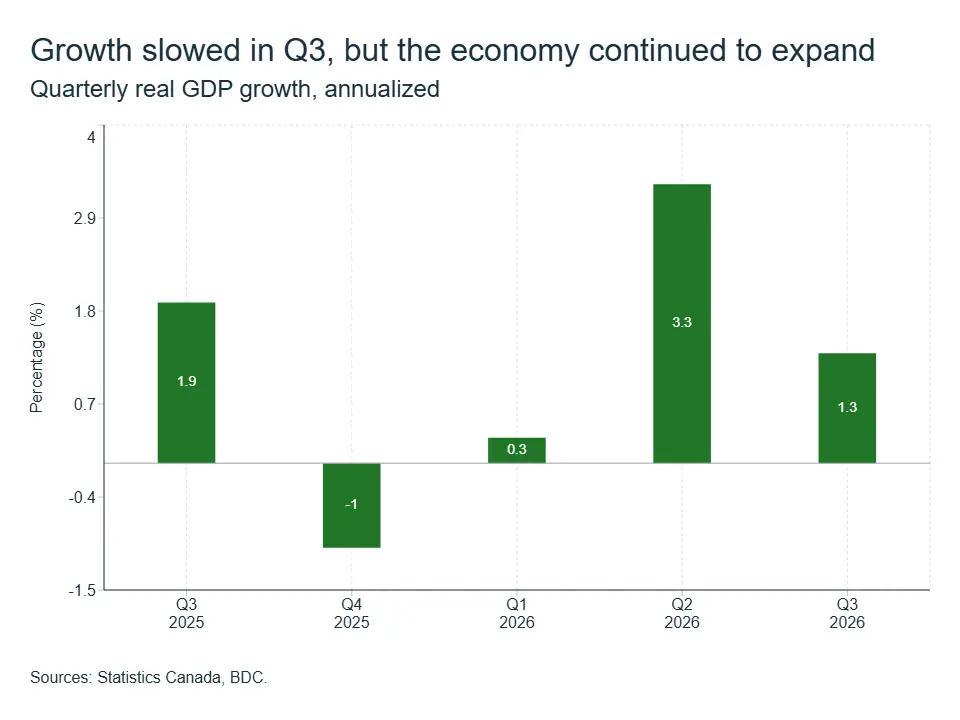
For businesses, the 1.3% estimate of Q3 is better read as modest demand growth than as evidence of a broad recovery. National output is rising, but the gains are not evenly distributed across sectors or regions. Service activity and resource-producing provinces continue to provide support, while trade-exposed manufacturers and their suppliers face a more difficult adjustment.
What it means for businesses
Plan for growth, but not for a surge in demand. Keep sales, inventory and staffing assumptions flexible, and avoid using one strong quarter as the baseline for 2027.
Trade volumes fell as the new tariff round reached the data
The trade picture weakened noticeably in September. In September, merchandise export volumes fell by 3.9%, compared with a 2.5% decline in imports from the previous month. Both sides of trade therefore moved lower after the late-summer introduction of new U.S. tariffs and Canadian counter-tariffs. The reversal is consistent with some activity having been brought forward into August before the measures took effect.
The decline in imports is not automatically good news for growth. Lower import volumes can improve the arithmetic contribution of net trade, but they may also signal softer domestic demand, weaker production needs or delayed investment.
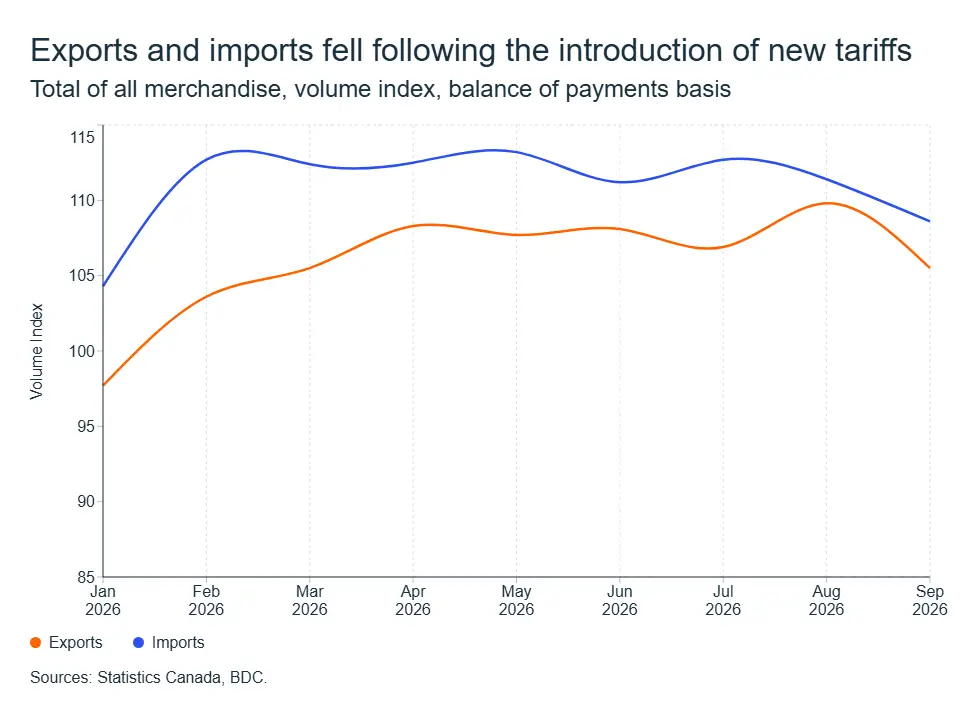
The fall in exports is more directly concerning because it points to weaker foreign demand and to the real cost of the new barriers for affected firms. Trade is likely to remain a source of quarterly volatility instead of a dependable growth engine.
Energy and metals complicate the picture. Elevated oil prices continue to support the value of Canadian energy exports, producer revenues and activity in resource-rich provinces, even when total export volumes weaken. Metals producers face the opposite mix: prices and demand for some commodities remain supportive, but tariffs on steel, aluminum and related products are disrupting orders, margins and North American supply chains. In other words, strong commodity prices can cushion the national totals without eliminating the strain on tariff-exposed manufacturers.
What it means for businesses
Trade-exposed firms should assess whether recent orders reflect lasting demand or purchases brought forward to avoid tariffs. Importers should review tariff classification, supplier concentration and working-capital needs before assuming that September’s lower volumes mark a lasting trend.
Inflation is 3.1%, but the national average hides very different realities
Consumer price inflation reached 3.1% nationally in September, but provincial readings ranged from 2.5% in Ontario to 5.7% in Prince Edward Island. Inflation was also high across Atlantic provinces and Manitoba. Quebec, British Columbia and Ontario, biggest provinces, were close to the national average at 3.1%. Such differences are not unusual in Canada because provincial spending baskets, energy markets, housing costs, taxes and regulated prices do not move in lockstep.
The disparities matter because they change the local economic outlook. Where inflation is higher, households lose more purchasing power and may pull back more sharply on discretionary purchases.
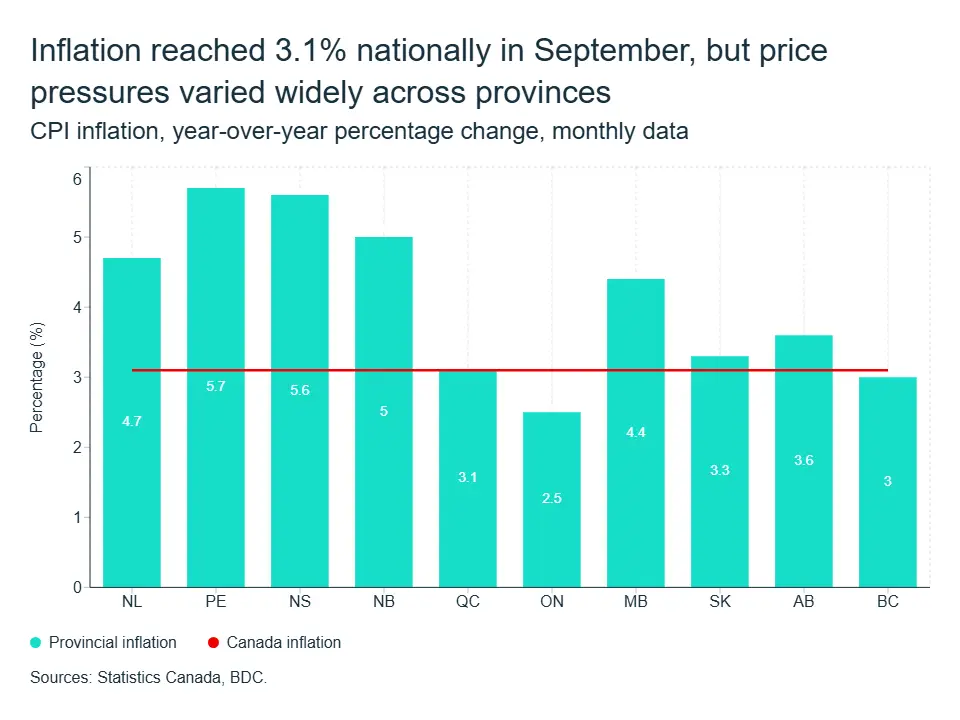
For producers, the same environment can mean higher wage demands, freight costs and input prices, but not necessarily enough pricing power to protect margins. A business selling into Atlantic Canada may therefore face a different demand-and-cost mix than one operating mainly in Ontario, even when both are responding to the same national inflation number.
The provincial spread also makes monetary policy harder to calibrate. The Bank of Canada sets one policy rate for the country, not ten provincial rates. It must therefore respond to the persistence and breadth of national inflation rather than to the highest provincial reading. Still, wide regional differences help explain why the same rate decision can feel very different from province to the other. The Bank’s October increase to 2.50% reflects concern that elevated energy and import costs could spread more broadly, even as core inflation remains closer to 2%, it might therefore result in difference impact on certain regions.
What it means for businesses
Use the inflation rate in your main markets, not only the Canadian average. Review pricing, wage budgets and sales forecasts by province, especially where energy, transportation and food costs are rising faster.
Employment is down year to date, with the private sector carrying more of October’s weakness
Employment fell again in October, but the monthly headline masks an important rotation. Private-sector employment declined by 52,500, while public-sector employment rose by 49,600.
The two movements nearly offset each other, leaving total employment little changed in October. For entrepreneurs, however, the private-sector decline is the more relevant signal because it points to continued caution in business hiring.
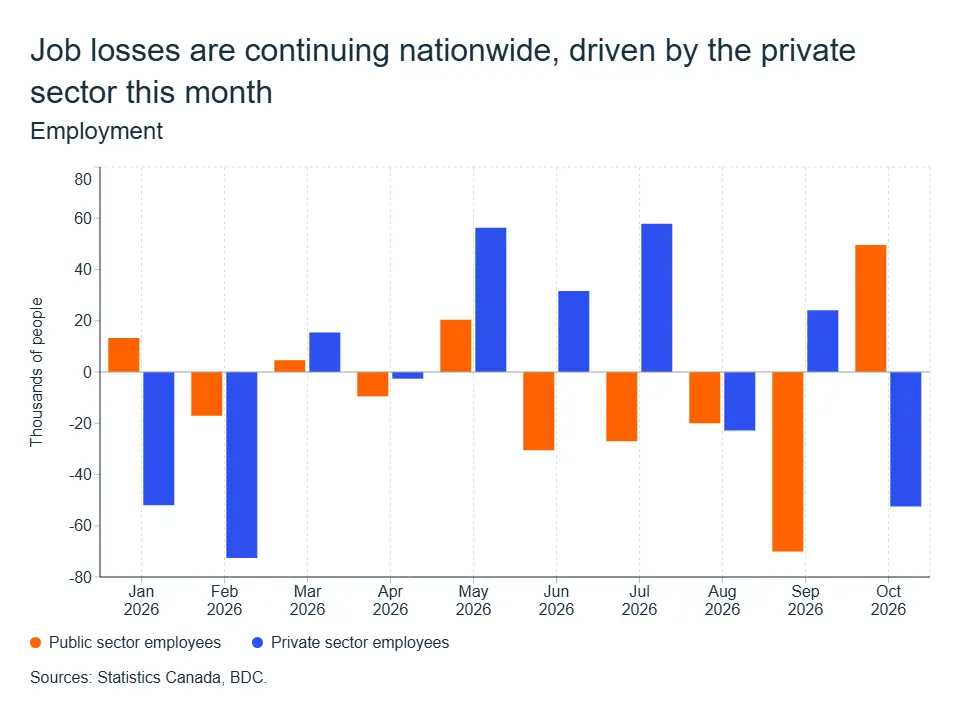
Since the beginning of 2026, employment has declined by roughly 103,000 positions on the basis of the monthly public- and private-sector changes. Public-sector employment is down by about 86,000 over that period, while private-sector employment is down by roughly 17,000. These cumulative figures should be interpreted cautiously because the monthly pattern has been exceptionally volatile with big swung losses and gains.
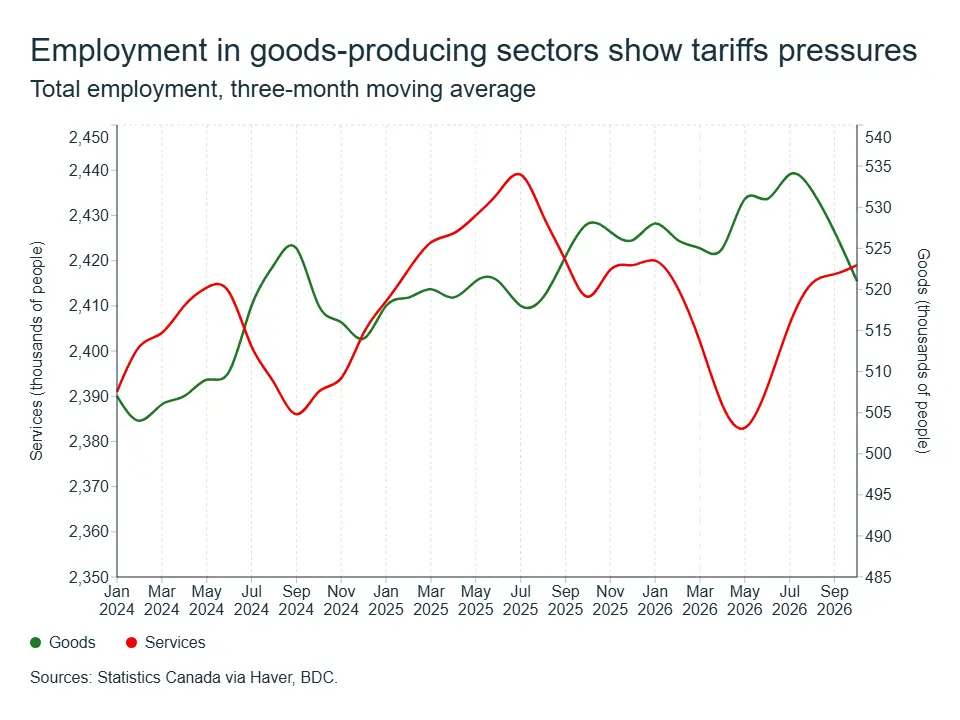
The volatility does not change the underlying message. Hiring momentum is weak, and employment in goods-producing industries remains under pressure as tariffs weigh on manufacturing and related activity. At the same time, slower labour-force and population growth mean Canada needs fewer new jobs each month to keep the unemployment rate stable than it did during the rapid population gains of recent years. The labour market is therefore softening.
What it means for businesses
Recruitment may become easier in some occupations, but broad skill shortages have not disappeared. Tie hiring to confirmed demand, protect critical talent and use temporary or phased hiring where visibility remains limited.
In a nutshell
Canada entered the final quarter of 2026 with positive but slower growth, weaker trade volumes and a labour market that remains unusually volatile. At the same time, 3.1% inflation is not a uniform national experience: the pressure on households and businesses differs sharply by province. That combination leaves the Bank of Canada balancing two uncomfortable risks. It must prevent energy and tariff-related costs from becoming persistent inflation without deepening weakness in trade-exposed sectors and private hiring.
For entrepreneurs, the economy is not sliding, but it is becoming more uneven. The practical response is to manage by market rather than by headline: distinguish volume from value in trade, compare inflation across provinces, monitor private-sector hiring and build financing and operating plans around modest growth with continued volatility.
British Columbia
British Columbia’s economy remains on a modest growth path, supported by major investment projects but constrained by slower population growth, trade uncertainty and weakness in the housing sector.
The labour market partially recovered in October, adding 12,300 jobs after losing 20,200 in September, while the unemployment rate edged down to 6.3%. However, the gains were entirely in part-time work, suggesting underlying labour market conditions remain soft. Consumer spending provided a more encouraging signal. Retail sales rebounded 2.1% in August, outperforming the 1.2% national increase. Still, slower population growth, a softer labour market and affordability pressures are likely to keep household spending growth moderate.
Housing activity also remains subdued. Home sales were down 4.7% year-over-year in August and remained 25% below their ten-year average, while average prices declined 1%. Affordability challenges and slower population growth continue to constrain demand.
Trade remains an important headwind, particularly for B.C.’s forestry and other export-oriented industries. However, the new 2026 federal budget provides some offset through support for forestry, infrastructure and major projects. B.C. stands to benefit from federal investments in transportation, LNG, mining and critical minerals, which should reinforce an already substantial pipeline of private and public investment.
Overall, B.C.’s economy remains resilient but is likely to grow below trend. Softer labour market conditions, housing weakness and trade risks will constrain near-term growth, while federal measures, major projects and a potentially more investment-oriented provincial policy environment provide some upside. BDC’s latest outlook forecasts real GDP growth of approximately 0.9% in 2026.
Alberta
Alberta should remain one of Canada’s strongest provincial economies for the rest of 2026 and heading toward 2027. Elevated oil production, greater access to non-U.S. markets and relatively limited tariff exposure will continue to support exports, investment and provincial revenues. Alberta’s crude exports outside the United States have already increased substantially, while oil production continues to trend upward.
The domestic economy is nevertheless expected to lose some momentum. In a lessen mater than the other provinces, population growth has slowed, reducing an important source of consumer demand and housing activity. Employment growth weakened in October, suggesting that household spending will provide less support in 2027 than it did earlier in 2026.
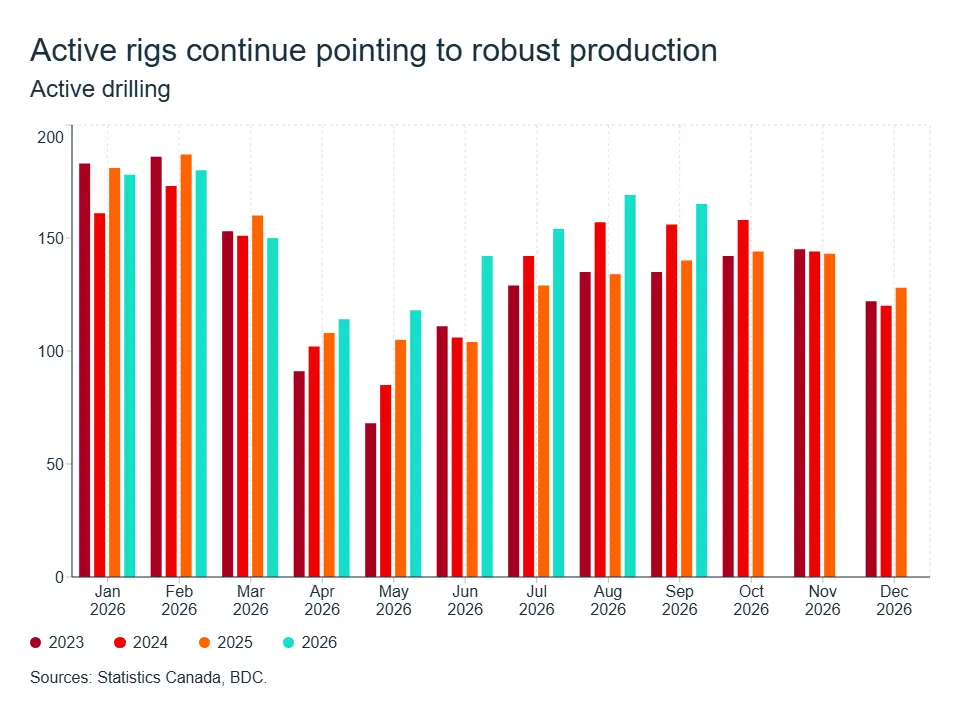
Overall, Alberta’s energy and export advantages should offset softer population and employment growth. BDC forecasts real GDP growth of 2.0% in 2027, the strongest rate among the provinces, following 2.4% in 2026.
Saskatchewan
Saskatchewan should remain among Canada’s stronger provincial economies into 2027, supported by its large resource sector and relatively limited exposure to U.S. tariffs. Exports were up 11.9% year-to-date through August 2026, with gains concentrated in commodities including energy, agricultural products and minerals.
Mining remains an important growth engine. Further investment in the sector should provide additional support into 2027, including BHP’s Jansen potash project and construction of NexGen’s Rook I uranium mine. Higher oil prices also favour Saskatchewan as an energy-producing province.
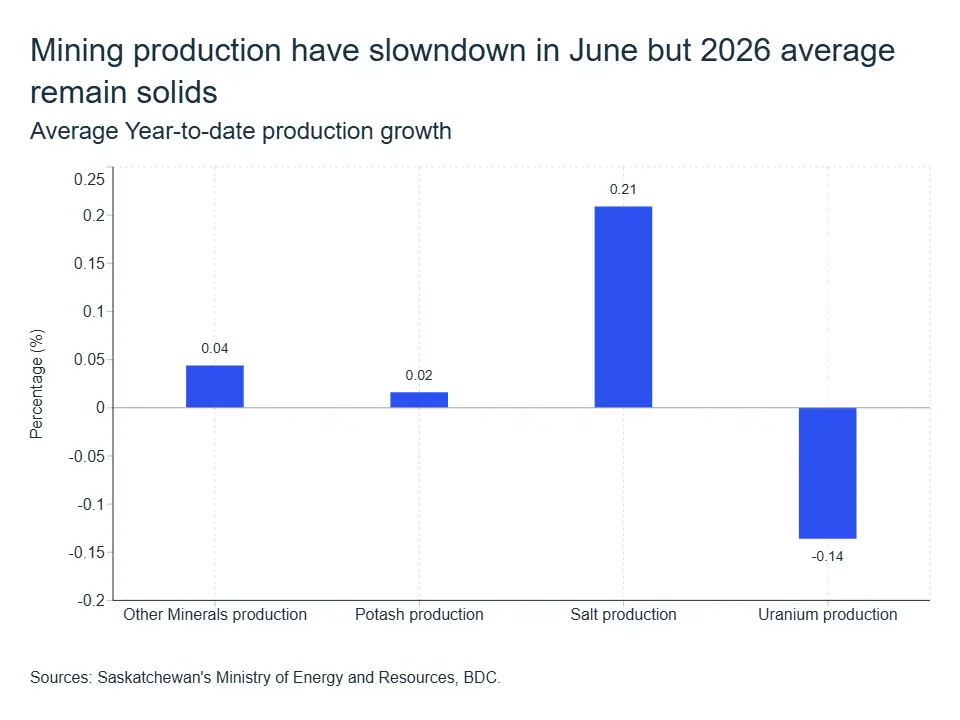
The picture outside resources is softer. Manufacturing sales were down 6.6% year-to-date, while slower population growth and a more moderate labour market should limit momentum from domestic demand and retail sales.
Overall, Saskatchewan’s commodity exposure, relatively low tariff vulnerability and major mining investments should keep growth comparatively strong in 2027. BDC forecasts real GDP growth of 1.7% in 2027, following 1.8% in 2026, placing Saskatchewan among the country’s growth leaders.
Manitoba
Manitoba is expected to see only a modest improvement in 2027. Its diversified economy provides some insulation from sector-specific shocks, but manufacturing and exports remain more exposed to trade tensions than in the resource-heavy Prairie provinces. Manufacturing is particularly important to the provincial economy, accounting for about 9% of real GDP.
The labour market weakened in September, with employment falling by 4,400 jobs, although the unemployment rate remained low at 5.0%. This relatively tight labour market should help support household spending, but slower population growth and elevated living costs are likely to limit the contribution from consumption ahead of 2027. Higher energy prices continue to act as an added cost for Manitoba households, but more significantly for the provinces’ transportation-intensive businesses.
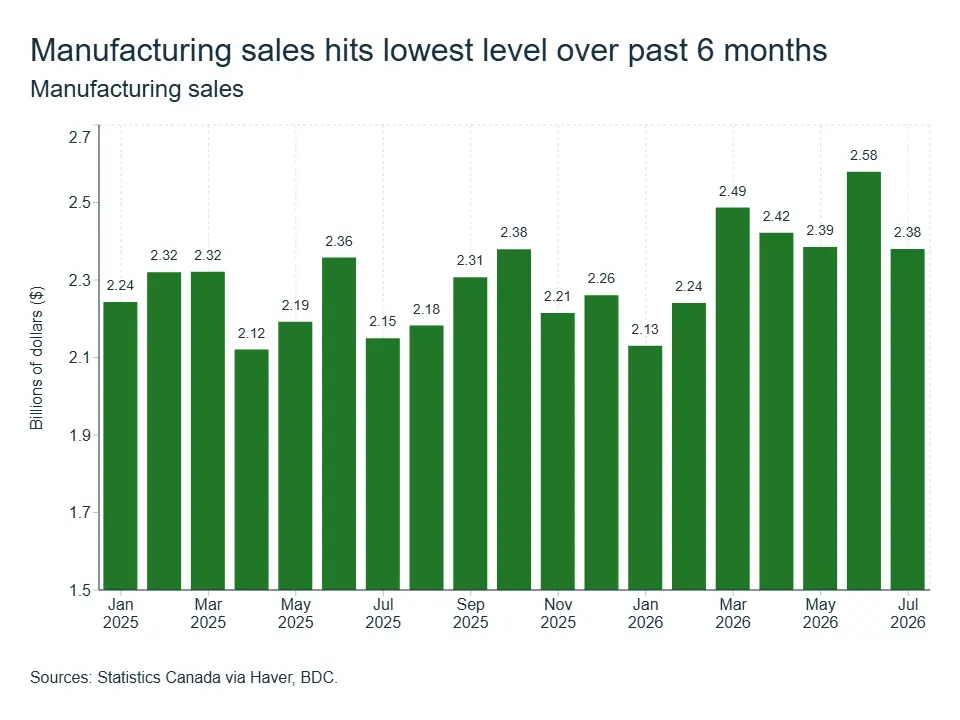
Investment should provide a partial offset. Infrastructure spending and Manitoba’s diversified industrial base should support activity, while easing trade uncertainty would particularly benefit its manufacturing and export sectors. Still, Manitoba lacks the strong commodity-price tailwind benefiting Alberta and Saskatchewan as the economy rely more heavily on Canada’s internal demand which has been easing. BDC therefore expects growth to improve only slightly, from 1.1% in 2026 to 1.2% in 2027, compared with 1.3% nationally.
Ontario
The labour market continues to slow. October employment data show that the economic slowdown is continuing. Employment fell by 8,600 jobs this month and by 46,700 since July. The retail trade, accommodation and food service sectors saw the sharpest declines. It appears that consumer spending is losing steam.
The good news is that, despite the new tariffs, the manufacturing sector is holding up. Exports in the affected sectors have declined, but employment across the manufacturing sector as a whole has been rising for several months. In addition, non-residential investment is growing, largely due to the Ontario government’s accelerated infrastructure spending, which is reflected in employment.
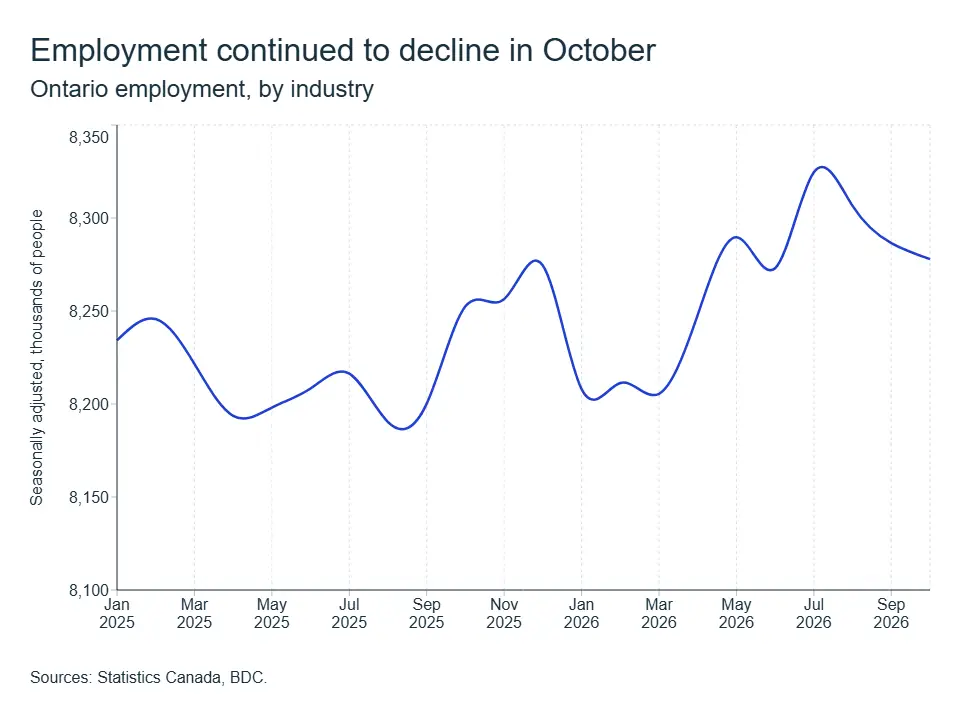
However, residential construction remains weak, and third-quarter data show a decline. Slow population growth in Ontario is limiting the sector’s growth, and rising interest rates will likely further constrain growth. We will have to wait until 2027 to see more positive results. We still forecast positive, albeit modest, GDP growth of 0.6% in 2026. Growth will improve in 2027.
Quebec
Quebec’s economy is still slowing. GDP shrank 0.1% in July, the province seemed to have started the third quarter on a weak note. Goods hit by tariffs have had mixed results this year: in the first nine months, lumber fell 9%, while steel rose 3% and aluminum rose 22%. But overall, trade was slow in Q3, with total exports up just 0.4% from Q2.
Jobs rose slightly in October. Most of the gains came from the public sector (+1,300), education (+1,700) and healthcare services (+1,100). Still, employment remains lower than at the start of 2026.
Retail sales are up 3.6% so far this year (before inflation). But with inflation at about 3% in Quebec, real gains have likely been small. This points to more moderate household spending.
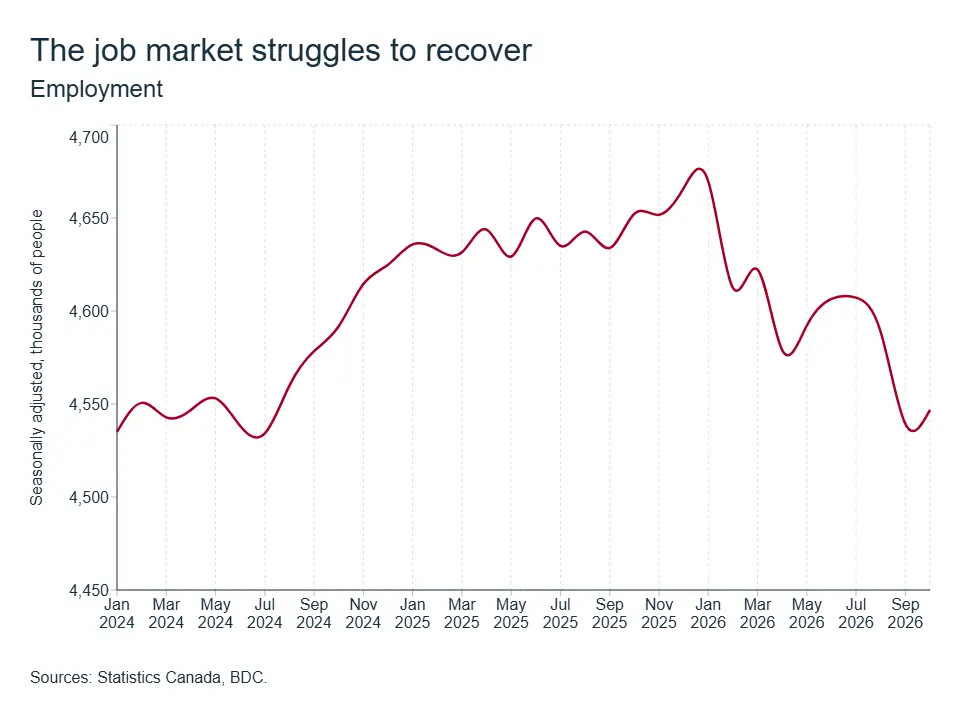
Households are also holding back on big purchases. Home sales fell in September and are down 5.3% so far this year, even though prices are up 4.6% over the same period. Slower population growth, higher interest rates and ongoing uncertainty will keep weighing on the housing market.
Weak non-residential investment has also held back the economy this year. So far, investment in industrial buildings is down 12%, and investment in institutional and government buildings is down 21%. Investment in commercial buildings has stayed flat.
Growth is still on track for 0.6% this year, held back by tariffs, slower population growth and weaker investment.
Nova Scotia
Nova Scotia’s economy is shifting from its strong pace in 2025 to more moderate growth. The province faces several challenges, including slower population growth, high inflation and trade tariffs.
Trade gains seem to have stalled in September. Exports rose in August but fell in September, leaving year-to-date growth at 0.8%. Exports to the United States are up 2.7% so far this year. However, tariffs remain a risk for sectors that rely on the U.S. market.
At home, the picture is more mixed. The job market has cooled but is still solid. Employment rose slightly in October, and the unemployment rate dipped from 6.3% in September to 6.2%.
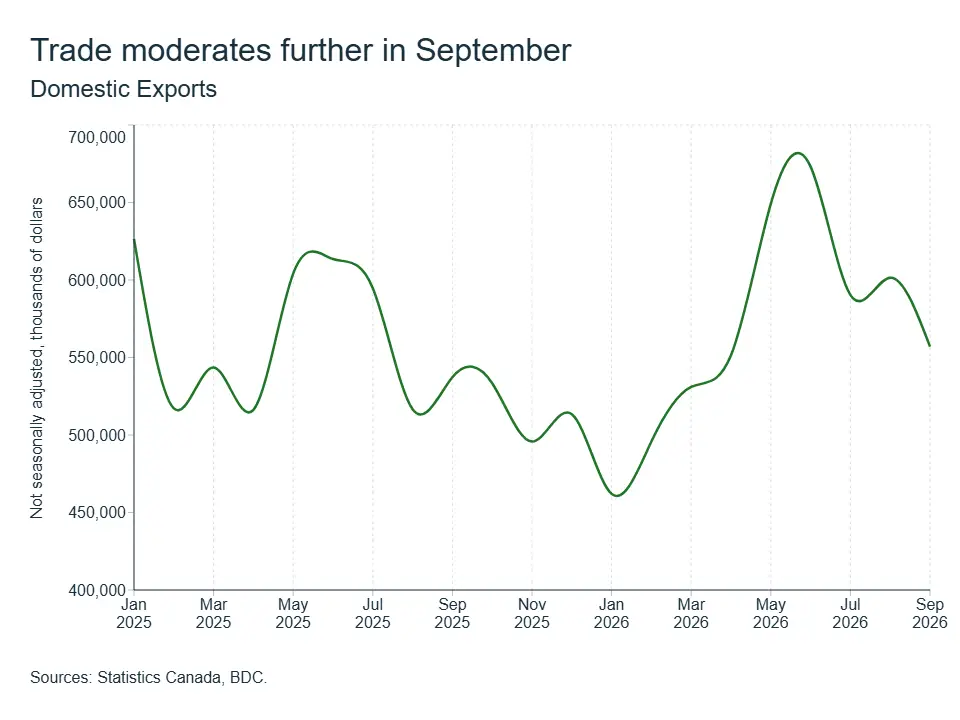
Retail sales were up 5.7% this year through August. However, inflation in Nova Scotia reached 5% in September, still higher than in Canada as a whole.
Some areas are helping growth, such as tourism and investment in institutional and government buildings (up 24% so far this year).
Over the longer term, defence, shipbuilding and other projects such as Wind West should support the economy. Our forecast is unchanged: we expect real GDP to grow by about 1.3% in 2026.
New Brunswick
New Brunswick’s economy is on track for moderate growth this year. We are keeping our 2026 real GDP growth forecast at 1.2%.
After a drop in September, employment rose in October with 2,000 new jobs, a sign of a somewhat uneven job market. Employment is still below its peak from March.
Consumer spending has held up despite the mixed job market. Retail sales were up 4.9% this year through August. Ongoing population growth is likely supporting spending and should continue to boost overall demand.
Manufacturing shipments have jumped 21% since early 2026, likely due mostly to higher oil prices. However, temporary shutdowns could hurt sales in the fourth quarter.
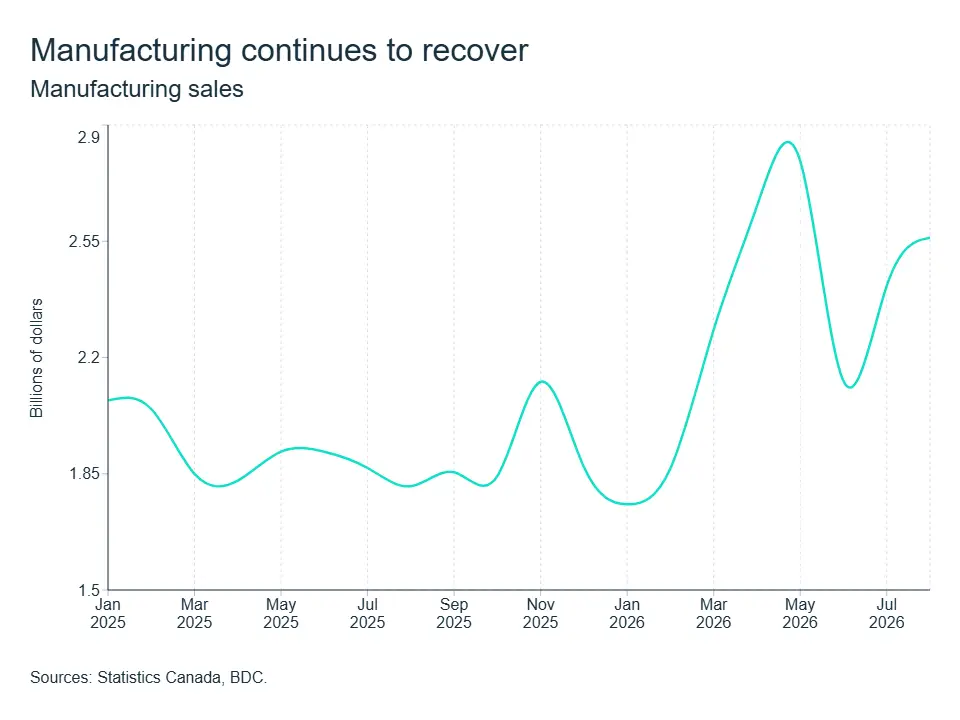
Exports are up about 14% so far this year, led by energy and seafood. Higher oil prices could keep the value of exports rising through the fourth quarter.
The province is working to attract investment in critical minerals, energy, data centres and advanced manufacturing to reshape its economy. If these efforts lead to firm commitments, they could bring major economic gains to New Brunswick in the years ahead.
Prince Edward Island
Prince Edward Island’s economy keeps growing, but it faces slower population growth and ongoing trade tensions. Real GDP growth is expected to reach 1.5% in 2026, faster than the national average. Population growth slowed to 0.8% in the second quarter compared with a year earlier, which could weigh on local demand.
The job market also lost some steam in October. About 1,300 jobs were lost, and the unemployment rate rose slightly from 7.3% to 7.4%.
Consumer spending is holding up well. After several months of gains, retail sales fell 0.6% in August, their first monthly drop of 2026. Even so, sales were 9.7% higher than a year earlier, a sign that households are still spending.
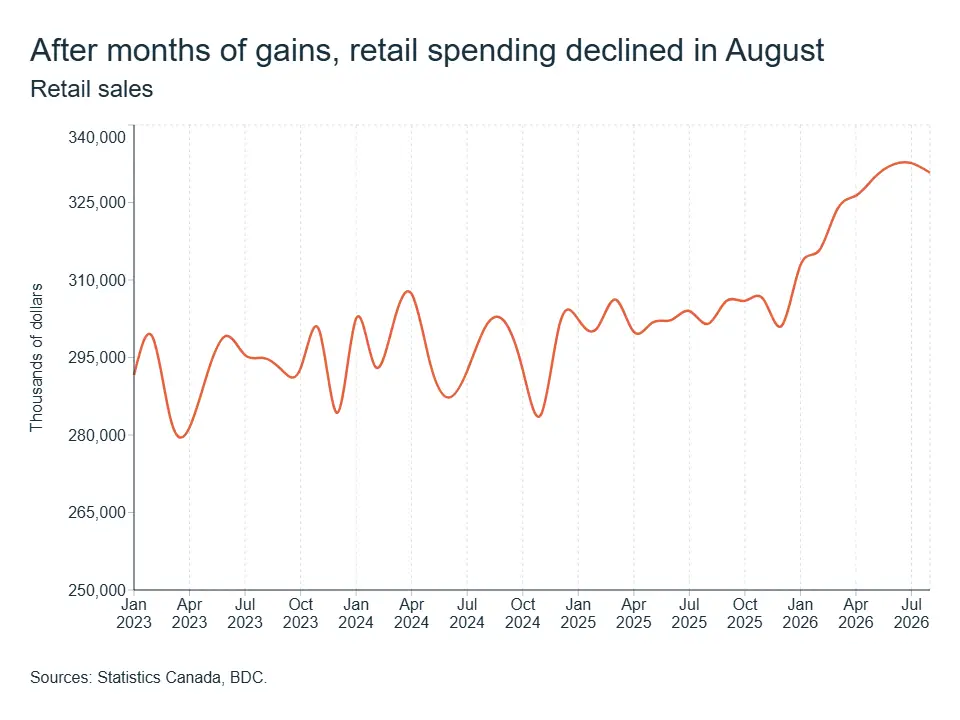
Exports are also improving despite trade tensions. Total exports rose 7.6% this year through September. Exports to the United States fell 4.7%, while exports to China rose 19.5%. Manufacturing is still struggling, with sales down 1.6% this year through August.
Looking ahead, steady consumer spending and stronger exports should keep supporting the Island’s economy. But slower population growth, tariffs now in effect and weak exports to the United States could limit growth in the coming months.
Newfoundland and Labrador
Newfoundland and Labrador is on track to lead all provinces in growth in 2026, with GDP expected to grow 3.0%.
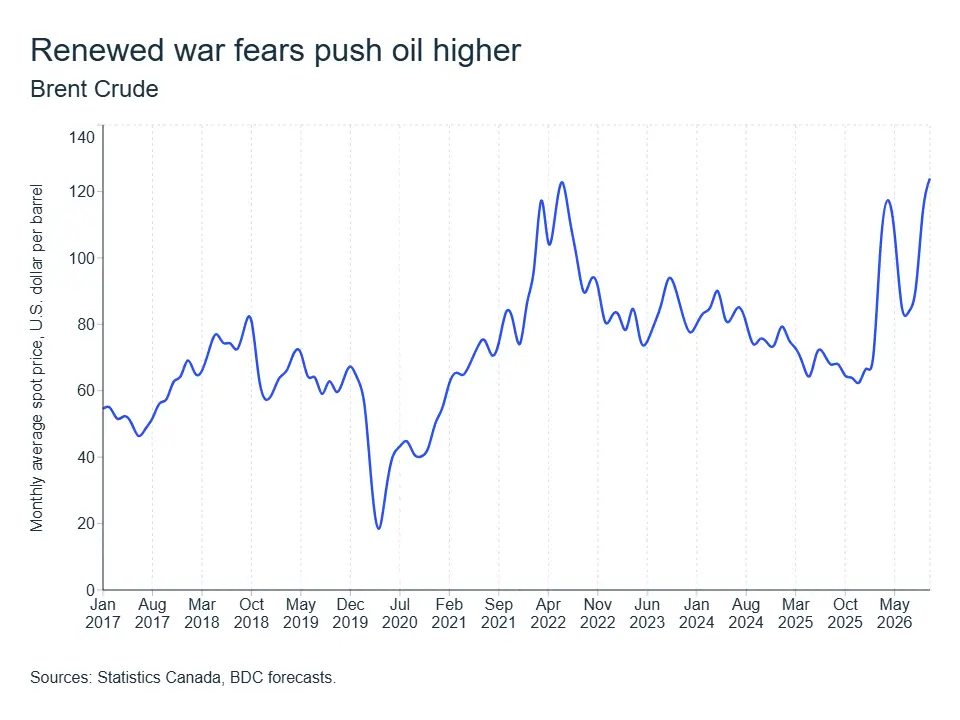
Much of this growth comes from the resource sector. Renewed fears of war have pushed Brent crude close to the highs seen when the US-Iran war began in the spring.
Beyond higher production and oil prices, offshore oil exploration is picking up again. Shell is restarting its offshore activity, with six licences covering more than 15,000 km² and over $210 million committed to exploration. This is good news for the province’s energy sector.
Employment has risen for two months in a row since September, making up for all the jobs lost between March and August. Gains were widespread, in both goods- and services-producing sectors.
Retail sales were up 4.5% this year through August, despite two monthly declines in a row. Housing construction has also picked up, with starts up 17% over the same period, although home sales remain uneven.
Overall, strong commodity prices, solid exports and ongoing investment in resource projects are driving growth this year.