

Monthly Economic Letter
Keep abreast of key economic indicators.
Read moreTariffs are raising the stakes for Canadian businesses
A targeted shock, not a recession trigger
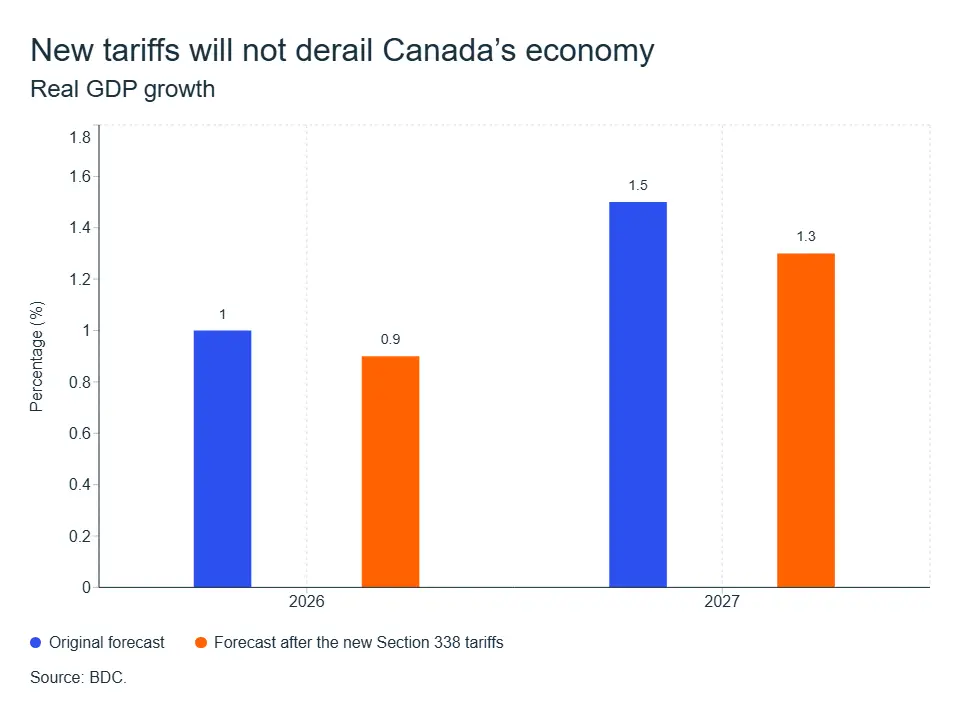
Canada is facing another tariff shock, but not necessarily an economy-wide crisis. The latest U.S. measures affect goods representing about 5% of Canadian exports. BDC Economics has consequently revised its real GDP growth forecast only modestly, from 1.0% to 0.9% in 2026 and from 1.5% to 1.3% in 2027. Growth is weak and below Canada’s potential rate, but it remains positive. In other words, tariffs are likely to slow the economy rather than push it into recession.
That distinction matters. Canada’s economic exposure is broad enough to affect growth, but too concentrated to produce the kind of generalized contraction normally associated with a recession. Household and government spending should continue to support activity, while the adjustment is borne primarily by business investment, exports and industries directly covered by tariffs.
Small businesses face the sharpest pressure
For entrepreneurs, however, national averages provide only limited comfort. Over 25,000 Canadian businesses are estimated to operate in sectors covered by the new measures, and approximately 5,500 of them export to the United States. These firms are spread across roughly 100 industries (based on six-digits NAICS), demonstrating that the shock is more diversified than the headline categories suggest. More importantly, smaller firms account for more than two out of every five businesses identified as directly exposed.
Business size changes how a tariff shock can be managed. A larger exporter may be able to redistribute production, negotiate with multiple customers or temporarily compress margins. A smaller company is more likely to depend on a limited number of contracts and have less room on its balance sheet. A single delayed order can quickly translate into weaker cash flow, reduced inventory purchases or postponed hiring. This is why the most important effect may not be the customs charge itself, but the sequence it initiates: lower orders weaken cash flow, weaker cash flow limits borrowing capacity, and tighter financing constrains the investment required to improve competitiveness.
Exposure is concentrated in key supply-chain sectors
The sectoral composition of the shock reinforces this concern. Outside agriculture, the potentially exposed businesses to this latest tariffs round include exporters in miscellaneous manufacturing, in measuring, medical and control devices, in plastics, in fabricated metal products and in general-purpose machinery manufacturing. These are not merely final goods producers. Many supply specialized components, capital equipment or intermediate inputs to other companies. The economic impact can therefore travel along supply chains through fewer orders, longer payment cycles and weaker demand for transportation, maintenance and professional services.
Regional exposure tells only part of the story
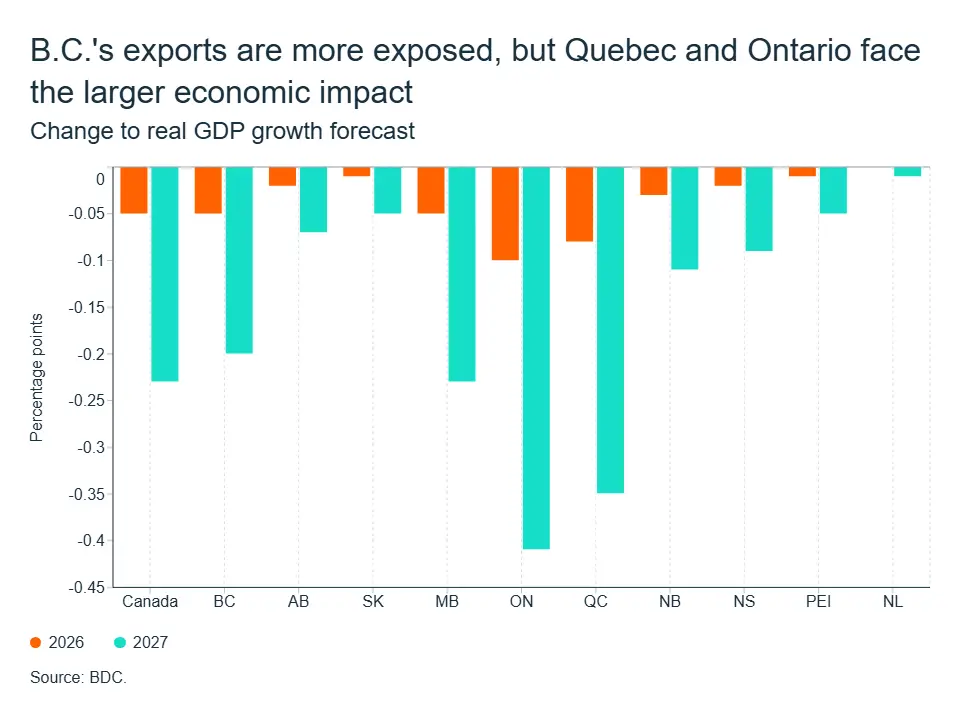
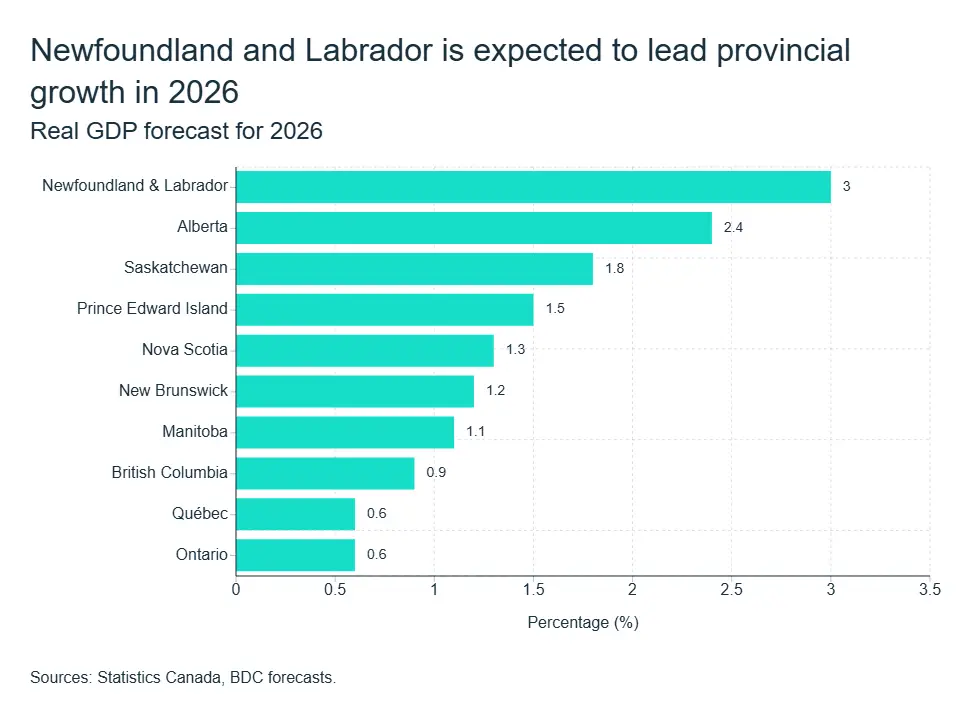
The consequences will also vary considerably by province. Products affected by the new tariffs represent an estimated 14% of British Columbia’s exports to the U.S., compared with 11% in Quebec and 9.5% in Ontario. Yet product exposure alone does not determine the economic impact. U.S.-bound goods exports represent only about 7% of British Columbia’s GDP, versus nearly 20% in Quebec and Ontario. This means British Columbia has the largest affected share of exports, while Quebec and Ontario have more economic activity tied to the U.S. goods market. BDC consequently forecasts real GDP growth of only 0.6% in both Quebec and Ontario in 2026, compared with 0.9% in British Columbia and 2.4% in Alberta
Costs will ripple beyond exporters but risk won’t expand to inflation
Tariffs also affect companies that do not export. Canadian countermeasures can raise the price of imported machinery, equipment and intermediate inputs. Remissions and exemptions should limit the pass-through to consumer prices, but the burden may remain significant for individual businesses. A firm unable to pass higher costs to customers must accept a lower margin as these tariffs must go somewhere. A firm that raises prices risks losing sales in an already low demand environment. A firm that delays purchasing new equipment protects near-term liquidity but may sacrifice future productivity. Overall effect on inflation is therefore expected to be modest while higher input costs will hit directly affected businesses.
The exchange rate can soften one side of this pressure while reinforcing the other. A weaker Canadian dollar increases the value of U.S.-dollar revenues when converted into Canadian dollars and generally enhances the competitiveness of Canadian exporters by making their products relatively less expensive for U.S. customers. But it simultaneously increases the cost of imported capital goods and components, particularly for firms relying on imports that are also subject to Canadian counter-tariffs.
For a business that both exports and imports, the relevant question is not whether a lower dollar is “good” or “bad,” but whether its U.S.-dollar revenues exceed its foreign-currency costs, and whether exchange-rate movements occur before contracts can be repriced.
The bigger risk is weaker investment
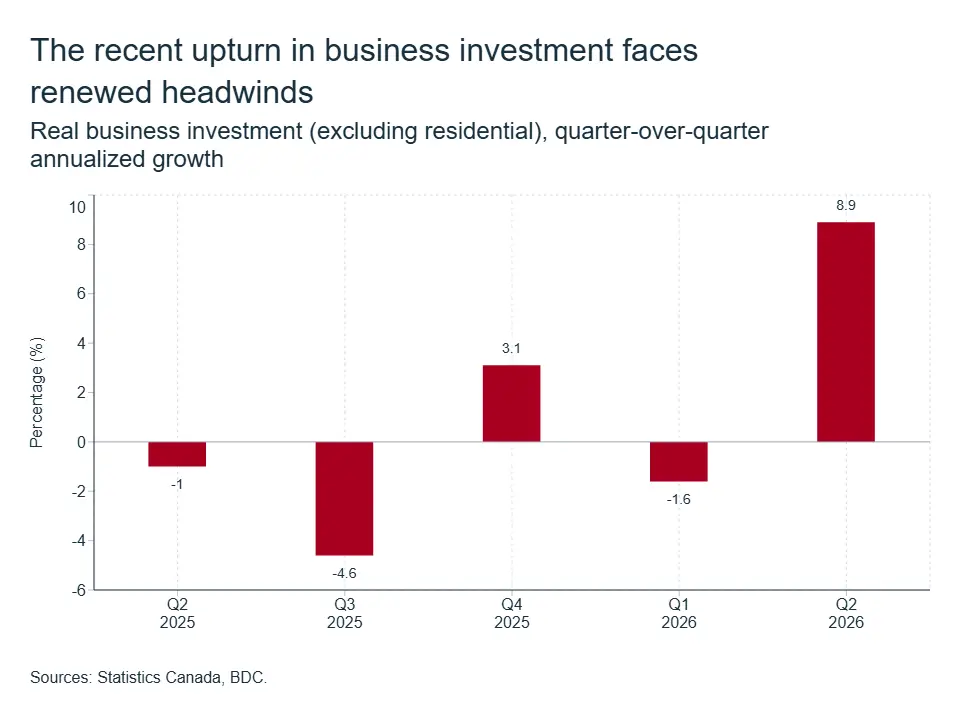
The larger macroeconomic risk is that this combination of trade costs and uncertainty further delays investment, extending a period of weak capital spending that has seen little to no growth since the beginning of the U.S. tariff turmoil. Canadian businesses non-residential investment declined 1.6% in the first quarter of 2026 before increasing 8.9% in the second quarter, leaving an uneven trajectory rather than a sustained expansion for the year. A July 2026 BDC survey nevertheless showed a positive balance of investment intentions of 22%, moreover, 58% of these businesses were confident they would proceed with planned investment over the following 12 months. The tariff escalation now threatens to interrupt that improvement just as financing objectives were shifting from maintain operations toward growth and productivity.
Manage uncertainty without stopping growth
This is the central economic issue for entrepreneurs. Tariffs create an immediate cost, but chronically weak investment creates a lasting competitiveness problem. Businesses cannot control trade policy, but they can measure their exposure and adapt. That means identifying U.S.-dependent revenue, separating tariff-sensitive inputs from other costs, testing margins under different exchange-rate and tariff assumptions, and prioritizing investments that reduce unit costs or broaden the customer base. These actions will not eliminate the shock, but they can prevent a temporary trade disruption from becoming a permanent loss.
Canada’s economy is likely to absorb the latest measures because most exports remain unaffected and domestic demand continues to provide a floor under growth. That resilience should not be mistaken for immunity. For thousands of manufacturers, machinery producers, plastics firms and specialized exporters, the adjustment will be immediate and financially demanding. The best businesses to navigate it will be those that protect liquidity without abandoning productivity, diversify without losing sight of their strongest markets, and treat uncertainty as a variable to manage rather than a reason to stop investing. The good news is that Canadian businesses have been growing more and more accustomed to the trade dispute and last year debacle is proof that the Canadian economy can continue to grow through the trade-storm.
What it means for entrepreneurs
- Leave the headlines behind and estimate your exposure to these new tariffs. Assess reliance on U.S. customers, tariffed products and imported inputs.
- Protect productive investment by focusing on projects that lower unit costs and strengthen your competitiveness.
- Stress-test costs and cash flow. Use free tool to model tariffs, exchange rates, margins and financing needs together.
- Build resilience into the business while not an easy task under stress, it’s never too late to start diversifying your customers and suppliers while protecting core markets.
Canada avoided recession all together, but the economy is losing altitude again
Canada escaped recession, but not slow and volatile growth. The 3.3% Q2 rebound was welcome and domestic demand improved, yet weaker July trade, the ongoing energy-driven inflation pickup and a 41,700-job decline in August show that the recovery remains volatile and vulnerable.
The rebound is real, but the composition calls for caution
Canada’s economy performed better in the first half of 2026 than previously thought. First-quarter real GDP growth was revised from a 0.1% annualized contraction to a 0.3% increase, and growth accelerated to 3.3% in the second quarter. That combination removes the technical-recession narrative that took over headlines at the start of the year. The pickup was also broad enough to matter; household spending rose at a 3.3% annualized rate in Q2, residential investment rebounded 10.4% after falling 10.6% in Q1, and business investment strengthened as spending on non-residential structures rose 6.5% and machinery and equipment jumped 22.6%.
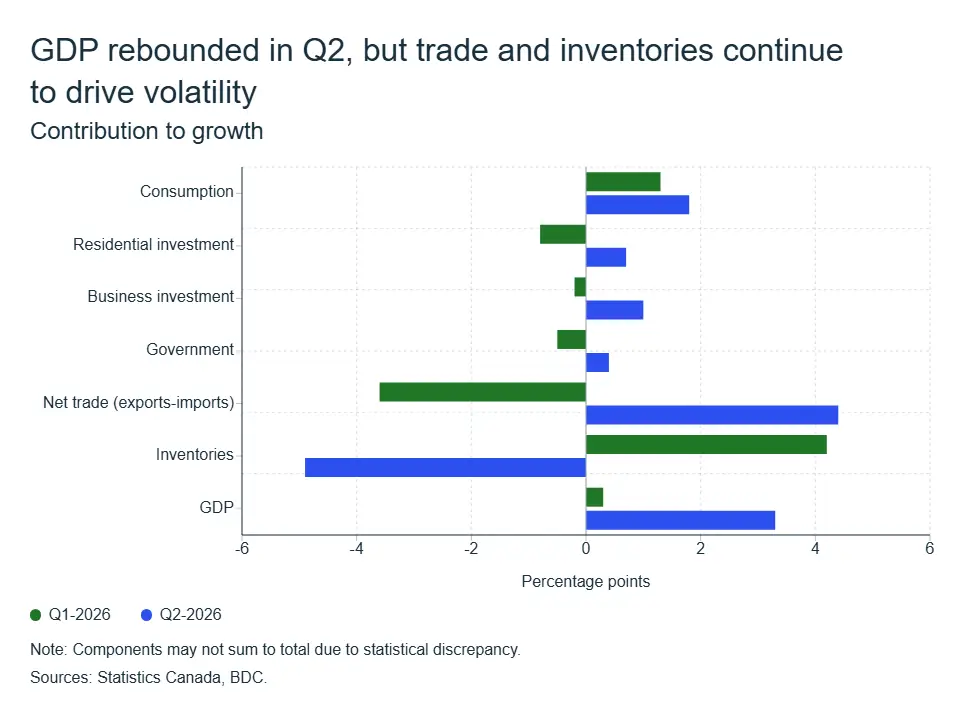
The contribution-to-growth graph nevertheless shows why the headline should not be read as the beginning of a smooth expansion. In Q1, net trade subtracted 3.6 percentage points from growth while inventories added 4.2 points. In Q2, those movements almost completely reversed: net trade added 4.4 points while inventories subtracted 4.9 points. These two components therefore largely offset one another over the first half of the year and generated substantial quarter-to-quarter volatility. The more durable, and fundamentals, components were all largely positive contributors to Q2 namely consumption and investment. The economy continues to expand, but its strength still depends partly on large swings in trade and stocks rather than a settled, self-sustaining acceleration.
July trade data point to a softer start to the third quarter
The first data available for Q3 are less encouraging than one would hope. The merchandise import-volume index rose from 110.4 in June to 112.8 in July, a 2.2% monthly increase. Over the same period, the export-volume index fell from 108.5 to 106.8, a 1.6% decline. The gap between the two indices therefore widened to 6.0 points in July. In practical terms, Canada bought more goods from abroad while shipping fewer overseas, making net trade a negative contributor to growth at the start of the latest quarter.
The July reversal also puts the strong Q2 trade contribution in perspective. In Q2, exports of goods and services surged 15.1% annualized while imports increased only 2.3%, allowing net trade to add to GDP growth.
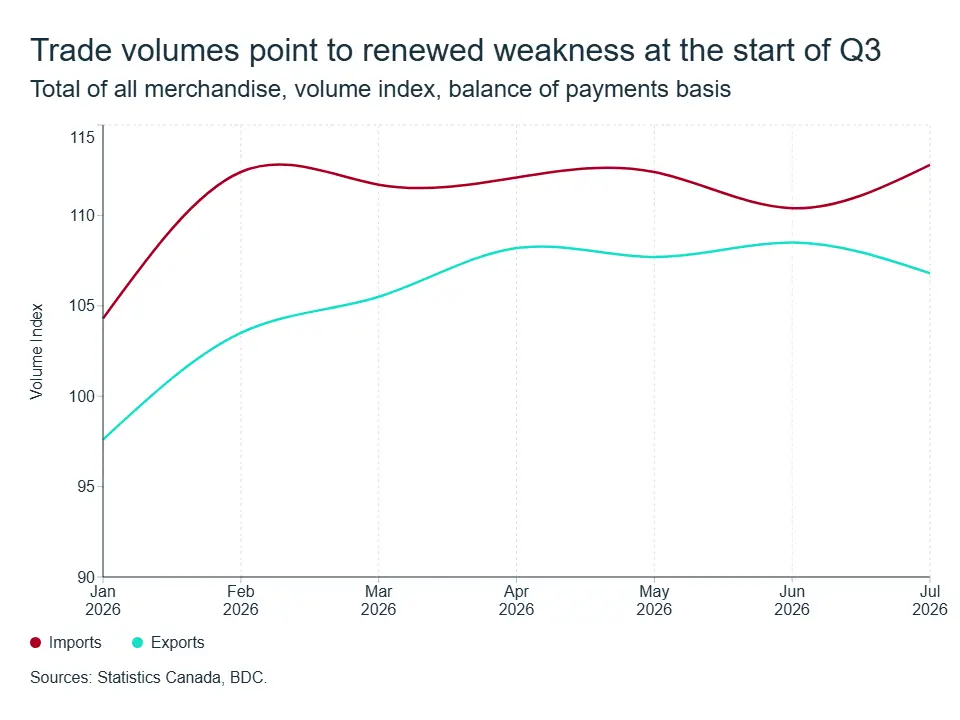
July moved in the opposite direction. Export volumes remained above January’s index level, but they were slightly below their June peak. Import volumes, by contrast, reached their highest reading in the seven months shown. One month does not determine the quarter, but the starting point suggests that trade is more likely to restrain Q3 growth than reproduce Q2’s large boost. And that was at a period where trade talks with our southern neighbour were still looking promising.
Inflation is contained outside energy, but the Bank of Canada remains cautious
The Bank of Canada maintained its policy rate at 2.25%. The inflation data explain why the Bank can remain on hold, but also why it is not signalling an immediate easing cycle. Headline inflation reached 3.0% in July, up from 2.8% in June and 1.8% in February (last month before the conflict in Iran took over energy markets). Inflation excluding energy was much steadier at 2.2% in July. The gap between headline inflation and inflation excluding energy shows that the recent acceleration is concentrated in energy rather than spread broadly across the consumer basket.
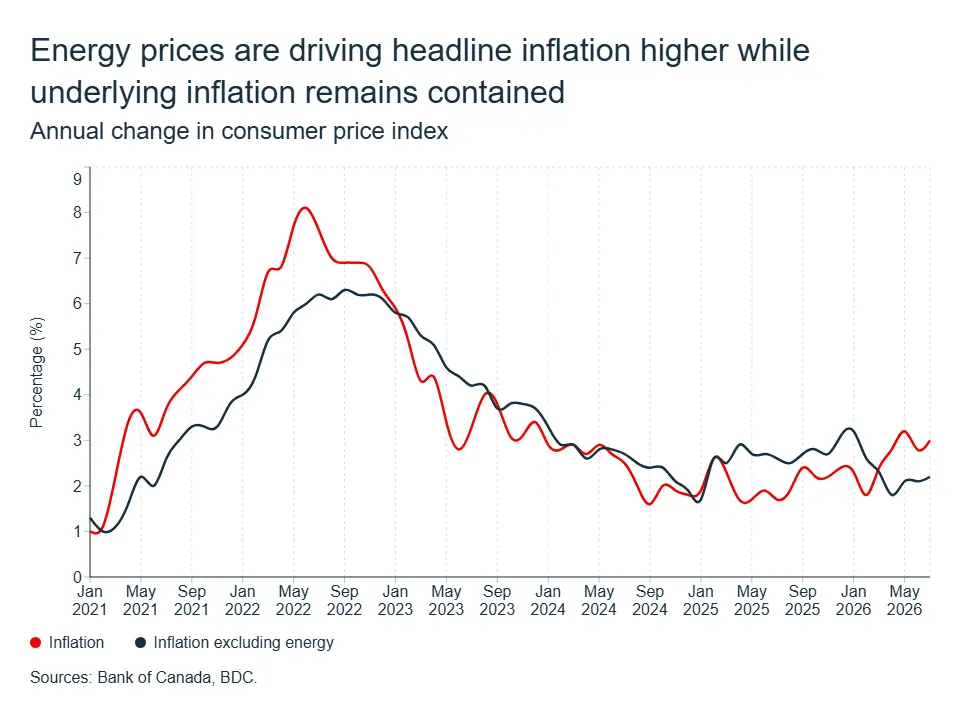
That distinction matters for monetary policy. Inflation excluding energy remains close to the Bank’s 2% target, while the 2.25% policy rate sits at the lower end of the Bank’s estimated neutral range. The Bank can therefore look through part of an energy-driven increase as long as it does not spill into other prices. However, the rise in headline inflation from 1.8% in February to 3.0% in July is too large to ignore according to Governor Macklem latest allocution. Persistent energy costs can raise transportation, production and distribution expenses, which is why recent the central bank analysis has shifted the near-term inflation risk away from tariffs alone and toward energy prices and possible second-round effects. For Canadian consumers and businesses, a quick relief in borrowing costs from policy rate is likely out of the Bank of Canada scope.
August employment fell, but the labour market is not collapsing
Employment declined by 41,700 in August after three months of back-to-back gains. The August loss is disappointing, but it followed a cumulative increase of 181,100 jobs over the previous three months. Even after the setback, employment stood 216,500 above its August 2025 level, the strongest year-over-year employment gain so far in 2026. This is why the latest report is better described as a loss of momentum than a broad deterioration in labour-market conditions.
The full-year pattern remains choppy. Canada lost 24,800 jobs in January and 83,900 in February, recovered 14,100 jobs in March before losing another 17,700 in April. Summing the monthly changes leaves employment approximately 26,800 higher than at the end of 2025.
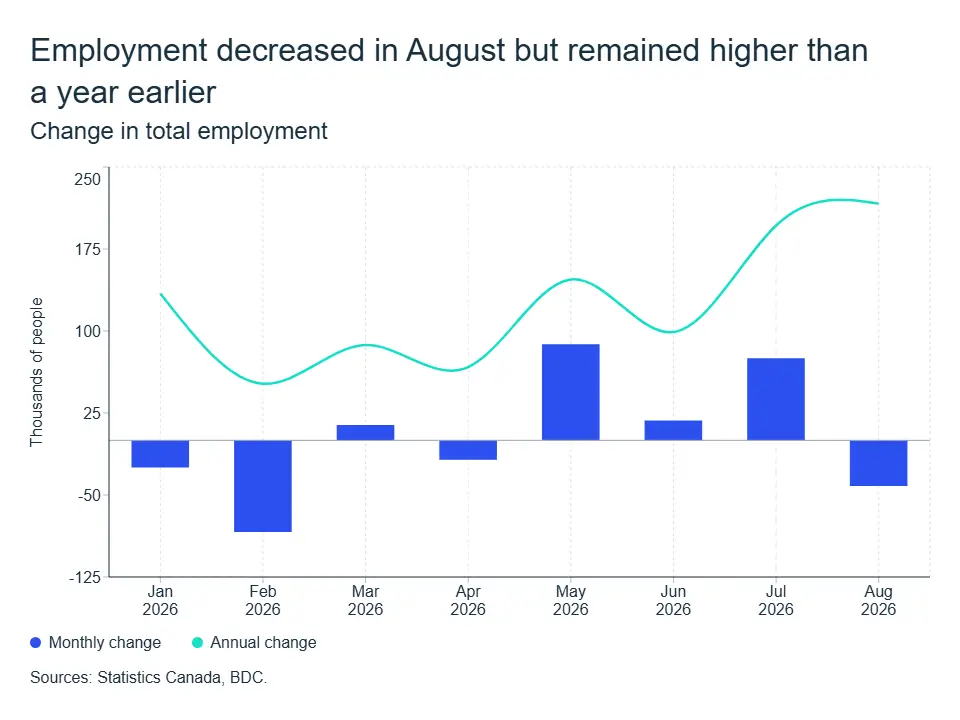
The numbers are therefore consistent with an economy expanding slowly through important monthly volatility. The August result is not unusual, and far from enough to signal recession on its own, but it is not good news either: it arrives just as trade volumes are pointing to a weaker start to Q3 and suggests businesses remain cautious about adding labour.
What it means for your business
- Exporters should continue planning for uneven foreign demand. The widening trade deficit suggests that external demand remains a headwind for the economy and could weigh on growth if exports do not recover in August and September.
- Businesses should continue planning around a policy rate near current levels. Energy-intensive firms should nevertheless stress-test fuel, freight and other input costs, as energy prices can remain volatile and influence headline inflation even when underlying price pressures are contained.
- Recruitment conditions may ease somewhat as economic growth slows, but businesses should not expect a broad increase in labour availability. Structural demographic pressures, discussed in previous editions of this Economic Letter, will continue to limit labour supply. The key signal is that hiring conditions are becoming less restrictive, not that labour shortages have disappeared. Hiring plans should therefore remain tied to business demand and expansion projects rather than labour market headlines alone.
- Overall, the Q2 rebound strengthens the near-term demand outlook for many Canadian businesses, but one strong quarter does not establish a trend. Businesses should plan for uneven sales and keep inventories, staffing levels and working capital flexible, as weaker trade performance and softer leading indicators suggest slower growth in Q3 and Q4.
British Columbia
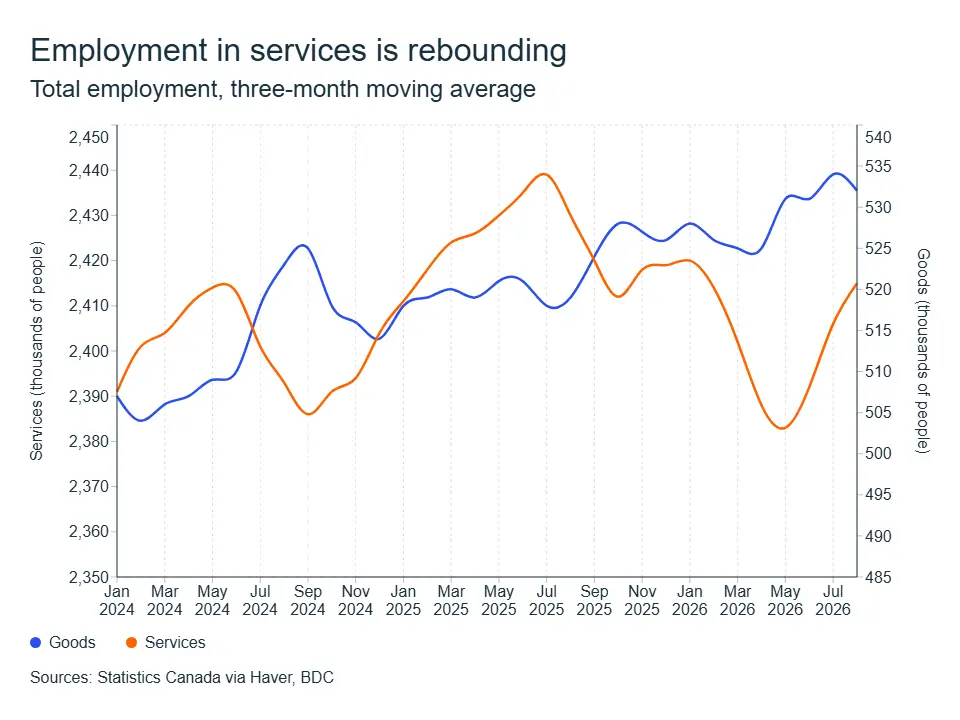
The B.C. economy continues to show signs of stabilization in spite of some emerging headwinds. Employment edged lower in August, while the unemployment rate increased to 6.5%. Of note was a continued recovery in employment in services, while goods employment pulled back slightly. Although labour market conditions remain softer than a year ago, employment levels have generally stabilized after a weak start to 2026.
Consumer spending inched up 0.1% in June after jumping 2.5% in May. A portion of the increase, however, was driven by higher prices, as real retail volumes were flat and core sales weakened, suggesting households remain cautious in the face of economic uncertainty.
The latest escalation in U.S. tariffs represents a risk for the province, as B.C. is among the provinces most exposed to the newly targeted products. The forestry sector is particularly vulnerable given its heavy reliance on the U.S. market and the industry's ongoing challenges from existing trade barriers. The tariffs are expected to weigh on exports, business investment and employment in affected sectors.
The housing market also remains subdued. Residential sales in July were down 6.7% from a year earlier and remained nearly 19% below the 10-year average. Home prices continued to soften modestly, while year-to-date sales activity remained below 2025 levels, indicating that a broad-based recovery has yet to emerge.
Overall, B.C.'s economy appears more stable than earlier in the year, but growth is likely to remain modest. Softer labour market conditions, weakness in housing and the heightened threat from U.S. tariffs are expected to weigh on economic activity through the remainder of 2026.
Alberta
Alberta remains the strongest-performing large provincial economy in 2026. While trade uncertainty and slower population growth are weighing on activity across Canada, the province continues to benefit from elevated energy prices, robust export performance and ongoing investment in resource-related projects.
Energy remains the cornerstone of Alberta's economic outlook. Although oil prices have retreated from the highs reached in the spring, they remain well above year-ago levels and continue to support provincial revenues, corporate profits and export earnings. Ongoing geopolitical tensions in the Middle East have kept energy markets tighter than anticipated, extending the upward pressure on prices and providing an additional tailwind for Alberta's energy sector.
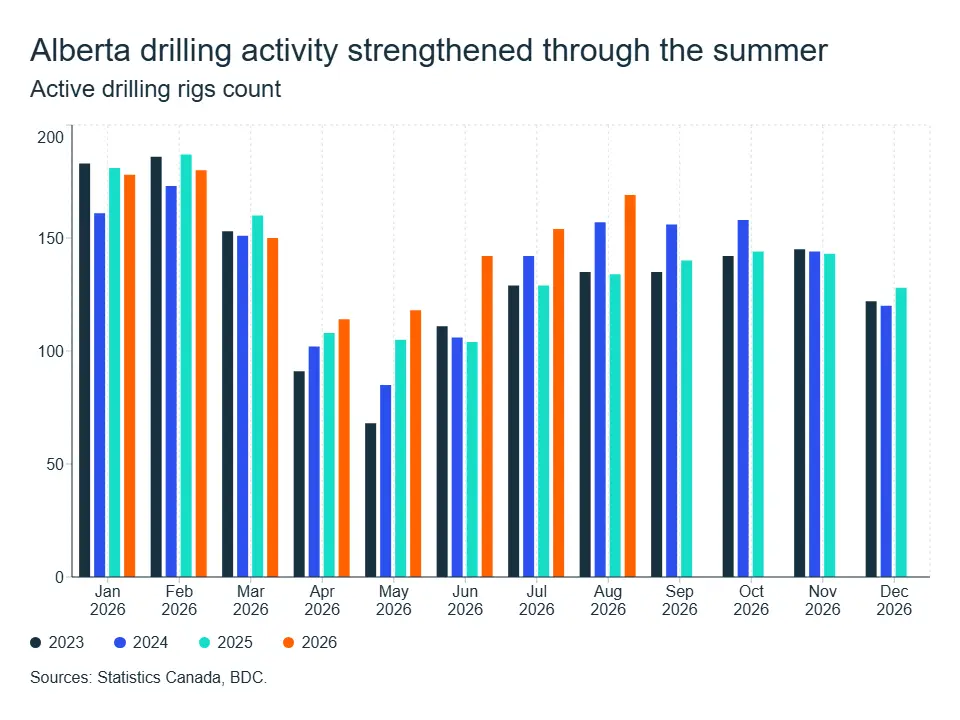
Although producers remain focused on balance-sheet discipline and shareholder returns, production continues to increase. Drilling activity remains elevated, with the number of active rigs well above levels seen in recent years. The longer energy prices remain supportive, the greater the likelihood that investment in machinery, equipment and related infrastructure will strengthen, providing an additional boost to economic activity.
The labour market continues to support growth despite some recent softening. While employment declined by approximately 9,000 positions in August, employment remains well above year-ago levels. Alberta is also one of the few provinces where population growth remains comparatively resilient. However, labour force growth has begun to moderate, contributing to a 0.2 percentage-point decline in the unemployment rate despite recent job losses. Retail spending edged lower in June, largely reflecting lower gasoline prices rather than a broad-based weakening in consumer demand.
Trade remains a key source of strength for the provincial economy. Alberta is less exposed than Central Canada to the sectors most affected by recent U.S. tariff measures and continues to benefit from resilient demand for energy and other resource exports. Strong commodity prices and increasingly diversified export markets are helping to cushion the impact of ongoing uncertainty surrounding North American trade relations.
Overall, Alberta enters the final months of 2026 with stronger economic fundamentals than most provinces. BDC currently forecasts Alberta’s real GDP growth to ease from 2.4%in 2026to 2.0%in 2027.
Saskatchewan
Saskatchewan is expected to remain among the top-performing provincial economies in 2026. BDC Economics forecasts real GDP growth of 1.8%, well above the national outlook of 0.9%. While trade uncertainty continues to weigh on several Canadian provinces, Saskatchewan remains supported by favourable commodity markets, a resilient resource sector and a pipeline of major mining projects.
Resource industries remain the foundation of Saskatchewan's economic outlook. Higher oil prices continue to support energy producers, but mining remains the province's primary growth engine. After reaching a record $12.8 billion in mineral sales in 2025, the sector has maintained strong momentum in 2026.
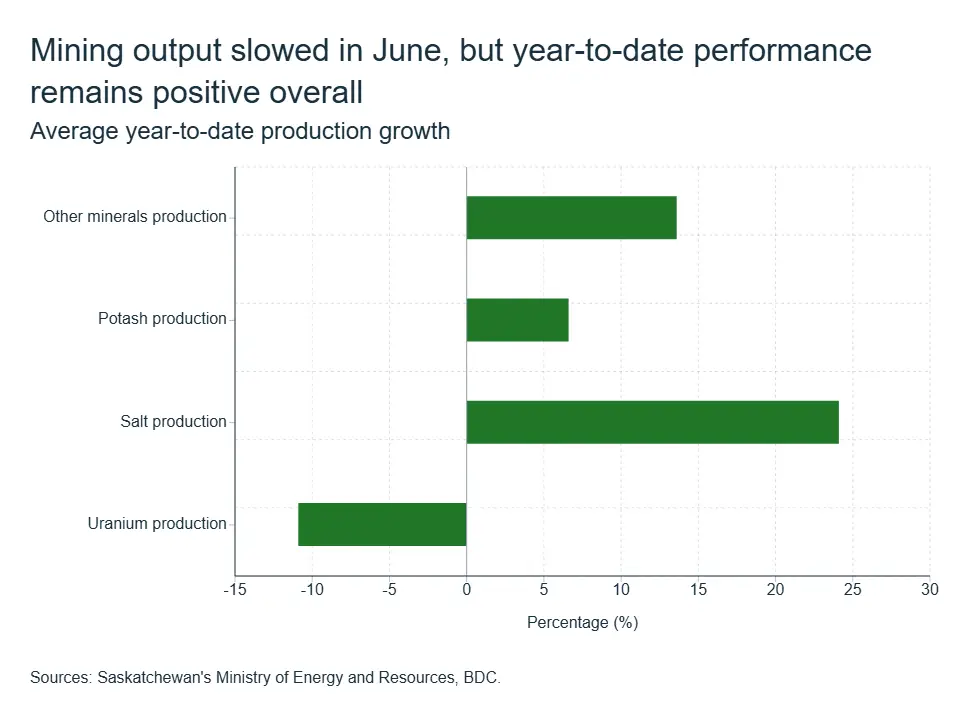
Mineral production eased somewhat in June, but year-to-date activity remains solid across most major commodities. Potash output continues to trend higher, supported by firm global fertilizer demand, while uranium markets remain underpinned by growing investment in nuclear energy despite periodic production interruptions related to maintenance activities.
The province's medium-term outlook also remains closely tied to its mining sector. Construction activity associated with several major projects continues to support investment and business confidence across the province. While these projects are unlikely to materially alter growth in 2026, they reinforce Saskatchewan's position as one of Canada's most attractive destinations for resource investment and should support economic activity over the coming years.
Outside the resource sector, economic conditions remain more mixed. Manufacturing activity has shown signs of improvement compared with earlier in the year, particularly in industries linked to agriculture and mining. Trade conditions remain challenging, although Saskatchewan is less exposed to tariff-sensitive industries than many other provinces.
Labour market conditions have been volatile throughout 2026, contributing to relatively weak consumer spending. Retail sales growth has generally lagged behind that of most provinces this year. More recently, however, the labour market showed signs of improvement, with the province adding more than 4,000 full-time positions in August. Although part-time employment declined, total employment still increased by 2,600 jobs during the month.
BDC Economics currently forecasts real GDP growth of 1.8% in 2026 and 1.7% in 2027.
Manitoba
Manitoba's economy is expected to post moderate growth in 2026. A diversified industrial base, resilient household spending and a relatively stable labour market should help the province navigate a period of slower growth. However, renewed trade uncertainty is expected to become an increasingly important challenge for the provincial economy.
The province lost approximately 7,000 jobs in August and the unemployment rate rose by 0.5 percentage points to 5.5%. Despite this setback, the labour market remains one of Manitoba's relative strengths. While employment growth has moderated compared with earlier in the year, the province continues to maintain one of the lowest unemployment rates in the country, supporting household incomes and consumer spending.
Manufacturing activity has improved significantly since the start of the year. Following weakness in late 2025 and early 2026, manufacturing sales regained momentum through the spring and remained elevated into the summer. Much of Manitoba's manufacturing base is concentrated in agri-food processing, transportation equipment and industries linked to Prairie economic activity, helping support output despite a challenging external environment. The recovery in manufacturing is particularly encouraging given the sector's importance to both Manitoba's economy and the broader Prairie supply chain.
That said, trade remains the principal source of downside risk. The latest round of tariffs imposed by the United States, along with Canada's retaliatory measures, is expected to create additional challenges for Manitoba businesses. The province's integrated manufacturing sector is more exposed to trade disruptions than those of many other provinces. Higher energy prices also continue to pressure transportation and logistics costs, an important consideration for an economy that relies heavily on the movement of goods across domestic and international markets.
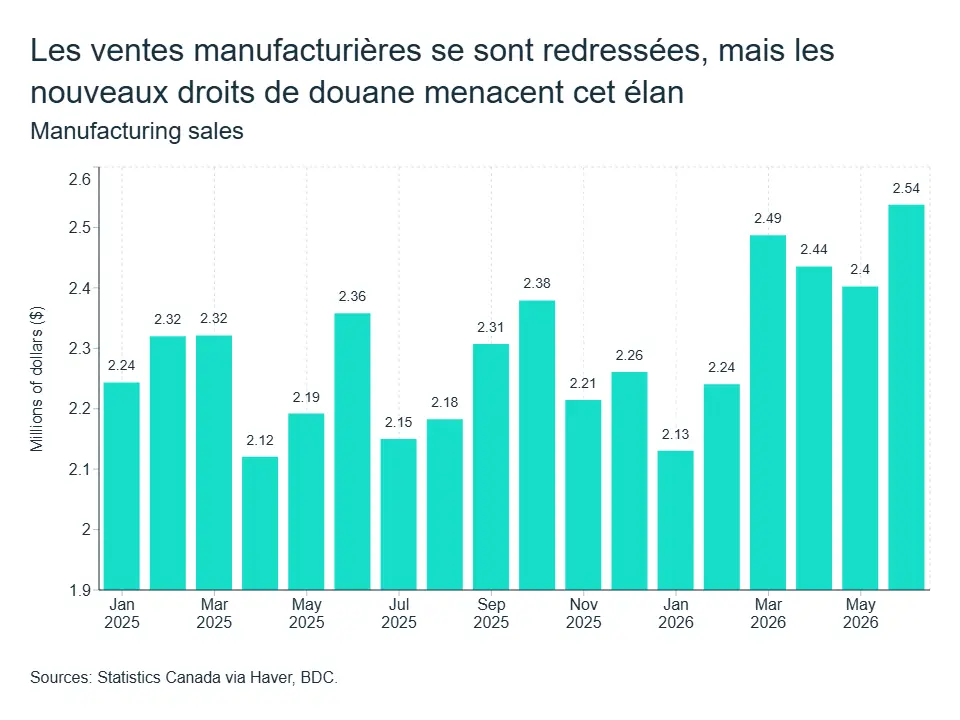
Even with these challenges, Manitoba enters the second half of the year with several supportive factors. A relatively healthy labour market has helped cushion the impact of growing trade uncertainty, while improving manufacturing activity should continue to support economic growth in the months ahead. Nevertheless, ongoing trade tensions and heightened geopolitical uncertainty are likely to keep growth modest through the remainder of 2026.
BDC currently forecasts Manitoba's real GDP growth at 1.2% in 2026, followed by a modest acceleration to 1.4% in 2027.
Ontario
The Ontario economy is gaining momentum ahead of the introduction of new tariffs. The labour market shows that the Ontario economy rebounded in the second quarter. Between the second quarters of 2025 and 2026, Ontario’s employment rose by 67,000, supported mainly by gains in full-time jobs, private-sector employment, self-employment, and growth in both service- and goods-producing industries. Over the same period, unemployment fell overall and across most sociodemographic groups, and hourly wage growth of 3.2% outpaced inflation of 2.3%.
With the introduction of 50% tariffs on over 500 products, growth is expected to moderate but remain positive over the remainder of 2026. Ontario will be one of the provinces most affected, with Section 338 tariffs covering around 10% of the province’s exports, mostly manufactured goods.
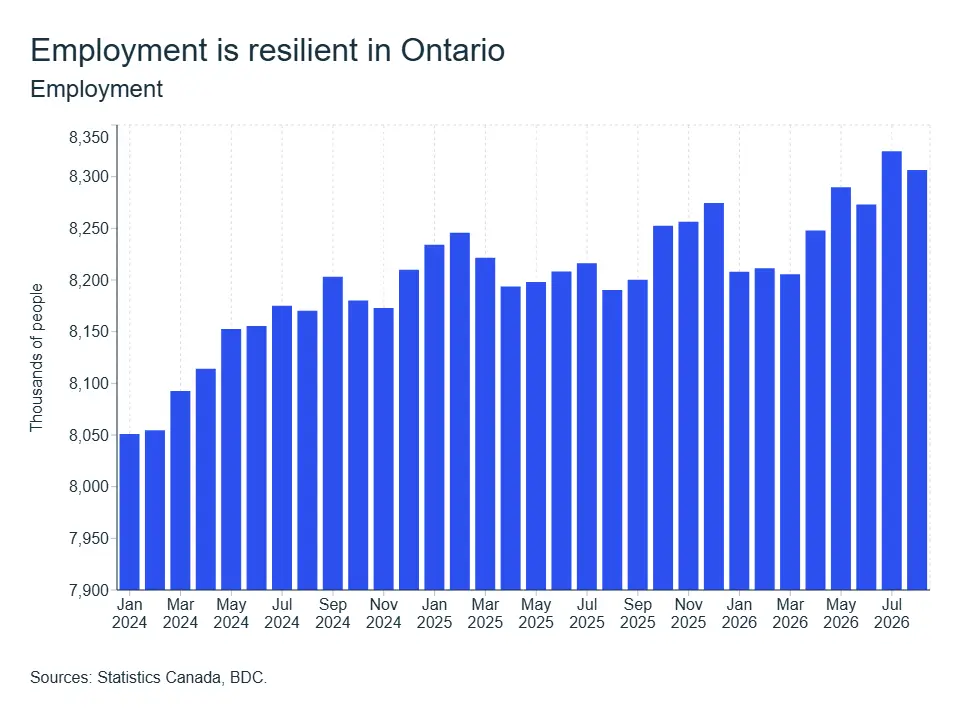
The effects are expected to be concentrated in specific exposed businesses, limiting the impact on the overall economy, although they will slow Ontario’s growth. We still expect growth at the end of 2026 and into 2027, supported by consumption and major investment.
Quebec
Quebec’s economy is once again being tested. New tariffs took effect in August, affecting about 11% of the province’s exports across several industries. Below-potential growth is expected to persist as trade uncertainty and a cooling labour market continue to weigh on activity. GDP growth is now projected at 0.6%, slightly below our previously published forecast.
The labour market remains soft. Job gains in June and July were fully offset by losses in August, putting employment back on a downward trend.
The real estate market also remains under pressure. Home sales are down 4.6% year-to-date, while price growth has remained firm. Residential activity is not expected to pick up significantly, as slower population growth and a weaker labour market continue to weigh on both home sales and residential investment.
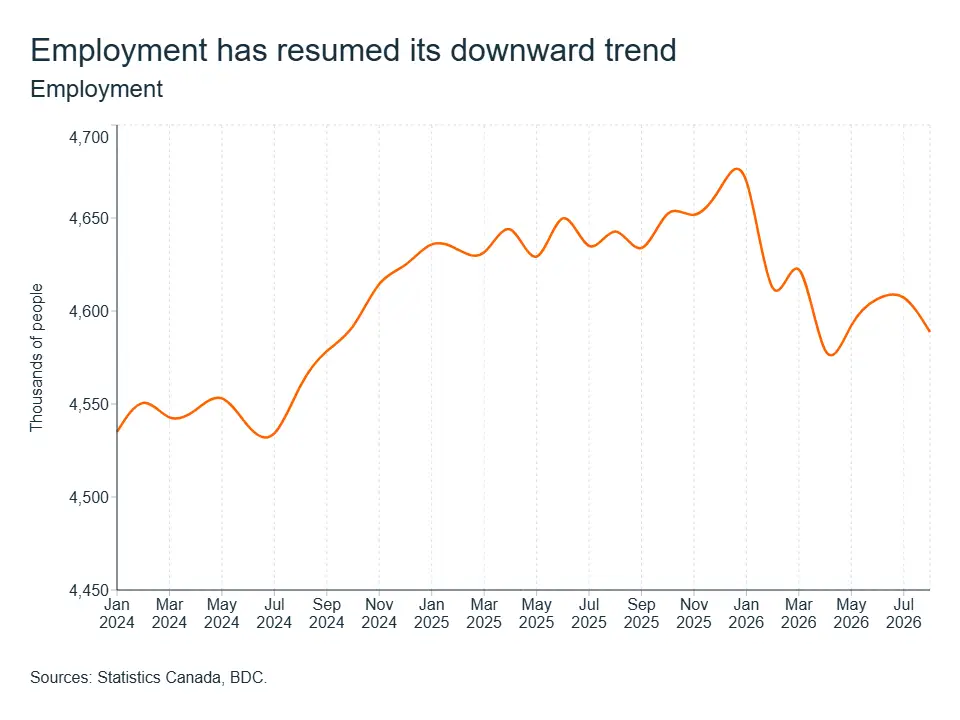
On a more positive note, consumer spending has remained resilient despite weaker hiring. Retail sales are up 3.6% year-to-date, while manufacturing sales have increased by 6.6%, supported by strong gains in electronics and moderate growth in the auto and machinery sectors.
Government spending and targeted measures are also expected to help soften some of the impact of tariffs on businesses and affected households.
Nova Scotia
Nova Scotia’s growth remains supported by solid domestic fundamentals. Household spending continues to rise, with retail sales up 5% year-to-date, while employment is showing signs of recovery.
The labour market strengthened over the summer after a slow spring. Employment increased in the second quarter and again in August, adding 7,000 jobs since May. This renewed momentum is a positive development for the provincial economy.
Trade, however, remains under pressure, with total exports still below last year’s levels. New tariffs are expected to add to these challenges, affecting around 5% of the province’s exports.
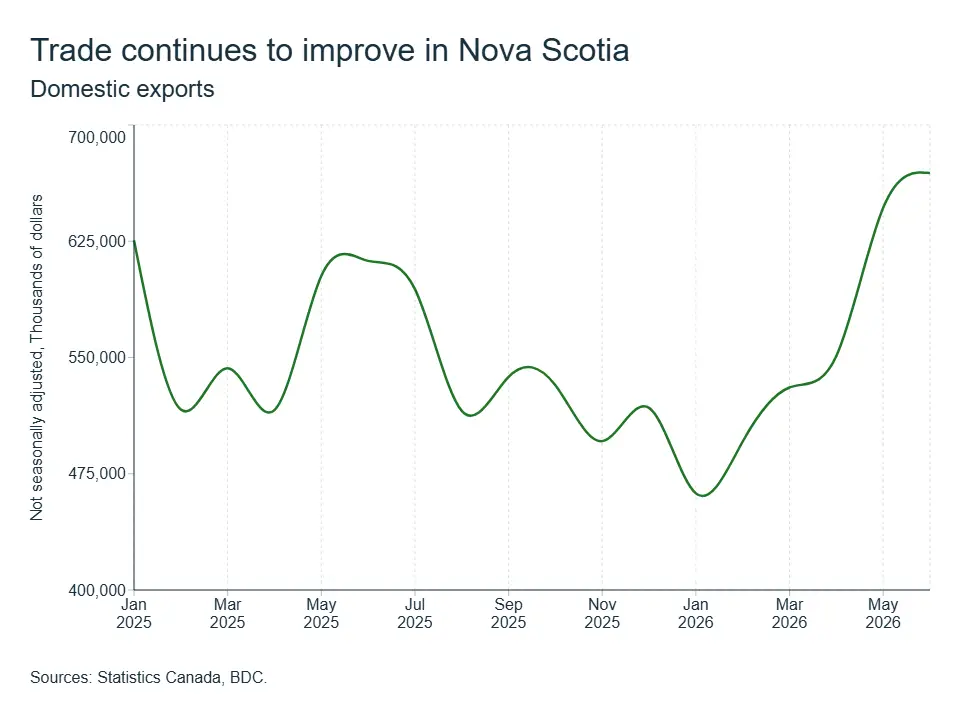
Looking ahead, strategic investments, government support and a strengthening job market should help sustain growth. Our forecast remains unchanged, with real GDP expected to expand by roughly 1.3% in 2026.
New Brunswick
New Brunswick’s economy remains on track for moderate growth this year, with our forecast unchanged at 1.2% for 2026.
The labour market is gradually regaining strength. Following job losses in April, May and June, employment edged up in July and August. Overall, employment is about 2,000 jobs higher than at the start of the year.
The improvement in employment has supported consumer spending, with retail sales up 4.9% year-to-date.
Manufacturing dipped in June, but levels remained higher than last year’s. Total sales rebounded strongly, increasing 16% year-to-date, led by strength in petroleum and coal products as well as food manufacturing.
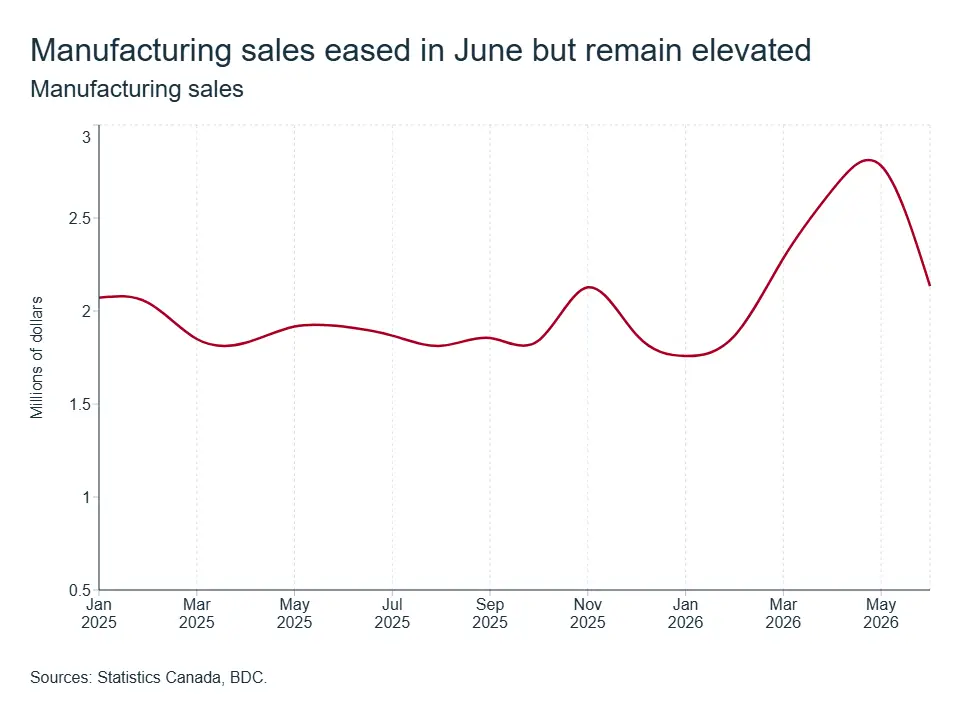
Trade conditions also improved, with total exports up about 10% year-to-date. Energy and seafood exports have been the main drivers of this momentum. New tariffs affect only a small share of New Brunswick’s exports—around 1.9%—and are therefore not expected to derail the province’s trade performance.
Prince Edward Island
PEI’s economy is moderating amid slower population growth and ongoing trade tensions. Even so, the province is still expected to outpace national growth this year, with real GDP forecast to increase by 1.5% in 2026.
The labour market remains soft. Employment has barely increased since the start of the year, while the unemployment rate is hovering around 7.9%.
Retail sales have increased for six consecutive months, pointing to resilient consumer spending. A strong tourism season likely provided additional support through the summer.
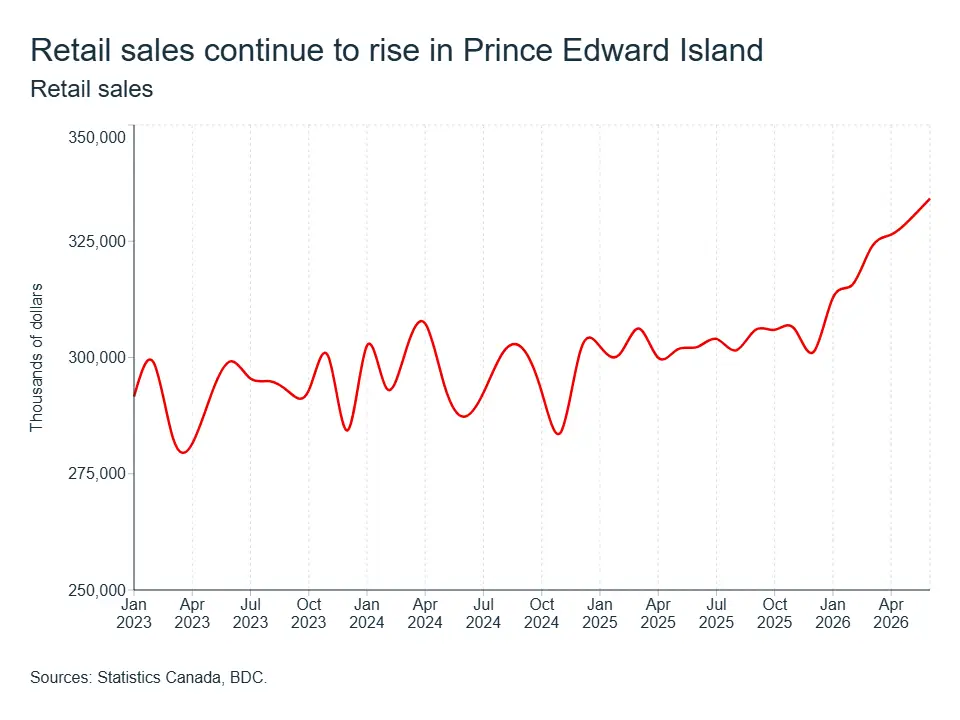
Trade performance remains mixed. Exports to the United States declined by 7% year-to-date, while exports to China rose sharply by 33%, supported by the agreement reached between Canada and China. Manufacturing also remains under pressure, with total sales down 2.5% year-to-date. New tariffs affect around 1% of the Island’s exports, which should limit their overall impact on trade.
Looking ahead, resilient domestic demand and a firmer recovery in exports will be important to sustaining growth through the remainder of the year.
Newfoundland and Labrador
Newfoundland and Labrador remains on track to be one of the strongest-performing provincial economies in 2026 at 3.0%.
The ongoing conflict in the middle east continues to put pressure on oil prices benefiting oil producers in the province. While total production eased in early summer, levels were about 50% higher than last year levels.
With no clear resolution to the conflict in the middle east, Brent prices are expected to remain higher for longer. Mineral exports bounced back in July hitting a record high since 2024. Seafood exports were also 10.3% higher year-to-date.
The labour market seems to be recovering adding 1200 jobs since June. Unemployment rate is now around its lowest levels around 8.6%. Consumer spending picked up the pace, increasing 3.76% year-to-date from January to July compared with the same period in 2025. Housing construction is slightly higher in 2026, but residential sales remain at lower levels than last year.
Overall, a resilient job market is expected to keep consumer spending solid, strong commodity prices, robust exports and continued investment in resource projects will drive growth this year before moderating in 2027.