

Mission, vision, values: Why and how to get back to your roots when corporate culture erodes
During periods of rapid growth, it’s not uncommon for the values that guided your company at its founding to get lost along the way.
That’s perfectly normal. The core group that surrounded you in the early days may still be there, but successive waves of hiring have diluted the original spirit. New hires, with whom you have less direct contact, may struggle to embody the company’s values. As a result, your “secret sauce” fades, and performance suffers.
As values erode, so does your company culture. Yet culture is what drives the execution of your objectives. It’s time to step back and breathe new life into the organizational qualities you care about most.
Don’t underestimate the importance of values. They are how you build the culture that will support your company through its next phase of growth.
Alexandre Hamelin
Senior Consultant, High-Impact Firms, BDC
Mission, visions, values: Three strategic pillars
There’s a certain cynicism surrounding the “directional statements” that guide a company’s strategy, to the point where values are sometimes dismissed as empty words posted on cafeteria walls.
That underestimates their potential. Your values shape the corporate culture, and that’s what enables you to fulfill your mission and realize your vision. But to do that, you need to clearly understand these concepts and how they complement one another.
Mission, vision, values: What are they?
- Mission: Your company’s purpose. Ambitious—sometimes even awe-inspiring—it’s what motivates you to show up every day.
- Vision: How you will accomplish your mission through the products or services you offer. It can evolve over time.
- Values: What you believe in and how you behave. They generate your corporate culture.
Together, these three pillars align your teams around a shared goal and empower them to make decisions independently.
Imagine a company whose culture encourages experimentation and calculated risk taking. If that culture is clear, understood and reinforced, employees will feel confident exploring unconventional ideas without asking for permission or fearing repercussions—because doing so aligns with the organization’s values. In fact, it’s expected.
Conversely, expecting a convention-driven, risk-averse organization to innovate daily is unrealistic. Creative minds will quickly feel stifled and eventually leave.
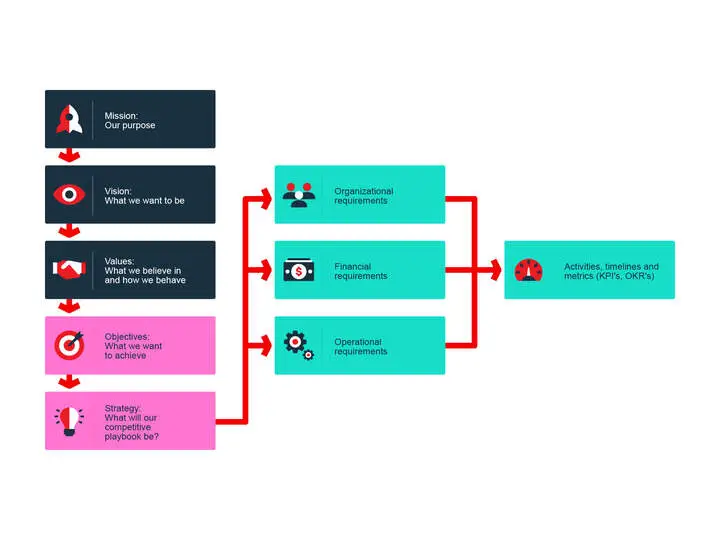
Once your mission, vision and values are clear, you can define realistic objectives and establish a grounded strategy, broken down into action plans, budgets and more.
Mission, vision, and value statements guide a company's strategy from its creation to its execution
Key questions to clarify your values
Together with my colleague Jacques Légaré, Executive Advisor, I created a workshop to help high-impact Canadian firms clarify the ambiguity that often surrounds values, with the goal of building or strengthening culture as they grow.
Are you at a pivotal stage in your growth? Are you learning to delegate to a management team, who in turn must delegate to their own teams? Here are a few areas to explore with your leaders to stay on course.
1. Do we have too many values?
First, ask yourself whether you have too many. Beyond three or four, it’s unlikely your employees know them all—let alone apply them. Three is probably ideal. Trim the list.
2. Are our values ambiguous?
Next, examine each value closely. What do you really mean by it?
This exercise is harder than it sounds, and you’ll quickly realize that some words are highly ambiguous and open to interpretation.
What do you mean by “people-first” or “rigour”? Does everyone—including your clients—understand them the same way? The conversation may get heated. The goal is to reach a clear, shared definition.
If your culture is clear and understood, employees will feel confident exploring unconventional ideas without asking for permission or fearing repercussions—because doing so aligns with the organization’s values. In fact, it’s expected.
Alexandre Hamelin
Senior Consultant, High-Impact Firms, BDC
3. From value to behaviour
The next step is to make your values tangible by translating them into behaviours for different roles across the organization. From management to customer service, define how these values should show up in day-to-day work.
Take rigour as an example: for HR leaders, it might mean applying company policies without bias, not letting emotions cloud judgment and avoiding favouritism. Most people would likely agree on that baseline interpretation.
But you should also identify what might be mistaken for rigour without truly being it—for instance, applying a policy blindly while forgetting there’s a human being on the other side.
Use this exercise to discuss real-world dilemmas. If a policy seems senseless or leads to harmful outcomes, what should the HR team do?
4. Spread your values
Now that you have a clear understanding of your values and how they translate into daily behaviour, how do you embed them?
Visual reminders—on cafeteria walls, T-shirts or promotional materials—can help, but you’ll go much further by systematically integrating them into your hiring process and company life.
- During recruitment
Include questions about your values. Ask candidates how they embody them—or don’t—in their daily lives. - During onboarding
Take the time to explain your values and the expectations that come with them. - At key moments throughout the year
Spotlight one value and celebrate those who embody it best.
5. Continuously evaluate integration
Have your teams truly integrated the company’s values into their daily work? Regular evaluation will help you find out.
Some values can be measured. Continuing with the example of rigour, in certain roles you might track accident rates or absenteeism. If you value innovation, time invested in research and development could serve as an indicator.
If existing data isn’t relevant or your values are harder to quantify, ask individuals to share recent examples of how they demonstrated those qualities. And don’t limit this to the traditional annual performance review. Instead, schedule monthly one-on-one meetings to gain a clearer picture of progress while also creating space to address other topics.
Hesitant to invest the time these exercises require? Don’t underestimate the importance of values. Through them, you build the culture that will carry your company into its next phase of growth. They deserve as much attention as your business strategy.
Next step
If you believe the Growth Driver Program, which includes this workshop, might be right for you, don’t hesitate to reach out to learn what you could gain from it.