

The Canadian economy in 2026: A year of uncertainty, slow growth and transition
As we know, the Canadian economy faced headwinds in 2025. The imposition of tariffs by the United States and China on Canadian exports had a definite impact on our economic growth.
The new year is shaping up to be another turbulent one, as the renegotiation of the United States–Mexico–Canada Agreement (USMCA) will once again create a climate of uncertainty that will hamper the country’s economic activity. Canada’s GDP is expected to grow by a modest 1% in 2026, down slightly from 2025, which is expected to close with 1.2% growth.
Before analyzing the economic outlook for 2026, let’s review 2025, which ended on a positive note, marked by growth in real GDP and employment. This performance marked a significant rebound after a 1.8% contraction in real GDP in the second quarter.
Key forecasts for 2026
The impact of tariffs
The impact of tariffs on the economy nevertheless marked the last year. Canadian steel exports declined by 25%, while those of aluminum dropped by 6% and those of the automotive sector by 5%. Furthermore, the Canadian economy has not yet fully felt the effects of the tariffs recently imposed on the lumber and kitchen cabinet sectors.
The good news, however, is that the impact was limited, especially in sectors affected by tariffs. This is evident in the fact that growth in the rest of the economy has offset the effect of tariffs and prevented a recession.
The job market has also strengthened, with 180,000 jobs created in the last three months of 2025, resulting in a decrease in Canada’s unemployment rate to 6.5% in November. The number of jobs even increased in the manufacturing sector, which was hit the hardest by tariffs.
What can we expect in 2026?
The Canadian economy will continue to evolve in a highly uncertain context, once again dominated by tariffs and the USMCA’s renegotiation—scheduled for July—which will continue to impact our exports negatively. These trade tensions are also likely to dampen businesses’ enthusiasm for investment.
Thus, consumer spending will once again be the primary driver of economic growth in Canada in 2026. Year after year, household consumption accounts for about 60% of GDP. The demand for goods and services plays a more crucial role in the current context, serving as a stabilizing factor for the Canadian economy.
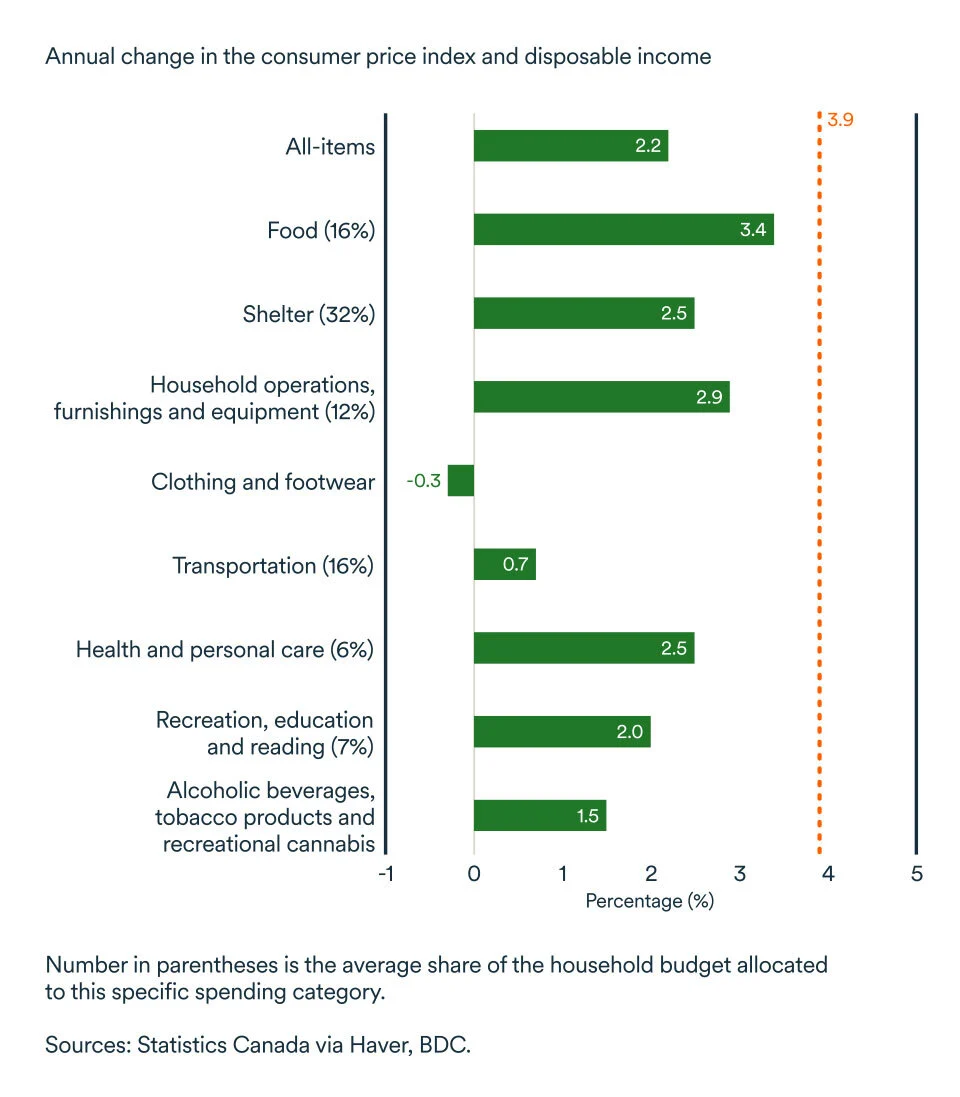
This consumer spending is supported by interest rates that have reached their lowest level in a year. Another important factor is our relatively strong job market, which, combined with wage increases, contributed to a boost in household disposable income in 2025. However, part of this increase has been allocated to savings, which should also raise consumer spending over the next year. Finally, consumer spending will also be buoyed by the fact that inflation remains within the Bank of Canada’s target range, namely close to 2%.
Governments will likewise do their part, as expansionary budgets will also contribute to economic growth.
Government and consumer spending will therefore fuel Canadian economic growth in 2026, albeit at a slower pace due to the impact of tariffs and trade tensions.
Chart 1: The share of discretionary spending in household budgets will be reduced by inflation in food and housing prices, but disposable income continues to grow faster
The impact on businesses
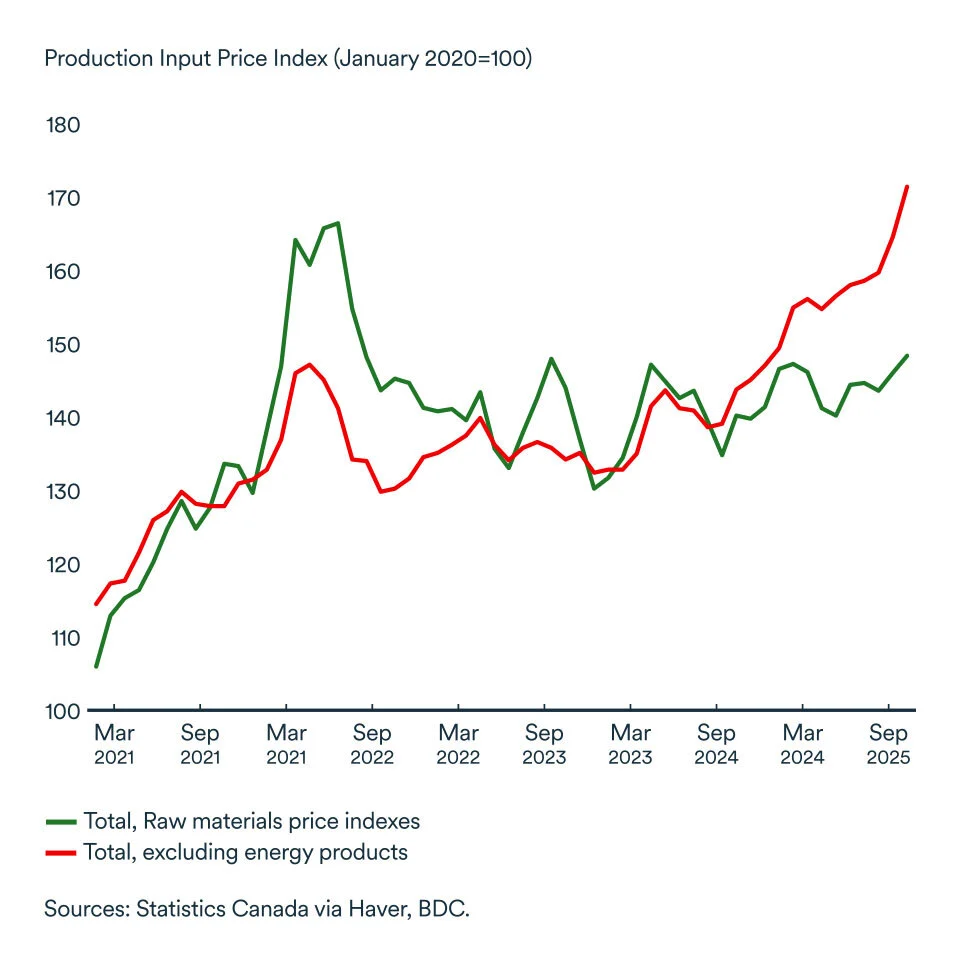
Next year is shaping up to be another difficult one for many Canadian businesses as they face significant cost pressures once again. These pressures primarily stem from trade tensions that have led to tariffs and counter-tariffs, as well as shifting supply chains.
In addition, the Canadian dollar is expected to remain weak in the coming months. Businesses that import products from the United States or from other countries in U.S. dollars will therefore continue to experience cost pressures.
Finally, despite the economic slowdown, wages continue to rise. This unusual situation, attributable to the aging population, means that businesses are still experiencing labour shortages, particularly in regions outside major urban centers, as well as cost pressures.
Caught between cost pressures and a slowing economy, businesses will have no choice but to increase productivity to maintain profitability.
Chart 2: Input costs have risen rapidly, but unlike in 2022, demand cannot offset these increases
An economy in transition
There are numerous opportunities for businesses to capitalize on as 2026 marks the start of a significant shift in the Canadian economy.
We are in the midst of a technological revolution. Companies that embrace this shift, particularly by adopting and integrating artificial intelligence, will be able to improve their operational efficiency.
In addition, the Canadian government has recently announced a series of significant projects that will not only impact the country’s economy but also represent new opportunities for local businesses. The expansion of the Port of Montreal in Contrecœur, the implementation of mini nuclear reactors in Ontario, and a liquefied natural gas terminal in British Columbia are all examples of projects that will benefit Canadian businesses.
Increased demand for electricity, notably to support transportation electrification projects, power data centers, and the development of artificial intelligence, will lead utility companies such as Hydro-Québec, Hydro One, and BC Hydro to invest billions of dollars over the next decade to increase their electricity generation capacity. Canadian companies will be well-positioned to become part of their supply chains, which represents another excellent business opportunity.
Finally, the defence sector is also expected to expand in 2026 and in the years to come, as the Canadian government has committed to significantly increasing its spending to strengthen Canada’s sovereignty. It also aims to establish a national supply chain for the defence sector, presenting an opportunity for companies to capitalize on the billions of dollars that will be invested in the sector’s development.
Next step
In a commercially uncertain context, BDC offers solutions, resources, and tools to support your business.