

Many entrepreneurs are ready to pass the torch, but few are prepared
According to our recent study on business acquisitions, nearly one in five Canadian companies plans to exit within the next five years. This transition puts more than $300 billion in revenue at stake. That makes helping entrepreneurs prepare for their next chapter everyone’s concern.
Selling a business is rarely quick or straightforward. For many owners, it’s also central to their retirement plan. That’s why success depends on both early preparation and timing.
To assess how prepared Canadian small and medium enterprises (SMEs) are, we analyzed results from our survey on business transfers, focusing on companies most likely to change ownership in the next five years. We supplemented this data with practical insights from BDC advisory experts who have helped many entrepreneurs plan their exit. We also interviewed Dominic Gagnon, an entrepreneur, author, investor and speaker with firsthand experience on both sides of the transaction.
There’s more than one way to exit a business
Stepping back takes significant planning and involves many moving parts, such as:
- valuation
- legal structuring
- successor readiness
- financial preparation
But no two exits look the same, and the path an owner chooses will shape the planning required.
Examples of exit paths and how they influence business transfer planning
| Path | Potential buyer | Objective | Requirements |
|---|---|---|---|
| External sale |
Competitor, supplier or client Private equity firm Another entrepreneur or individual |
Maximize value |
Strong financials Operational independence Clear market positioning |
| Internal transfer |
Family member Existing management Existing employees |
Preserve legacy Ensure continuity |
Leadership development Gradual handover |
Regardless of the chosen path, a full exit isn't the only option. Owners who are ready to step back can plan a more gradual departure. They might:
- delegate responsibilities
- bring in a partner
- sell a partial stake
- move into an advisory role
These interim steps reduce dependence on the founder and help prepare the business for a smoother transition when the owner is ready to leave fully.
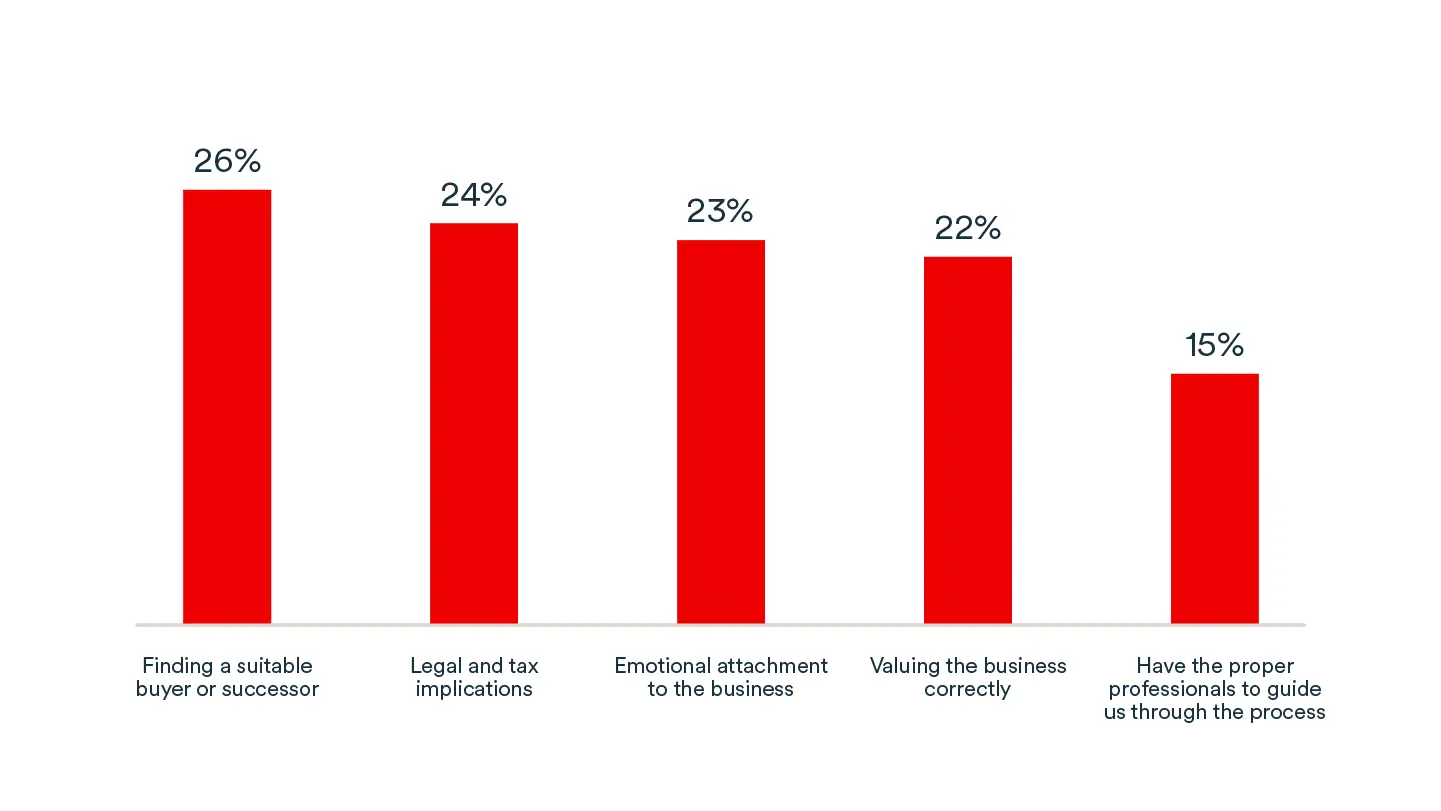
Finding the right successor or buyer is a top concern
Among businesses planning to exit within the next five years, nearly one in five say they aren’t confident they’ll be able to find a suitable successor or buyer.
The challenge varies depending on the exit path.
- In an external sale, the main concern is finding a buyer willing to pay a fair price.
- In an internal transfer, it’s identifying a successor who is both ready and willing to take the reins.
Emotional attachment ranks as the third-biggest challenge, underscoring the human side of the process. The concern can also vary depending on the exit path.
- In an external sale, owners may struggle to let go of something they built from scratch.
- In an internal transfer, business decisions can become entangled with family dynamics or long-standing working relationships.
In both cases, negotiations can be intense and personal. A clear plan, built early and supported by trusted advisors, is essential for keeping discussions productive.
Top challenges expected by respondents likely to exit in the next 5 years
Many owners underestimate how long a transition takes
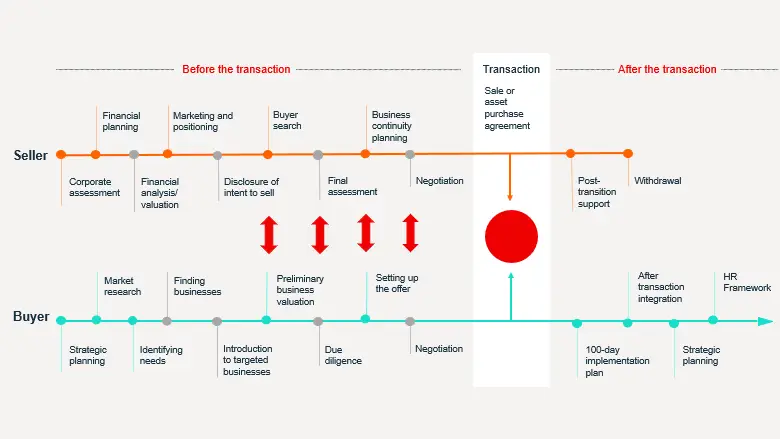
According to our advisory experts, entrepreneurs often underestimate the length and scope of a business transfer or sale. The focus is often on the transaction itself, but the real work usually starts well before and can continue well after. The preparation required depends on the exit path.
- In an external sale, owners need to strengthen financials, invest in key assets and reduce dependence on themselves before the transaction begins. These steps can help maximize value.
- In an internal transfer, the focus is often on mentoring, skills development and progressive delegation before the formal handover. These steps help prepare the successor and support continuity once the transition is complete.
In practice, a full transition often spans three to five years—much longer than the two years entrepreneurs expect on average. For owners hoping to exit within five years, the window to prepare is already narrowing. Whether they choose a sale, management buyout or family succession, success depends on managing the transition well, not just closing the deal.
When you talk to entrepreneurs, they think it'll take 12 to 24 months—far too short. In my case, I had been planning the sale for three years. That's what gave me real options when the time came to do the right deal.
Dominic Gagnon
Author, Investor, Entrepreneur and Speaker
The business transfer process: Before and after the transaction
Most entrepreneurs haven’t taken enough steps to ensure a smooth business transfer
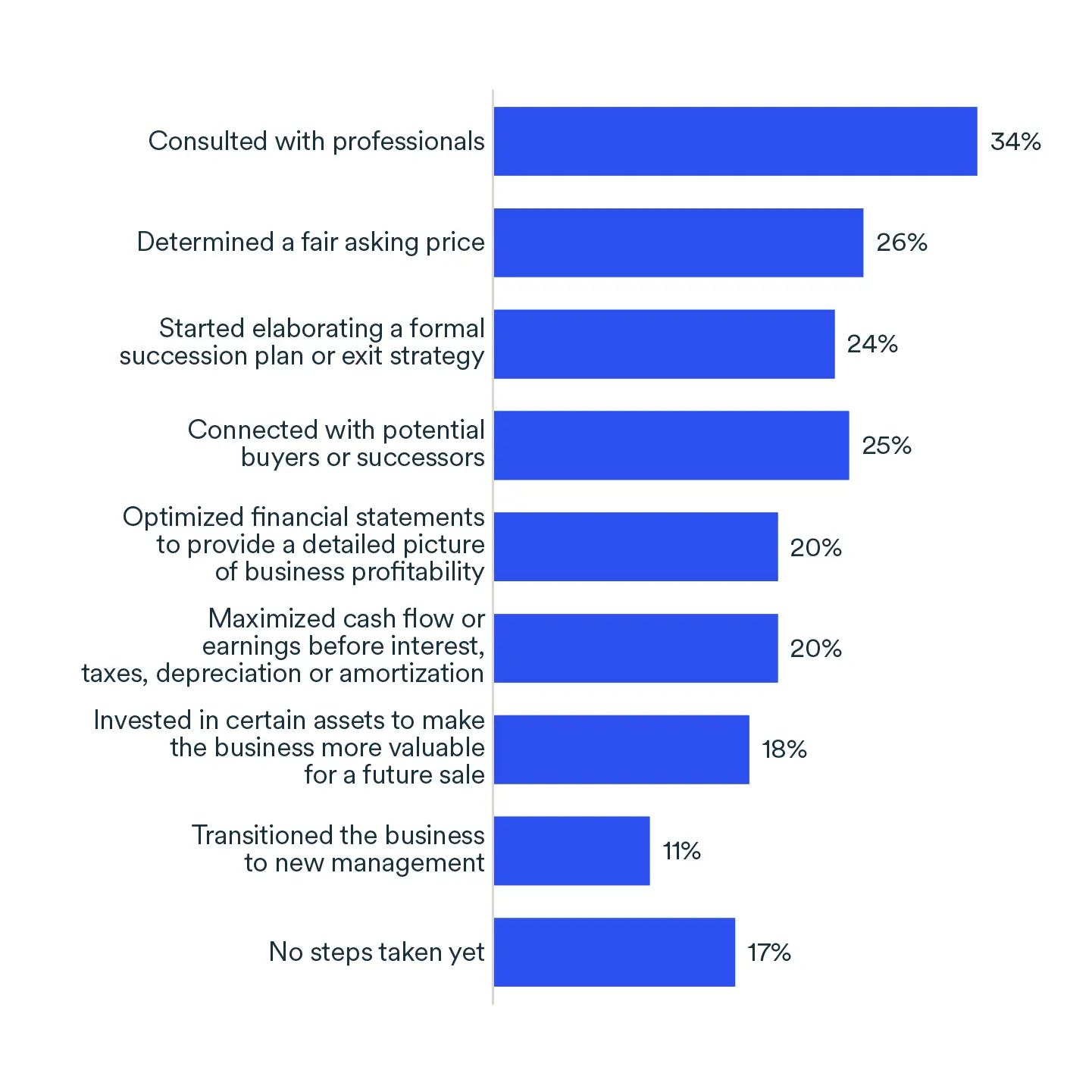
Our survey shows that most owners planning to exit within five years have started preparing: 83% have taken at least one step. But preparation is still limited: only 29% say they’ve taken three or more concrete actions.
Steps taken by respondents likely to exit in the next 5 years
Without enough preparation, many SMEs risk delays, lost value or failed deals. That risk is especially high given the complexity and timeline of a transfer or sale.
A successful transition requires planning on several fronts.
- Personal financial plan: for life after the transfer or sale
- Business transition plan: to map the key steps before, during and after the transaction
- Professional support: from lawyers, accountants and business advisors
- Business valuation: a realistic estimate to guide negotiations
- Owner identification: find potential buyers or a suitable successor
- Targeted investments: to increase sale value or support a smooth transition
- Delegation: to reduce day-to-day dependence on the owner
- Development support: to prepare a potential successor
Most of this work needs to happen well before the transaction process begins.
3 in 4 owners planning to exit still lack a formal exit strategy
Due to their length and complexity, business transfers require early and formal planning. Yet only 24% of businesses that are likely to exit in the next five years report having a formal succession plan or exit strategy.
A clear strategy helps entrepreneurs answer fundamental questions about the transaction, such as:
- objectives to be met
- potential successors or buyers
- how to prepare the business
- what is a realistic timeline
- financial needs after the transaction
External sales add another layer of complexity. During the transaction itself, owners often need to spend significant time on the deal. If too much still depends on them, day-to-day operations can suffer. That’s why a formal strategy should also identify which responsibilities can be delegated and who can step into key positions. Training and preparing the right team for this takes time.
Once a sale process starts, owners typically need to dedicate 70% of their time to it for 6 to 12 months. Too many owners get pulled into the transaction and lose focus on the business. They can end up more exhausted, with a weaker company than when they started.
Dominic Gagnon
Author, Investor, Entrepreneur and Speaker
Without a roadmap, owners may have to delay their exit or accept less favourable terms. The Exit Planning Institute estimates that 50% of exits are triggered by unplanned events, such as health issues, disability, divorce or disagreements between partners. This makes advance planning even more important.
Even if you don’t plan to leave soon, a formal exit strategy can act as a safeguard. It helps ensure that neither you nor the business is caught off guard if circumstances change.
Most owners haven’t taken steps to increase the value of their business
Getting the best price for a business often requires investment before the sale. Owners may need to clean up financial statements, strengthen cash flow or invest in key assets to make the business more attractive to buyers. Yet only 44% of businesses that are likely to exit in the next five years report having taken at least one action to increase their value.
Spending ahead of an exit can feel counterintuitive. But it can help protect or increase a business’s value by making the business easier to assess, transfer and operate. Even small improvements, such as organized, up-to-date accounting that clearly shows profitability, can make a meaningful difference in valuation and deal terms.
It's like buying a beautiful house and putting zero dollars into it for 10 years. When you finally decide to sell, you won't get the price you want because the roof is leaking or the foundation needs repairs. Businesses work the same way.
Dominic Gagnon
Author, Investor, Entrepreneur and Speaker
While these investments are often linked to external sales, they also benefit internal transfers. Clean financials, strong cash flow and a capable team can help make the handover smoother and give the next owner a stronger foundation to build on.
Your exit-readiness checklist
Many businesses have started preparing for their next chapter. But a successful exit takes more time, planning and support than many owners expect. This report covers some key elements, but there is more to consider.
Entrepreneurs can’t be experts in everything. When it comes to selling or transferring your business you need tax specialists, lawyers, M&A experts. It’s important to surround ourselves with the right people.
Dominic Gagnon
Author, Investor, Entrepreneur and Speaker
Our advisory experts recommend this checklist to help you prepare for each stage of the process.
| Before you begin | Before the transition | During and after the transaction |
|
Assess whether your business can run without you.
Know what your business is worth and what drives that value. Determine your exit path:
Clarify your personal financial needs after the exit:
Identify potential buyers or successors early. |
Develop a formal exit strategy with a realistic timeline. Assemble a team of trusted professionals:
Strengthen financials:
Reduce day-to-day dependence on you:
If transferring internally, invest in your successor’s development and credibility. Review legal structures:
Understand the tax implications of your chosen exit path. Build a contingency plan in case of unexpected events:
|
Support the transition with a clear handover period for the:
Communicate the plan to stakeholders:
Ensure your personal financial plan is in place and funded independently of the business. If estate planning, address the needs of family members who are not directly involved in the business. |
Next step
Maximize value and secure your company’s future by downloading BDC’s free guide, Preparing your Exit Plan.