

How to grow sales without spending too much
It’s been a tough year for the Canadian economy. Trade tensions have created a lot of uncertainty, which has led to a cautious spending approach. As a result, many entrepreneurs are struggling with sluggish sales right now.
The good news is that there are practical ways to boost sales without spending a lot of time or money. Most importantly, you can identify and pursue these strategies in a thoughtful manner that positions you for long-term success.
Start by really understanding your customers, especially their pains and gains. These are the reasons they buy, but also why they will buy from you instead of a competitor.
Patrick De Meester
Executive Advisor, BDC High-Impact Firms
Evaluating opportunities for future growth
When considering ways to grow your business, you generally have four main options—each carrying a different level of risk.
Ansoff matrix: Paths to growth
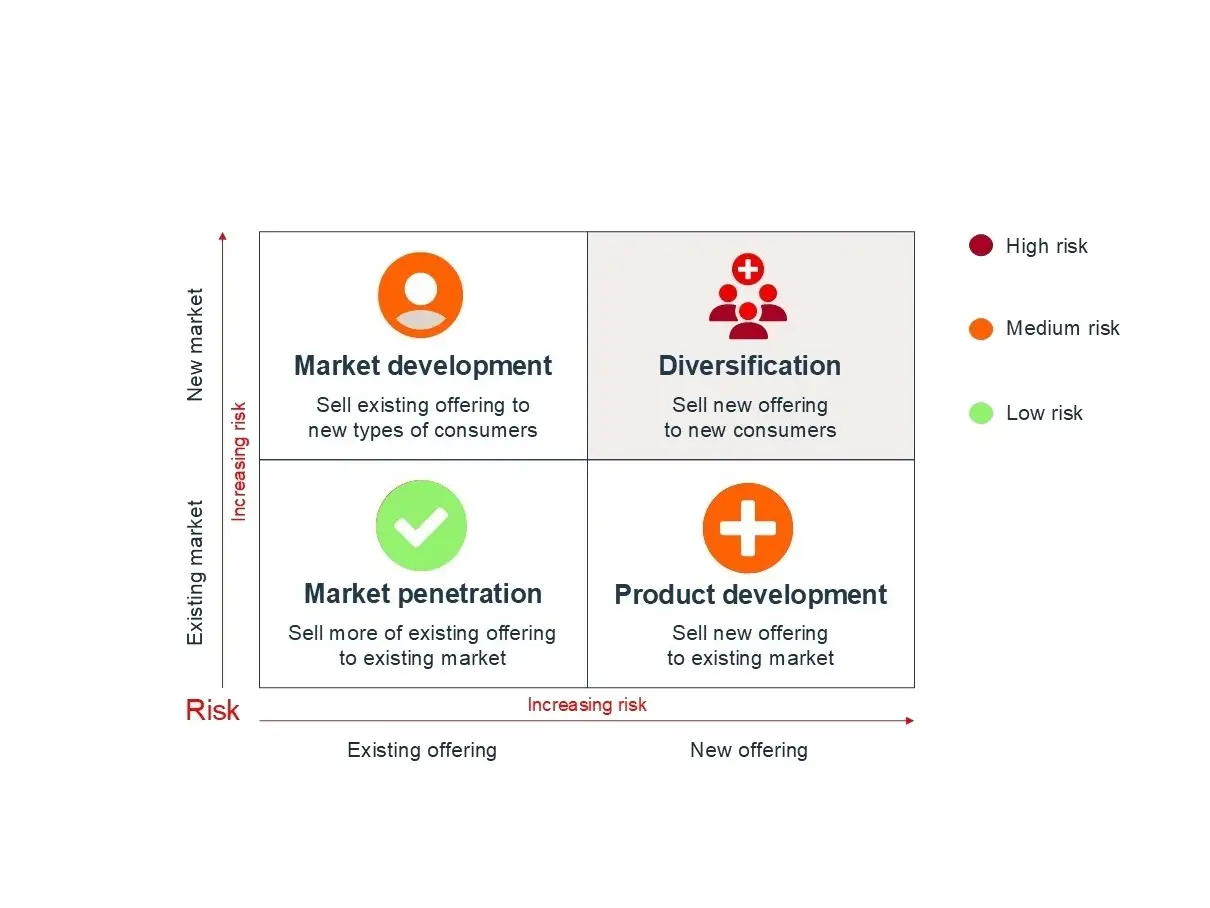
Market penetration (low risk)
This approach focuses on getting the most out of the products and customers you already have. It’s a low-risk strategy since you’re operating in familiar territory.
To find opportunities, take an honest look at these aspects of your business:
- Customers
- Products or services
- Market
The goal is to find areas where you could do more or do things better.
Ask yourself:
- Am I selling the right product at the right price?
- Am I communicating to the right customers in the right way?
Understand your customers
Start by really understanding your customers, especially their pains and gains. These are the reasons they buy, but also why they will buy from you instead of a competitor.
Examine your customer list, order history, emails, and past conversations. Look at:
- Geography: region, urban, suburban, landscape
- Demographics: age, gender, education, income
- Psychographics: beliefs, values, interests
- Transactions: how they like to buy from you
- Challenges/needs: what problem they’re trying to solve
You’ll want to deliberately look at each of these categories. Then validate your information by talking directly to a few of your best customers or checking comments and reviews online.
Build customer personas
Once you have this information, you will notice repeating traits that you can group into different customer types—this is known as customer segmentation.
Make it easy for your team to understand and remember them by creating clear and memorable customer personas.
- Think of your top two or three customers—not more.
- Create a table with one column per persona and fill in the categories.
- Give each persona a short, descriptive name your team will easily remember.
Here’s a high-level example based on a sporting goods store.
| Persona name | Elite Evan | Carpool Carrie | Leisure Leslie |
|---|---|---|---|
| Geography | Training arenas | Suburban | City dweller |
| Demographic | Male Age 16-28 | Female Age 35-50 | Male/Female 25-35 |
| Psychography | Elite athlete | Busy parent | Weekend activity |
| Transactions | Through sport club | In-person | Online |
| Challenge/need | Top quality Good fit | Time Budget | Variety Budget |
Once you’ve created your personas, use them as a decision guide. Any time you’re working on marketing, pricing or promotions, ask yourself:
- Which person is this for?
- What problem are we answering for them?
For example, promoting expensive, high-performance gear to Carpool Carrie—a busy parent—probably won’t work because they’re looking for simple affordable solutions, not elite features.
This allows you to focus your efforts where they’ll have the most impact.
Examine your products or services
Once you understand your customers, the next step is to look closely at what you’re offering them.
- Identify which of your products or services are top sellers.
Your bestsellers often reveal where customers find the most value. Consider what makes these top performers successful—is it their quality, convenience, availability, or their ability to solve a specific problem? - Pay attention to patterns in customer requests.
Frequent customization or last-minute changes by your clients, can signal an opportunity for a premium or “made-to-order” offer. - Adopt a design-build approach.
Work with clients to identify their true needs and present new solutions. Don’t just take orders—use your expertise to add value and turn your knowledge into a revenue stream.
What’s your market position?
Next, take a close look at your market and pinpoint what sets you apart from your competitors—this is your competitive edge.
Your edge usually comes in one of three forms.
- You offer lower prices
- You deliver something customers truly value
- You serve a specific niche better than anyone else
To build a strong market position, focus on excelling in at least one of these areas while staying competitive in the others. If possible, try buying from your competitors—the experience will quickly show you how you compare.
Think of ways to strengthen your advantage. Engage with your most active and promising clients to get ideas. Building closer relationships can also help to make you their preferred supplier.
Your bestsellers often reveal where customers find the most value. Consider what makes these top performers successful—is it their quality, convenience, availability, or their ability to solve a specific problem?
Alexandre Hamelin
Senior Consultant, BDC High-Impact Firms
Product development (moderate risk)
This strategy focuses on selling new products or services to your current customers. It entails improving your offering to better meet their needs. This approach is a bit riskier because you’re modifying what you offer.
To identify improvement opportunities, look where customers hesitate, customize, or ask for something extra. These moments usually point to unmet needs.
Then, consider whether you could enhance your offering in any of the following ways:
- Improve: Add features, increase service levels or make delivery easier or faster.
- Complement: Offer related products or services that customers are buying elsewhere. This could make your offer more comprehensive and convenient.
- Expand: Use your core capabilities and adapt what you already do to address a slightly different need.
Product development doesn’t mean reinventing your business. It’s about building on what already works to better serve the customers you already have.
Market development (moderate risk)
This strategy involves selling your current products or services to new types of customers. Since success relies on finding and accessing these markets, this approach carries moderate risk.
To identify new market opportunities, consider the following options.
- Micro-segments: Are there any surprising types of businesses, situations, or customers who are already buying from you? These unusual buyers can show you new groups of customers you could serve better.
- Adjacent markets: Are there groups with similar needs that you don’t currently serve? For example, aluminum and steel manufacturers could supply Canada’s defense program by using their existing capabilities—reaching a new market without changing their core business.
- Unfulfilled needs: Are there segments your competitors don’t serve well or where customers consistently complain? That gap can be an opportunity for you to step in with what you already offer.
Diversification (high risk)
This approach entails finding new markets while also expanding your products or services. It is the riskiest path to growth, as it requires you to modify both what you offer and the markets you serve.
Although it’s a great strategy for dealing with uncertainty, it takes careful planning and investment. For more information on this approach, consult BDC’s free guide on Diversification. For this blog, we’re focusing on lower-risk options you can apply more quickly.
How to execute your growth strategies
After looking at your business, you should have identified some areas where you could do things differently to optimize your efforts. Now you need to decide on the best approach for pursuing these opportunities—build, partner or buy.
Build
This means using your own team and resources to execute initiatives. This approach can take some time and effort, but the following actions make all the difference.
- Look for people in your company with the ambition and energy to help you.
- If you lack in-house expertise, consider hiring or training.
- Focus your efforts—pick one development area, flesh it out and get it done.
Identify build tactics
Before you can execute your strategy, you need to find the right tactics. Looking at each lever of your marketing mix is a great place to start.
- Product: what you offer customers to solve a problem
- Price: what customers pay for that solution
- Place: where and how customers find, buy and use your offer
- Promotion: how you communicate and sell your product or service
These levers are connected; even a small change to one can have a real impact on sales, especially when cash is tight.
Here are some concrete examples of tactics you can use for each one.
Product tactics
- Get rid of products or services that are not profitable.
- Focus on maximizing your good sellers instead.
- Add new features or capabilities to better meet customer needs.
- Improve inventory management if you have too much or too little stock.
Price tactics
- Add premium and budget options to serve different customers better.
- Bundle products at an advantageous price to encourage sales.
- Reward your best customers with special incentives or member discounts.
- Consider renting out some of your products in addition to selling.
- Offer a subscription model that allows customers to enjoy the latest features.
Place tactics
- Actively post and sell on social media.
- Ensure your website is up to date and sales ready.
- Feature your products and customer testimonials on both.
- Collect emails so you can stay in touch with customers and prospects.
- Organize retail space so it’s easy for customers to find what they want.
- Display related products next to each other (i.e., espresso cups next to espresso machines and coffee beans).
Promotion tactics
- Get client testimonials and feature them on your website or social media.
- Try upselling and cross-selling. Don’t be afraid to suggest products with more capabilities or related capabilities at the point of purchase.
- Email customers periodically with news or value-added content like special tips. This is called lead nurturing and keeps you top-of-mind.
Partner
With the partner approach, you collaborate with another business to share capabilities and risk. For example, if you want to enter a new market, you could partner with a complementary business that already has experience there.
Good partnerships should be practical and focused. You’re looking for a partner who already has something you don’t, and whose customers, values and capabilities fit naturally with yours.
In practice, partnerships usually help in three main ways.
- Reach more customers: This can be as simple as referral partnerships, like featuring each other on your websites and social media channels or offering a joint discount to shared clients.
- Create a stronger offer: Try bundling complementary products or services—like a digital marketing agency partnering with a website design studio—so both businesses can sell more value without building everything in-house.
To reach more customers and enhance your offering, try joint marketing with a partner. For example, you could co-create content or host events to target a shared audience. - Access new distribution channels: For example, a specialty food producer might work with corporate gift companies, subscription boxes or local retailers to reach customers they couldn’t reach alone.
Buy
The buy approach entails acquiring another business to gain access to their customers, markets, products and capabilities.
BDC just published a study comparing small businesses that grew through acquisitions with similar companies that grew organically. Within five years, companies that made an acquisition were earning four times the profits of those that didn’t.
This is especially significant because 19% of entrepreneurs plan to sell their business and retire in the next five years. That’s $300 billion in economic value that will be on the market.
That said, buying a business isn’t for everyone. It takes time, capital and careful attention to cultural compatibility and your capacity for integration. But for businesses that are ready, acquisitions can be a powerful way to accelerate growth.
Choosing the right approach
So, how do you know which approach to use? The right choice depends on your capabilities, your timeline, and how critical the opportunity is to your business.
The grid below presents a guideline depending on your situation, but there are no hard-set rules for choosing a path.
Growth path decision grid
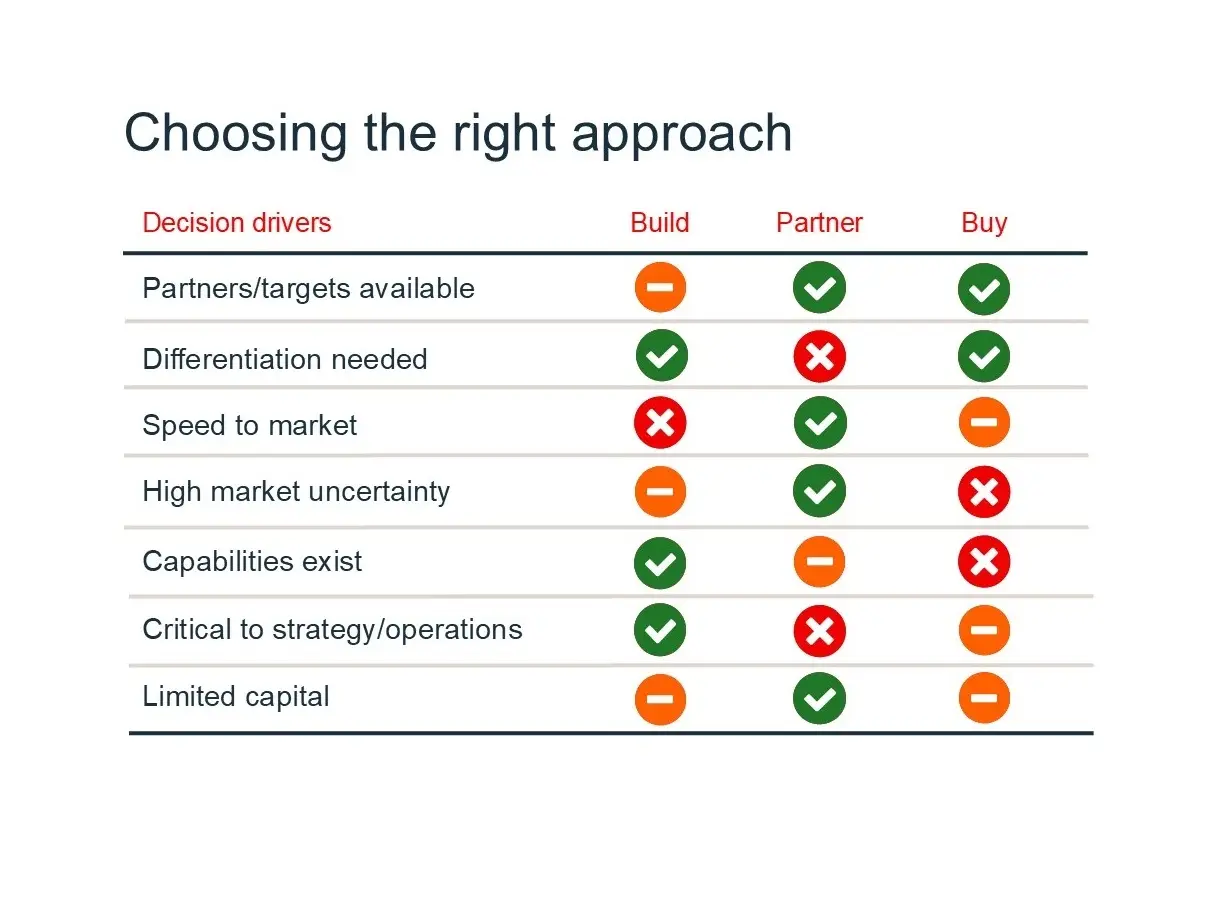
Start by asking yourself two questions:
- How quickly do you need to move?
- How much control do you need?
When to build
If the opportunity is core to your business and you already have the skills to act, building internally often makes the most sense. It gives you control and keeps things focused.
When to partner
If speed matters or the market feels uncertain, partnering can be a smart option. It lets you move faster and reduce risk by sharing effort and investment.
When to buy
Buying a business is usually the best fit when you’ve found a strong strategic match and you’re ready to invest for the longer term. It’s powerful, but it requires more time and capital.
Remember, not all revenue is created equally. We shared a lot of tactics to help you boost sales, but it’s important to pursue growth strategically. This framework is a good place to start.
Next step
Need advice on growing your business? BDC’s sales and marketing experts can help you chart a clear path to growth.