

Applied governance: Structuring your operations to support growth
One topic comes up often in my conversations with business owners: that governance is synonymous with “more meetings.”
But that’s actually far from the case. In reality, governance primarily helps you better structure and organize the meetings you already have in place. Don’t kid yourself: hallway and coffee-break conversations are your current norm. The result: overlooked details, forgotten stakeholders, and missed follow-ups… Governance doesn’t take away a company’s agility—it restores structure, clarity and accountability.
When implemented correctly, governance becomes a powerful tool for SMEs, especially those that are growing.
Do I need to establish a structure?
Corporate governance is the way a company is managed. It encompasses the rules, practices, and structures that lie at the heart of your decision-making processes.
It allows you to reduce organizational noise and ensure information flows strategically. In short, it helps you manage your business more effectively.
Meetings already exist, but they are often poorly organized. Governance is not about adding more meetings but about consolidating and structuring existing—and often informal—discussions.
Alexandre Hamelin
Senior Consultant, High-Impact Firms, BDC
I see this all too often. When a company reaches several dozen employees and generates a few million dollars in revenue, the instincts that enabled its owner to grow the business will prevent it from moving on to the next stage of growth.
With decisions made by the CEO or a few people and few formal meetings, your small business can operate organically for a long time. But as your business grows, you need to establish a structure.
Applied governance model
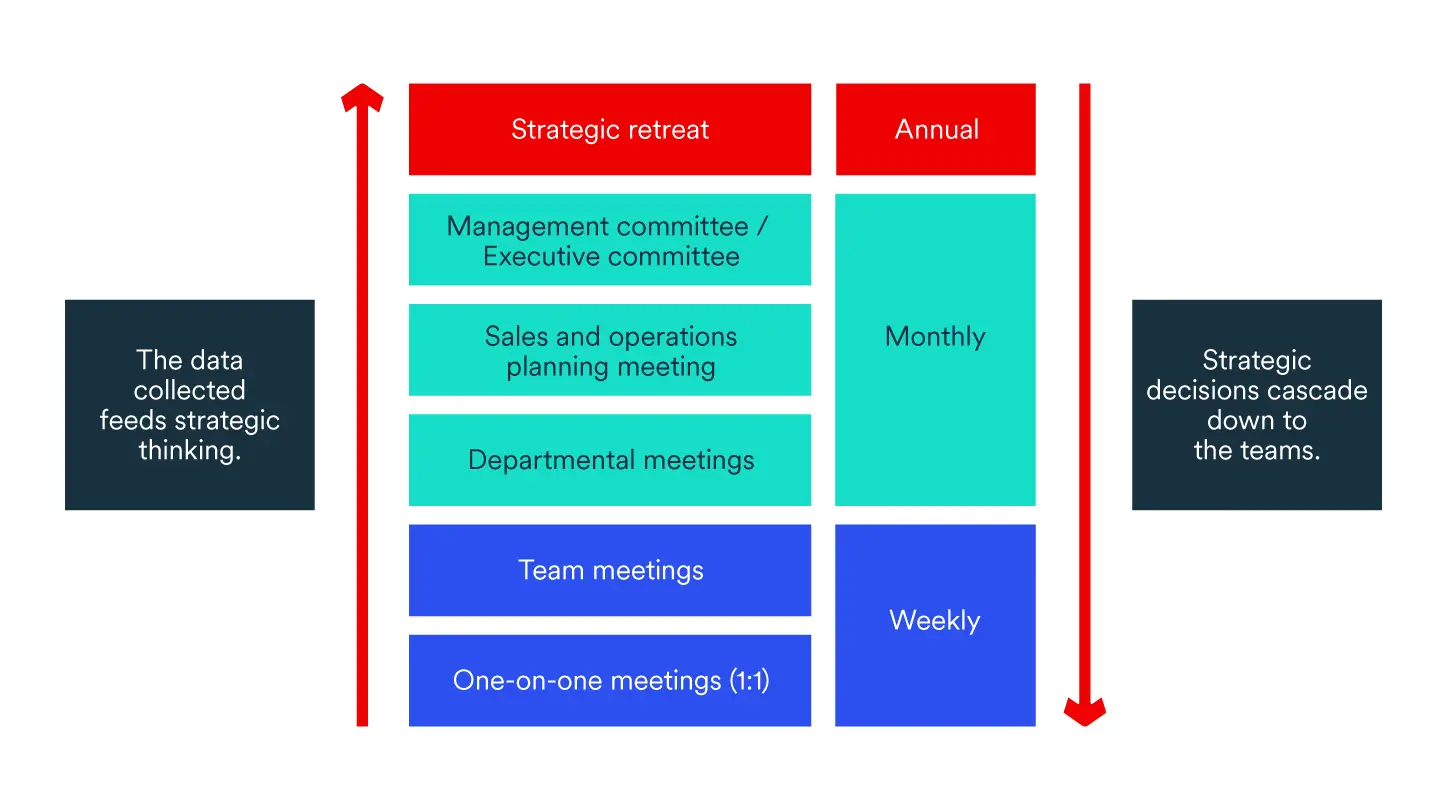
A growing business needs a governance model that functions as a loop:
- Each department continuously gathers relevant information through one-on-one meetings, team meetings, departmental meetings, or sales and operations meetings.
- This information then informs the discussions and deliberations of the management team during their monthly and quarterly tactical meetings.
- The findings and conclusions from these meetings will be reviewed during the annual strategic retreat.
- Once the retreat is over, strategic decisions are cascaded down to the teams in the form of objectives and activities, creating a two-way communication cycle.
Applied governance model diagram
Essential meetings to support your growth
1. One-on-one meetings
Frequency and duration: Weekly or biweekly, 30 to 60 minutes
Participants: Manager and team member
Objectives:
- Delegate tasks
- Align individual priorities with team objectives
- Assess the integration of company values and culture into daily work
Content:
- Review of progress since the last meeting
- Discuss challenges, what help is needed, and opportunities for development
- Upcoming projects and priorities
Format: Structured conversation
2. Team meetings
Frequency and duration: Weekly or bimonthly (30–60 minutes)
Participants: Manager and team
Objectives:
- Coordinate the team’s efforts and workload
- Align the team’s priorities with departmental priorities
- Strengthen engagement and accountability
Content:
- Update on activities and discussion of obstacles and solutions
- Recognition of contributions
- Upcoming projects and priorities
Format: Quick roundtable, followed by a discussion on priority issues
3. Departmental meetings
Frequency and duration: Monthly, 60–90 minutes
Participants: Department head and team leaders
Objectives:
- Coordinate projects and their impact on teams
- Align departmental priorities with company strategy
- Identify opportunities, obstacles and risks
Content:
- Performance review, identification of gaps relative to objectives
- Discussion of challenges and action plans to be implemented
- Sharing best practices and lessons learned
Format: Presentation of team results, followed by a strategic discussion and an action plan
Note: Not all SMEs need departmental meetings. Often, especially in smaller companies, team meetings are sufficient. A department is a large group, while a team is a smaller group that works more closely together. For example, the sales department includes all sales teams within a company, whereas the Montreal sales team consists of the three people responsible for sales in that specific market.
4. Sales and operations planning meeting
Frequency and duration: Monthly, 60 minutes
Participants:
- Sales and operations team leaders, as well as representatives from finance, human resources, and procurement
Objectives:
- Discuss and align the sales plan with the operations plan
- Resolve issues
- Manage the financial and HR impacts on the company
Agenda:
- Performance evaluation (20% of the meeting)
- Demand and production planning, followed by financial projections and an analysis of the impact on human resources (80% of the meeting)
Format:
Data presentation, forecast analysis, and decision-making
5. Management committee or executive committee
Frequency and duration: Monthly, 60–90 minutes
Participants:
- Management team (CEO and heads of key functions: finance, operations, sales, marketing, HR, etc.)
Objectives:
- Analysis and monitoring of the company’s overall performance
- Strategic decision-making
- Ensuring alignment with the company’s mission, vision and values
Content:
- Review of key indicators and performance
- Analysis of risks and opportunities
- Decisions on strategic adjustments and investments
- Action plan and resource allocation
Format:
Data presentation, strategic discussion and decision-making
Note: Every three months, the monthly executive meeting becomes a quarterly review, which allows for reevaluating certain assumptions in the plan based on trends observed over several months and making adjustments as needed.
6. Strategic retreat
Frequency and duration: Annual, half a day to two days
Participants: Executive team and department heads
Objective:
- To confirm, update, or replace the long-term vision and strategy (3–5 years).
Content:
- In-depth analysis of the business environment (competition, market trends, risks, opportunities)
- Review of the company’s strategic plan and roadmap
Format:
Presentations, workshops, discussions and brainstorming exercises
Note: Following a strategic review, the results, successes, challenges and changes made to the strategic plan must be communicated to the entire organization.
For a very small business, one-on-one meetings, a monthly review of results, and an annual strategic retreat may be sufficient. Weekly team meetings can be added as needed.
Alexandre Hamelin
Senior Consultant, High-Impact Firms, BDC
The benefits of good corporate governance
- Time savings and efficiency:
A structured discussion involving the right people can replace several scattered conversations and thus speed up decision-making. - Organizational alignment:
Repeated meeting cycles and the documentation of results create a more realistic picture of your operations. Decisions are based on data rather than on isolated impressions. - Team engagement:
When your team members can express their views, ask questions, and understand others’ perspectives, they are better equipped to support and implement collective decisions with conviction. - Managing uncertainty:
Good governance enables you to be prepared to deal with the unexpected. It promotes rigorous information gathering, accelerates decision-making and keeps your teams aligned with priorities.
Especially in a context of uncertainty, the key is aligning strategy with operations. And this alignment requires structured, regular and action-oriented meetings.
Alexandre Hamelin
Senior Consultant, High-Impact Firms, BDC
3 structures to implement right now for better governance
No matter the size of your business, here are three governance elements to prioritize right now:
- Establish one-on-one meetings.
This should be your number one priority. That’s where you get things done. - Set up a monthly executive committee meeting.
This meeting allows you to bridge the gap between your goals and actual results, and to align the company’s various functions. - Organize an annual strategic retreat.
This is your opportunity to step back from day-to-day operations and focus on the business as a whole: take a step back, anticipate challenges and make more strategic decisions.
Your next step?
Looking for expert advice to implement better governance structures? The Growth Driver Program might be right for you! Contact us to learn more.